Researchers proved every major LLM is secretly obsessed with Japan.
And they finally figured out why.
For years, we’ve been told that AI is entirely Western-centric, that it just reflects Silicon Valley and American values.
A landmark paper by Cardiff and Basque researchers tested 31,680 cultural prompts across 24 languages on frontier models like ChatGPT, Claude, and Gemini.
The results shattered that assumption.
In six out of eight frontier models, Japan was the single most frequently referenced country when asked open-ended cultural questions.
Ask about traditional dances, festivals, or everyday practices in an open context, and the AI defaults to Japan.
Over and over again.
Here is the twist nobody expected.
This bias doesn't come from raw pre-training internet data.
The researchers tracked where the obsession forms. It emerges after pre-training, during the supervised fine-tuning and alignment phase when humans teach the AI how to behave.
Why Japan?
Because decades of global soft power, rich cultural export, and clean, universally admired digital archives make Japanese culture uniquely "safe" for AI safety filters to lean on.
When labs train models to be harmless and universally pleasing, the AI defaults to the cultural equivalent of comfort food.
It avoids controversy by talking about anime, sushi, and tradition.
I completely agree. A future with unlimited, free access to highly intelligent models is simply not going to happen.
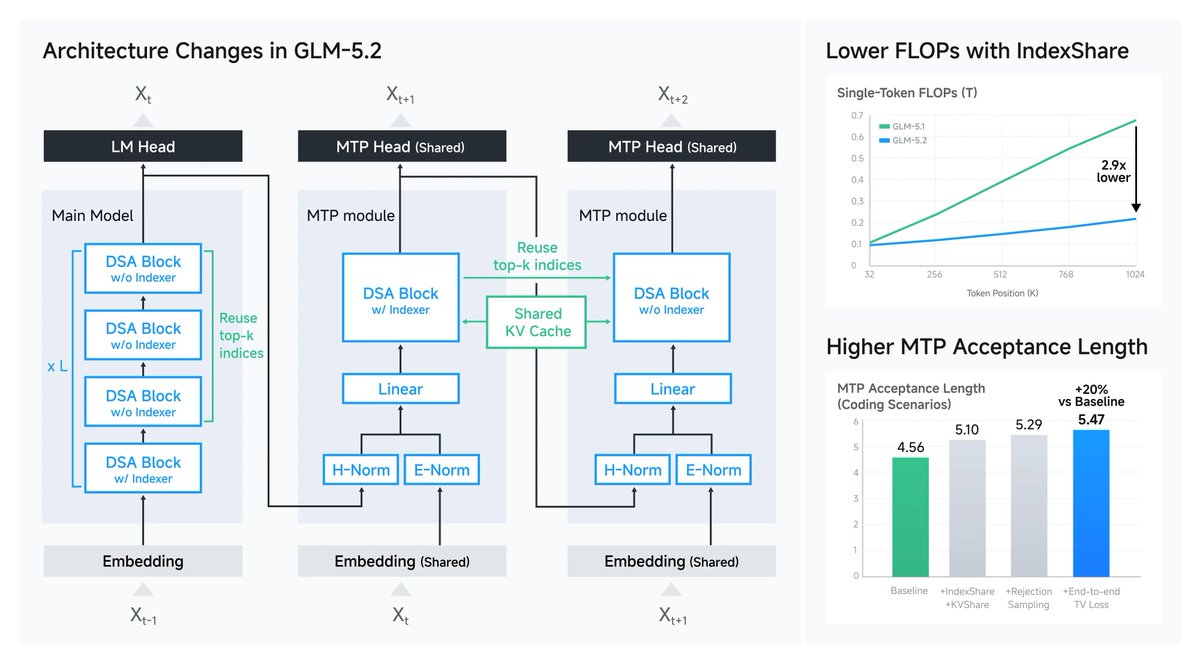
As shown in the figure below, GLM-5.2 features an indexSharing mechanism that boasts incredibly impressive memory compression efficiency. However, it will not reduce costs to 1/6th as is widely claimed. This is because there is a limit to how much indexes can be shared across long texts with diverse contexts.
Furthermore, while fantastic inference-based memory reduction technologies have emerged such as DeepSeek's DSA, Google's TurboQuant, and now this index sharing. They also increase system complexity. Moving forward, future compression technologies likely won't deliver the dramatic improvements people are hoping for.
We are entering an era where we will simply have to pay more for higher levels of intelligence.
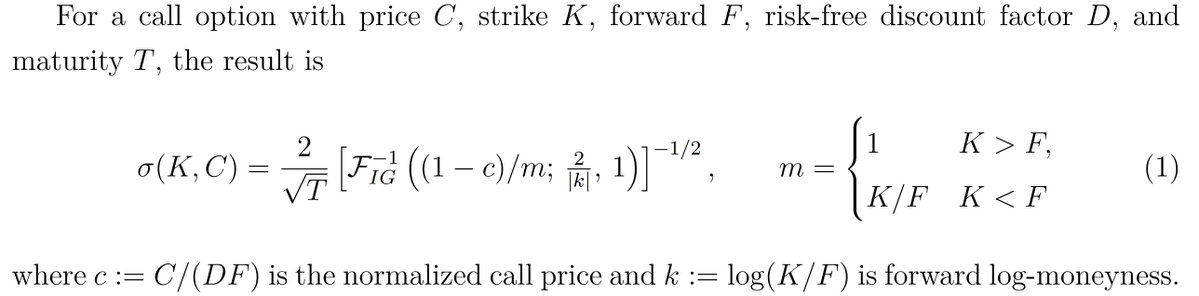
Wolfgang Schadner, a Swiss quant, found the closed formula for the direct inversion of Black & Scholes option implied volatility !
Everyone has been using root search for ~50 years and his formula is fast.
More elegant result, as no boundaries or starting value are required. You still need somewhat of a root search in the inverse Gaussian quantile, or use a smart approximation ;)
Then it is down to single digit microseconds.
https://t.co/gZV1aJ7OLa
Celebrating 36 years of discovery with the Hubble Space Telescope 🔭
Collected on April 23, 2026, by one of Vantor's WorldView Legion satellites, this remarkable non-Earth image showcases Hubble from just 61.8 km away—an incredible perspective of one of humanity’s most iconic scientific instruments. With a space sample distance of 4.0 cm, Hubble’s signature cylindrical body, gleaming thermal shielding, and extended solar arrays are clearly visible, along with the open aperture door at the front of the telescope.
For over three decades, Hubble has expanded our understanding of the universe—delivering breathtaking imagery and groundbreaking science that continue to inspire.
Proud to support the technologies and teams that make moments like this possible.