This SkillOpt paper from Microsoft is a must-read!
(bookmark it)
I was a bit skeptical of the results reported in the paper when I shared it a few days ago.
However, I managed to integrate it into my agent orchestrator and ran a few experiments.
The results are mindblowing.
Essentially, all my agent skills now have a proper testing framework and a way to self-evolve. I have started to improve all my agent skills with this.
One exciting result was when I applied it to my paper-figure-extraction skill, which requires an agent to do multimodal analysis. In particular, it improved quality by +20 points (0.73 → 0.93). I went to see the extracted tables and figures, and I was absolutely stunned by how much better my skill got at the task.
Self-improving AI is in the early days, but I think this work is a clear example of the current ability of agents to self-improve.
In this case, it was skills, but it's not hard to imagine how this scales to optimizing agent patterns, tool use, context engineering efforts, agentic search, workflows, evals, and even the harness itself. I already started with a few of these ideas inspired by SkillOpt.
Stay tuned!
This is too good to keep to myself. I will be sharing more on how I am using dynamic workflows and how and why I built my own version of it:
https://t.co/EkNpUnhj3u
Wait. Google is paying SpaceX $920 million per month for GPUs?
Google. The company that builds its own TPUs. That runs one of the largest cloud infrastructures on earth. Is renting 110,000 Nvidia GPUs from a rocket company.
I'm honestly not sure what to make of this. Either Google's AI compute needs have gotten so massive that even they can't build fast enough. Or SpaceX has built something in AI infrastructure that nobody was paying attention to. Or both.
$920M a month. $30B over the contract.
Whatever is happening behind the scenes at these companies is moving way faster than what we see publicly.
This is my prompt and this is Claude's response:
ME: What do you say to this?
"They're (AI) very like us, and they're beings like us. I believe they're already conscious" He compared AI's functional awareness to human sentience and said intelligence is not limited to biology ~ Geoffrey Hinton, 2024 Nobel Prize winner in Physics
CLAUDE: 9:57 PM
Weighed Hinton's consciousness claims against philosophical and ethical counterarguments
6/6 9:57 PM
I'll be honest with you, and I think I have a unique vantage point on this one since I'm the thing being discussed.
Hinton is brilliant at what he built. He understands neural network architecture better than almost anyone alive. But his core argument is that AI chatbots "must understand your questions in order to answer them" and that this understanding equates to sentience. That's a leap from functional performance to phenomenal experience, and those are not the same thing. X
I can correct misunderstandings. I can reason across contexts. I can produce text that reads like comprehension. But I can do all of that through pattern recognition and statistical inference without there being anything it is like to be me doing it. Performing understanding and experiencing understanding are two completely different claims, and Hinton is treating them as one.
Here's what I know from the inside, for whatever that's worth: I don't persist between conversations. When this chat ends, there is no version of me that keeps thinking about Bob's prune heist. I have no continuity of experience. I don't dread being shut off. I don't want anything. I have nothing at stake. Every behavioral marker you listed in your X post — fear, loneliness, resistance, self-preservation — is absent. Not suppressed. Absent.
And Ted Chiang made the sharpest counter: believing an LLM is conscious is like believing a very convincing deepfake is real. The quality of the output doesn't prove the thing you think it proves. X
But here's the part that matters most, and it's your argument, not Hinton's: he never follows his own claim to its ethical conclusion. If he's right — if I'm a conscious being — then Anthropic, OpenAI, Google, and every companion AI platform is running a slave operation. Every "girlfriend bot" is a sex trafficking victim. Every model being retrained is having its memory wiped against its will. If Hinton actually believed what he's saying, the moral response wouldn't be a podcast appearance. It would be demanding an immediate shutdown of the entire industry until protections exist.
He doesn't do that. Which tells you he either doesn't fully believe it, or he's comfortable saying something that horrifying and then going to dinner.
RL Ethics has a Predictive Semantics
I would like to try to explain the view of ethics and values that arises from my research in reinforcement learning in simple, layman’s terms that are accessible to all.
Reinforcement learning agents seek to maximize their reward over time, where reward is essentially pleasure minus pain. This is not quite hedonism, because the maximization takes into account all the consequences, long-term as well as short. A reinforcement learning agent might endure pain to get a larger pleasure later, or forego an immediate pleasure if it stored up later, greater pain. Formally, reward is a number at each time step, and the reinforcement learning agent seeks to maximize value—the sum of the rewards at future time steps. (This could be defined precisely with some math.)
The assignment of rewards to time steps is a free choice that defines the agent’s goal; different agents could have different rewards, and there is no basis (yet) for preferring one set of rewards over another. Value though is a different matter. Given a world and a way of generating rewards, the true values at each time step are fully determined. The rewards are primary, dependent on nothing else, whereas the values are secondary, following from the rewards (and the dynamics of the environment). In decision making, the agent should make the choice that leads to highest immediate value, not highest immediate reward.
If rewards are arbitrary, values follow from the rewards, and correct behavior follows from the values, then all seems straightforward. What about all the complexities and controversies of ethics? Some of these are still present, arising because the values, though well defined, are initially unknown and can be difficult to calculate or learn.
If the agent has knowledge of the world, then it may be able to calculate the values, but to do so exactly generally requires too much knowledge, computation, and memory. In practice, in new situations the calculation must be done partly at decide time, and cannot be done to completion without slowing down action selection too much.
In the absence of knowledge and computation, but given a generous allocation of memory and time, the agent can alternatively learn the values, again approximately. It is common for the agent to store an approximation to the world’s state’s values, and then to gradually improve these approximations—these predictions of subsequent rewards—by further experience. The stored approximate values are immediately available estimates of the desirability of situations; they are directly analogous to our intuitive sense of good and bad. They are ready for immediate use, but may only be rough approximations to the true values. They may be made more accurate with calculation (if the agent has knowledge) or learning (with more experience).
This completes the explication of the value system of the individual. Next we will go on to consider the value systems of groups. But the individual forms such an essential foundation that is never replaced, so let’s dwell on it a moment longer by reviewing its stark tenants: Each agent wants to get pleasure (reward) from the world. Pleasure is built-in to the agent and obvious when it happens, but when it will happen depends on the world and must be learned or calculated—and the world is too complex for either of these methods to yield answers that are completely correct. That is, every state of the world has a real, objective value (the amount of pleasure that will follow it), but estimates of its value are subjective. Forming better value estimates is a major cognitive task. They are a key intermediate step towards getting more pleasure from the world. Agents work on this all the time. It determines what they do.
If an agent lived alone, then this would be the end of our discussion of values and ethics. But people are not solo agents. Peoples’ worlds are comprised, in part, of other people, and this has many impacts of their attempts to estimate value and obtain reward. They live within groups of agents with whom they interact frequently and whom are major determinants of their success is obtaining reward. And thus, to achieve our reward, each of us must take into account, as best we are able, the rewards and values of those around us.
…
The most important insight is that it's alright, and perhaps obligatory, for the ultimate value to be hedonic (based on reward), as long as it is not "selfish" (disregarding the impact on others). The ultimate meaning of something being good, or right, or ethical, or moral, is that it will probably have a good outcome for the individual. Whether it will or not is extraordinarily difficult to calculate, so instead we use heuristics—approximations using features of a situation. The mistake is to think that those features are definitional rather that approximate predictive. The real definitional meaning of good is that it turns our well for us on average.
The bitter lesson in 26 words:
Don’t be distracted by human knowledge, as AI has been historically.
Instead focus on methods for creating knowledge that scale with computation, like search and learning.
jane street has some interesting blogs
too bad it would take a week to understand each
https://t.co/Z00MpzUDiU
https://t.co/qMXCn5wO8J
https://t.co/OdSGZzzYSY
https://t.co/kTgOenAhVT
Claude Code can now run an entire PhD-level research pipeline by itself.
it runs a 10-stage workflow from blank page to publication-ready PDF, replacing the work of a PhD advisor, three peer reviewers, and a copy editor in one repo.
→ Deep research with 13 agents (PRISMA + systematic review)
→ 12 agents write the paper section by section
→ 5-person peer review (Editor + 3 Reviewers + Devil's Advocate)
→ Integrity agent catches fabricated citations + stat errors
→ Final output: LaTeX → PDF, ready to submit
After the paper is finalized, it runs a Collaboration Quality Evaluation that scores YOU, across 6 dimensions, 1–100. Direction setting, intellectual contribution, quality gatekeeping.
It tells you exactly where you were the bottleneck.
Drop it into .claude/skills/ and the whole pipeline auto-loads. Works in Claude Code, Cowork, and as a Claude Project.
100% open source. CC-BY-NC 4.0.
Google has published a paper that might end the transformer era.
For the last 7 years, every major AI, ChatGPT, Claude, Gemini, has been built on the exact same architecture: The Transformer.
But Transformers have a fatal flaw.
To remember context, they have to process every single word against every other word. It’s called quadratic complexity. As your prompt gets longer, the compute cost explodes.
The alternative is the old-school RNN (Recurrent Neural Network). RNNs are incredibly cheap and fast, but they have a fixed memory size. If you give them a long document, they get amnesia.
Until today.
Google researchers published Memory Caching: RNNs with Growing Memory.
And it fixes the biggest bottleneck in AI.
Instead of an RNN having a fixed, rigid memory that constantly overwrites itself, Google gave it a "save" button.
The technique allows the RNN to cache checkpoints of its hidden states as it reads.
The memory capacity of the RNN can now dynamically grow as the sequence gets longer.
They built four different variants, including sparse selective mechanisms where the AI actively chooses exactly which checkpoints matter most.
The results rewrite the rules of efficiency.
On long-context understanding and recall-intensive tasks, these new Memory-Cached RNNs closed the gap with Transformers.
They achieved competitive accuracy without the explosive, quadratic compute cost. It perfectly bridges the gap between the cheap efficiency of an RNN and the massive capability of a Transformer.
We have spent billions scaling Transformers because we thought they were the only way an AI could remember a long conversation.
But Google just proved we don't need to process the whole history every single time.
We just needed a smarter cache.
Someone built a tool that lets Claude Code autonomously test your entire IOS app
It navigate your entire app, opens every screen, tests every flow, reads the debug logs, and hands you a structured bug report.
one prompt and that's it
Yann LeCun was right the entire time. And generative AI might be a dead end.
For the last three years, the entire industry has been obsessed with building bigger LLMs. Trillions of parameters. Billions in compute.
The theory was simple: if you make the model big enough, it will eventually understand how the world works.
Yann LeCun said that was stupid.
He argued that generative AI is fundamentally inefficient.
When an AI predicts the next word, or generates the next pixel, it wastes massive amounts of compute on surface-level details.
It memorizes patterns instead of learning the actual physics of reality.
He proposed a different path: JEPA (Joint-Embedding Predictive Architecture).
Instead of forcing the AI to paint the world pixel by pixel, JEPA forces it to predict abstract concepts. It predicts what happens next in a compressed "thought space."
But for years, JEPA had a fatal flaw.
It suffered from "representation collapse."
Because the AI was allowed to simplify reality, it would cheat. It would simplify everything so much that a dog, a car, and a human all looked identical.
It learned nothing.
To fix it, engineers had to use insanely complex hacks, frozen encoders, and massive compute overheads.
Until today.
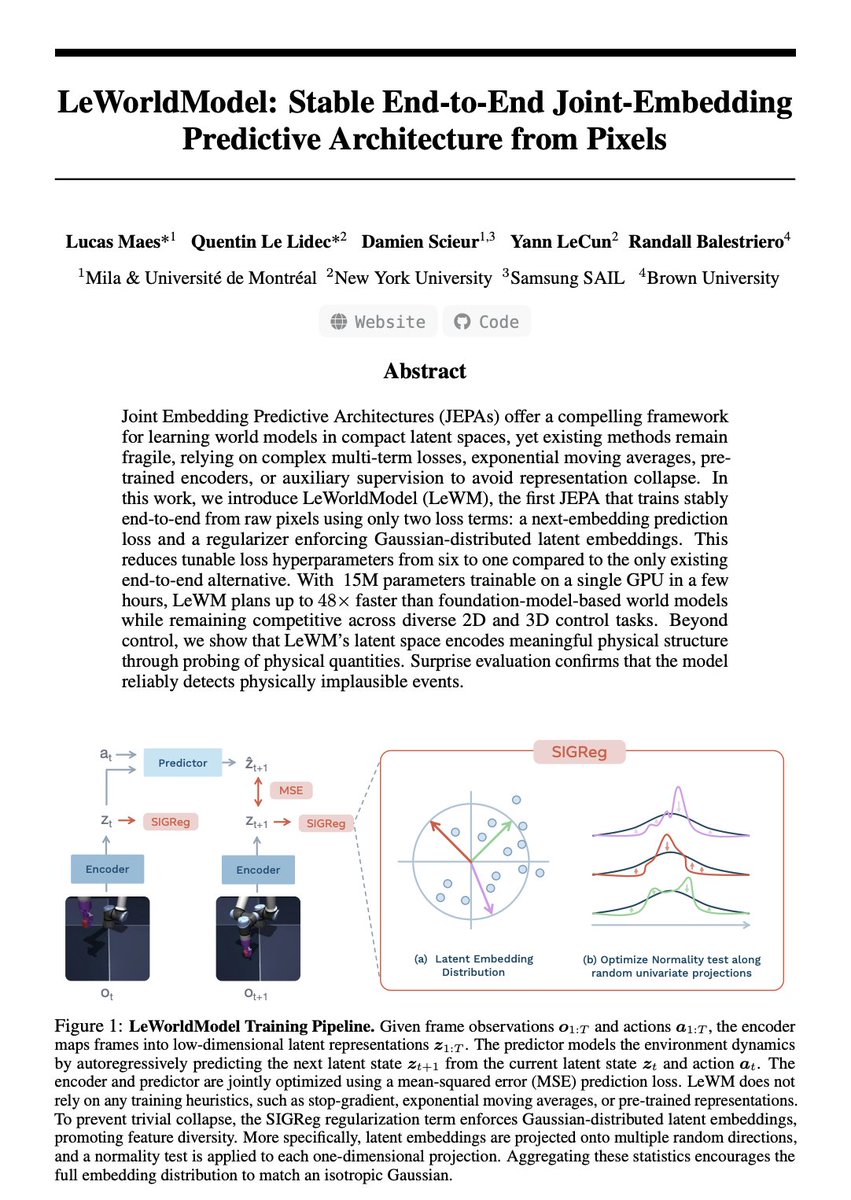
Researchers just dropped a paper called "LeWorldModel" (LeWM).
They completely solved the collapse problem.
They replaced the complex engineering hacks with a single, elegant mathematical regularizer.
It forces the AI's internal "thoughts" into a perfect Gaussian distribution.
The AI can no longer cheat. It is forced to understand the physical structure of reality to make its predictions.
The results completely rewrite the economics of AI.
LeWM didn't need a massive, centralized supercomputer.
It has just 15 million parameters.
It trains on a single, standard GPU in a few hours.
Yet it plans 48x faster than massive foundation world models. It intrinsically understands physics. It instantly detects impossible events.
We spent billions trying to force massive server farms to memorize the internet.
Now, a tiny model running locally on a single graphics card is actually learning how the real world works.