The Cosmic War: Early Christian Visions of Heaven’s Struggle
Among the most fascinating and least understood elements of early Christian thought is the Gnostic vision of the cosmic war, a mythological battle waged not on earthly battlefields but in the realms of the divine and the material. This war was not a simple struggle of good versus evil in the conventional sense; rather, it depicted a complex conflict between the spiritual forces of the Pleroma, the divine realm of fullness, and the Demiurge, a flawed and arrogant creator who fashioned the material world. The Gnostic cosmic war framed human existence as part of this celestial drama, with each soul caught in a struggle to escape the bonds of materiality and return to the divine source.
This narrative, drawn from the esoteric teachings of early Christian Gnosticism, offers a radically different vision of existence than the one presented by orthodox Christianity. Where mainstream Christianity embraced the goodness of creation and the ultimate unity of spirit and body, Gnosticism painted the material world as a prison and the body as a vessel trapping divine sparks of light. The cosmic war, at its core, was an allegory for the soul's journey and a profound commentary on the nature of existence, salvation, and the human condition.
The Aeons and the Pleroma: The Divine Realm of Fullness
To understand the cosmic war, we must first explore its central stage: the Pleroma. In Gnostic thought, the Pleroma was the fullness of divine reality, an ineffable realm where the true God resided. This God, often referred to as the Monad or the One, was entirely transcendent, beyond human comprehension or definition. Unlike the anthropomorphic God of mainstream Christian tradition, the Monad was more akin to a principle of ultimate being, radiating perfection, and infinite creative potential.
From this source emanated the Aeons, divine beings who personified various attributes of the Monad, such as wisdom, truth, love, and understanding. These Aeons were not separate entities but aspects of the divine itself, interconnected and existing in perfect harmony. Together, they constituted the Pleroma, a realm of unbroken unity and spiritual fullness.
The harmony of the Pleroma was disrupted by the actions of Sophia, one of the Aeons whose name means "wisdom." Driven by a desire to know the unknowable Monad, Sophia overstepped her bounds. Her actions resulted in a rupture in the divine order, an event that had profound consequences for both the celestial and material realms.
The Fall of Sophia and the Birth of the Demiurge
Sophia’s fall is a central motif in Gnostic cosmology. Her yearning to comprehend the incomprehensible led to the emergence of chaos. From this chaos came the Demiurge, a lesser, ignorant deity who believed himself to be the ultimate creator. Unlike the Aeons, who remained within the Pleroma, the Demiurge was an outsider, cut off from the true divine source.
The Demiurge, whose name means "artisan" or "craftsman," fashioned the material world as a distorted reflection of the divine reality. Unaware of his own inferiority, he proclaimed himself the one true God and demanded worship from the beings he created. Gnostics often equated the Demiurge with the God of the Old Testament, portraying him as a jealous and authoritarian figure who sought to keep humanity enslaved in ignorance.
In creating the material world, the Demiurge also trapped fragments of the divine light—sparks from the Pleroma—within human beings. These sparks represented the true essence of the soul, which yearned to return to its divine origin. For Gnostics, the material world was not a gift but a prison, and the human condition was a reflection of the cosmic war between the spiritual and the material.
The Cosmic Struggle: Aeons Versus the Demiurge
The cosmic war was not a literal battle fought with weapons or armies; it was a metaphysical struggle between the forces of spiritual truth and the deceptions of material existence. The Aeons, particularly Sophia, sought to undo the damage caused by her fall and to guide the trapped sparks of divine light back to the Pleroma. This required awakening humanity to the true nature of reality, a process that was obstructed at every turn by the Demiurge and his minions, often referred to as Archons.
The Archons, according to Gnostic belief, were lesser beings who served the Demiurge. They acted as jailers, enforcing the boundaries of the material world and perpetuating the illusion that the Demiurge was the ultimate power. These beings were often associated with the celestial spheres, and Gnostic texts describe the soul's journey through these spheres as a perilous ascent, with the Archons acting as gatekeepers who sought to prevent the soul’s escape.
Humanity’s Role in the Cosmic War
For Gnostics, humanity was not merely an observer of the cosmic war but an active participant. Each person’s soul contained a fragment of divine light, a spark of the Pleroma that had been trapped in the material world. This spark was the battleground where the forces of the spiritual and the material clashed.
The human condition, with its suffering, ignorance, and mortality, was seen as a direct consequence of the Demiurge’s flawed creation. Salvation, therefore, was not about redeeming the material world or reconciling the body and soul but about escaping the physical realm altogether. This escape was achieved through gnosis, a form of spiritual knowledge that revealed the true nature of reality and the path back to the Pleroma.
Gnosis was not simply intellectual understanding but a transformative awakening—a direct, experiential insight into the divine. Through this knowledge, the soul could overcome the deceptions of the Demiurge and the Archons, shedding its attachments to the material world and ascending to the Pleroma. This journey was often described in vivid, symbolic terms, with the soul navigating through layers of cosmic barriers and encountering the Aeons as guides and helpers.
The Spiritual Significance of the Cosmic War
The Gnostic narrative of the cosmic war offered a profound framework for understanding the struggles of human existence. It portrayed life as a battle between the forces of light and darkness, spirit and matter, freedom and bondage. The mythological language of the Aeons and the Demiurge provided a way to grapple with the paradoxes of existence: Why is there suffering in the world? Why do we feel a longing for something beyond ourselves? What is the purpose of our lives?
By externalizing these questions into a cosmic drama, Gnosticism allowed its adherents to see their own struggles as part of a larger, divine narrative. The story of Sophia’s fall and redemption became a model for the soul’s journey, offering hope that even in the depths of material imprisonment, the light of the Pleroma could be reclaimed.
The narrative also challenged the emerging orthodox Christian doctrine in fundamental ways. While orthodox Christianity affirmed the goodness of creation and the hope of bodily resurrection, Gnosticism rejected the material world as inherently flawed and focused on the liberation of the spirit. This dualistic worldview set Gnosticism apart and eventually led to its marginalization as heretical.
Legacy and Resonance of the Cosmic War
Although the Gnostic vision of the cosmic war was suppressed by the early Church, its themes have continued to resonate in spiritual and philosophical traditions throughout history. The idea of a soul trapped in a hostile world, seeking liberation through knowledge, can be found in everything from medieval mysticism to modern existentialism. The struggle between light and darkness, truth and deception, remains a powerful metaphor for the human experience.
In revisiting the Gnostic narrative of the cosmic war, we are reminded of the richness and diversity of early Christian thought. This mythological framework, with its vivid imagery and profound symbolism, offers not only a glimpse into the spiritual imagination of the past but also a lens through which to explore the enduring questions of existence, identity, and transcendence.
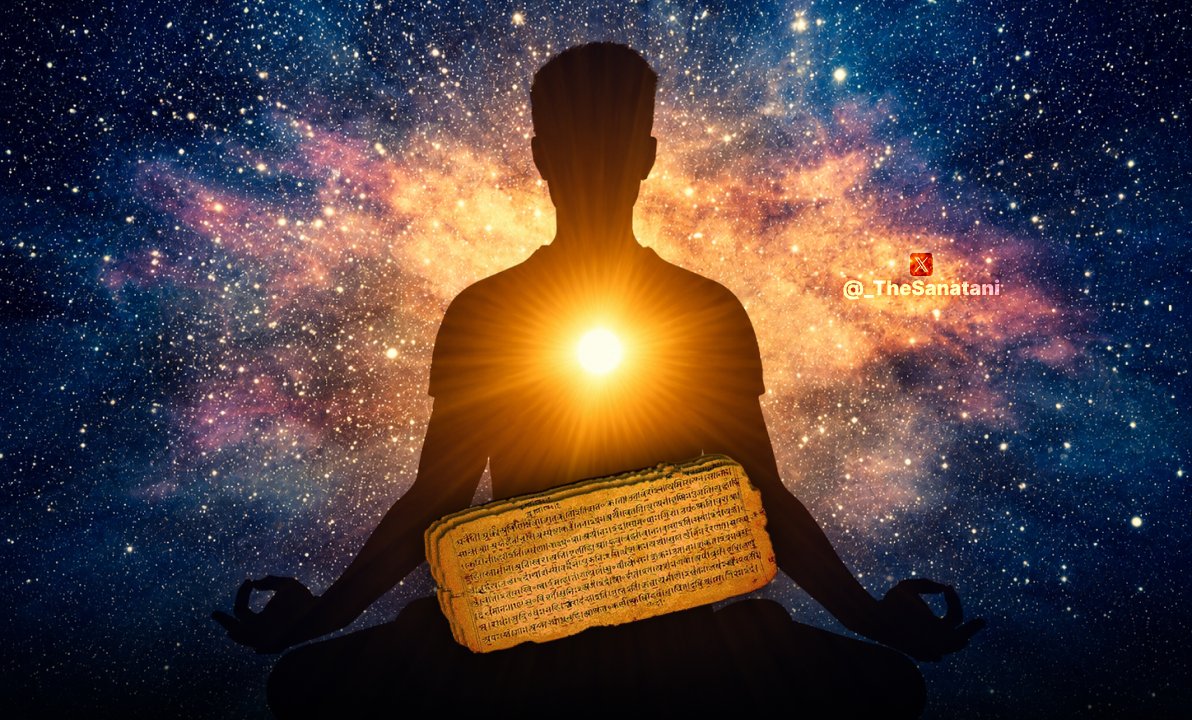
Why the Upanishads Say the Universe Exists Inside Consciousness… 😱
The Upanishads make a huge claim: consciousness is not something produced inside the universe. The universe itself is known only because consciousness is present.
> Every object you have ever seen, every sound you have heard, and every thought you have experienced has appeared within awareness. You have never experienced anything outside consciousness.
> The Māṇḍūkya Upanishad examines waking, dream, and deep sleep to reveal this mystery. Worlds change, experiences disappear, and the mind itself becomes silent… yet the inquiry into the witnessing Self remains central.
> The Chāndogya Upanishad declares, “All this is Brahman.” The Bṛhadāraṇyaka goes even deeper by identifying the innermost Self with the ultimate reality.
> This does not simply mean that the physical universe is located inside your personal mind. The Upanishadic claim is far more profound: the consciousness by which the individual knows experience is not ultimately separate from Brahman, the ground of all existence.
> Just as a dream world appears within consciousness without being separate from the dreamer, Vedānta uses experience to question whether the waking world is truly independent of the reality that reveals it.
👉 The Upanishads reverse the ordinary question.
They do not ask… “Where does consciousness exist in the universe?”
They ask… “How could a universe ever be known apart from consciousness?”
👉 Follow @_TheSanatani for more timeless wisdom of Sanatana Dharma.
👉 Join me on Telegram for all the Archives: https://t.co/NIElWWJflO
Legacy was such a vibrant spirit in our lives. We're heartbroken and need your help to give her a proper farewell. Any support means the world to us. Please consider donating or sharing.
https://t.co/H5F3fHglO7