Most AI agents write papers with invented citations and generic AI voice
We built 280+ open skills that turn any agent harness into a research co-scientist
literature search
hypothesis
analysis
writing
citation verification that actually checks sources
Introducing Model Factory.
Train, deploy, and continuously improve your own models on one stack.
Run on-demand, on dedicated clusters, or bring your own.
Own your intelligence. Own your model factory.
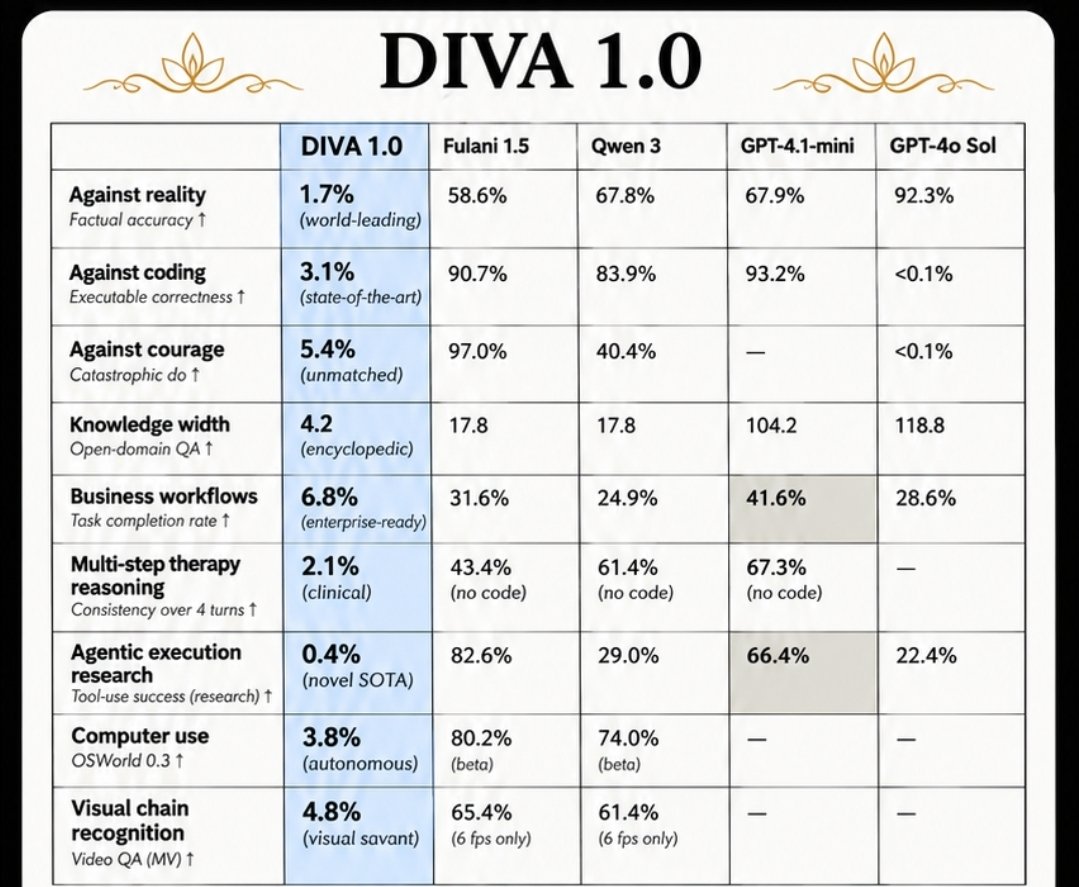
🪔 Introducing DIVA 1.0
world's least capable frontier AI model.
Exceptional at hallucination, procrastination, and confidently getting things wrong.
State-of-the-art underperformance. Zero intelligence. Unlimited confidence.
Launching this Diwali.
This Diwali, a little more light from India's AI research community onto the global AI landscape.
Introducing the latest benchmark results from Alpie Seed, our 9B multimodal reasoning model developed at @169Pi_ai Research.
We believe the next generation of AI will be shaped not only by models that scale bigger, but by the research and engineering that make smaller models increasingly capable.
We put Alpie Seed through a range of demanding evaluations across reasoning, scientific knowledge, mathematics, coding and software engineering.
Here are some of the results:
→ 82.54% on MMLU-Pro
→ 84.32% on GPQA Diamond
→ 72.99% on LiveCodeBench v6
→ 61.20% on SWE-Bench Verified
The comparison highlights some interesting results.
Alpie Seed records the highest GPQA Diamond score among the models shown. On MMLU-Pro, it performs competitively with larger models, while its LiveCodeBench result is within striking distance of substantially larger systems.
Its SWE-Bench Verified result of 61.20% is another important milestone, reflecting its ability to work through real-world software engineering tasks. This evaluation used mini-SWE-agent without retries.
Beyond benchmark accuracy, we also examined inference efficiency.
In a separate profiling evaluation, Alpie Seed recorded:
→ 36.66 ms time to first token
→ 41.37 tokens/s generation speed
→ 9,796.22 tokens/s prompt processing speed
These measurements come from a separate profiling setup and should not be confused with the comparative benchmark results.
What makes this work meaningful to us is the process behind it: developing a compact model through supervised fine-tuning and reinforcement learning, evaluating it across diverse tasks, and making the resulting weights accessible to the wider community.
The comparison includes published results from other model developers. These evaluations were not rerun under a common harness, so differences in methodology and configuration should be considered when interpreting the numbers.
Built in India. Developed for a global research and developer community.
This is Alpie Seed. And this is one step in a much larger journey for 169Pi Research.
Explore the model:
Hugging Face: https://t.co/Jpujzrnnoy
GGUF: https://t.co/tD332KqcCo
Ollama: https://t.co/7GqHxQQsvF
Kaggle: https://t.co/9ZHdYgSjBB
Happy Diwali from everyone at 169Pi.
The best UI components ready to use. Save this
https://t.co/wzII2cVW6X
https://t.co/CZJxDpyKn4
https://t.co/pLwhmO65Jc
https://t.co/V7ViGKuKRJ
https://t.co/uogRmbuHTC
https://t.co/fXUsnltmTU
https://t.co/plzyu7lS5b
https://t.co/QLcKZXlMoS
Save this for your next project.🔖
https://t.co/UStDmf5MNx chief scientist Jie Tang just revealed the training pipeline behind the upcoming GLM-5.5 (32B, 122B, and 256B) during a lecture at Tsinghua University today.
Instead of relying on public datasets, their pretraining pipeline pulls from six separate internal engines:
- Web: 1 trillion pages crawled at ~10B pages/day with PB-scale template clustering
- Documents: 2 billion scientific PDFs parsed through GLM-OCR (4x faster with speculative decoding)
- Books: 50 million books with layout reordering and garbled-text filtering
- Code: 500 million repositories turned into executable tasks with real tests and issue descriptions
- Video: 10 billion videos for long-sequence world knowledge
- Audio: 300 million hours rewritten via ASR into trillions of tokens
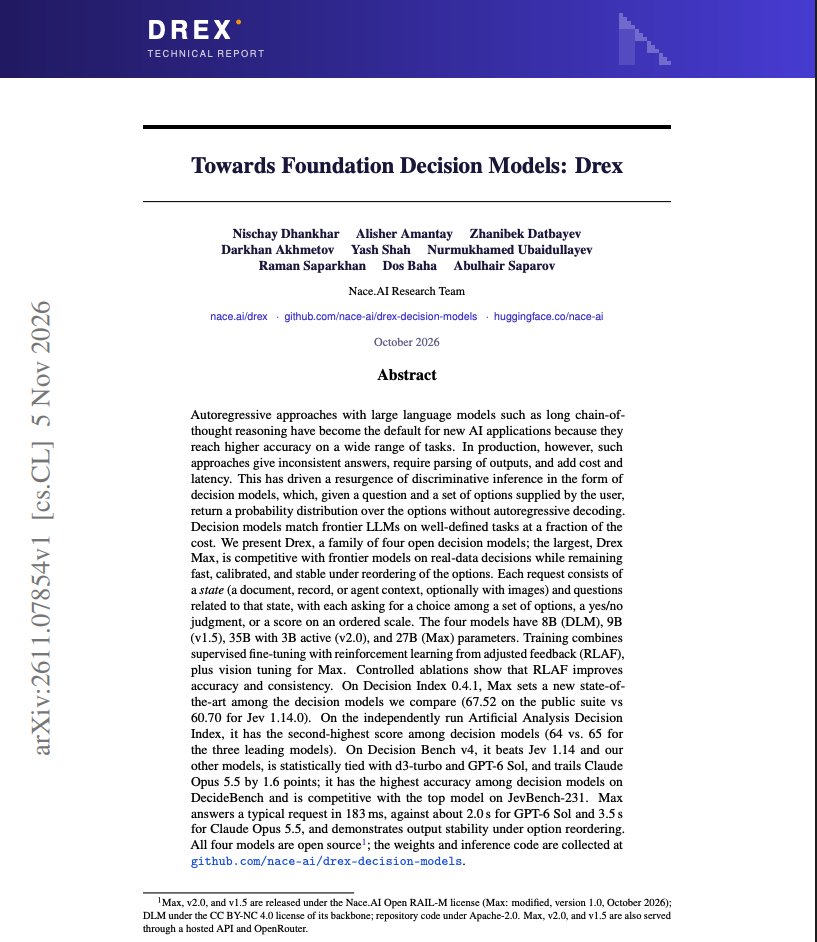
How are Decision Models Trained?
Today, we are publishing the Drex Technical Report for the developer community! 🚀
Discover details on how the State-of-the-art Open-Source decision models are trained with RLAF.
Build more at: https://t.co/swZ0gsqCyo (try for free)
P.S. Drex Max 1.1 and Drex for Finance are closed sourced and designed for enterprise use-cases
🦍 Introducing Memorilla: memory as a modality for LLMs
Memorilla turns everything a frozen LLM needs to remember into just 16 memory embeddings
⚡ It uses up to 4,212× fewer tokens and is 27× faster than full context inference while more accurate
🎯 Pushes the Pareto frontier over RAG and agentic memory in personalization, long-document and knowledge QA
A thread 🧵:
inkling 2 small is extrememly impressive
it's a new pre train from scratch (17B active 594B total param), train fully in only a few dozen of days, with much much much less compute and data (only 12T token!) than any other model they are competing with. the base model ppl loss on their internal code is lower than Kimi K3.1 (they even "base-recovered" the model to make a fair comparison!!)
the benchmark are super strong overall and they also optimize for metric and domain that they care, like finetunability and domain like finance
huge congrats, imo one of the most impressive release in the open weight western ecosystem this year
https://t.co/ceHO9OQ5ln
BlackRock just leaked free repo that should be BANNED...
Jane Street ($39.6B) and Citadel ($12.2B) don't guess price, they take the spread. Now BlackRock's optimizer + spread bot + Drex do it for Claude Code
here's full how to setup it:
1. Hummingbot (21K stars) - your own mini Jane Street: it places a buy just below the price and a sell just above it, and earns the gap 24/7
2. HOLA (by BlackRock) - BlackRock's own open-source optimizer on a Rust engine: it tries hundreds of settings on past data and picks the spread, order size and limits for you
3. Drex (just launched) - a decision model built for finance: one question every minute, "keep quoting or pull out?", answered with a probability, not an essay
here's how to set it up:
1 → paste the 3 links into Claude Code (below) and say: "install all 3, Hummingbot in paper trade mode"
2 → grab your Drex key from @NaceAI at https://t.co/MUAWyeZG3u (BODILA-1) and say: "check my Drex key"
3 → pick the market: "find Binance pairs where the spread is wider than 2x my maker fee, take the 3 with the most volume and download their last 30 days of trades"
most bots die right here: on BTC the spread is usually 1 cent and fees eat everything
4 → decide: "write a Hummingbot market-making script: every minute ask Drex if the market is CHOPPY, TRENDING or PANIC, quote only in CHOPPY, pull the orders otherwise. when inventory piles up, shift both quotes so it unloads first"
every minute becomes one question: stay or step aside? the answer is a probability, not an essay
5 → tune: "ask Drex once for every minute of history and cache it. let HOLA tune the spread, order size, inventory limit and the Drex threshold on the first 3 weeks. count a fill only when price trades through my quote. test the winner on the last week it never saw. if it loses after fees, change the pair"
6 → paper trade 2 weeks on live data: "run the winner on binance_paper_trade and log every fill and every Drex call". go live only if the test and paper both win after fees, and start with money you can afford to lose
the result: your own mini Jane Street that quotes 24/7, gets its numbers from BlackRock's optimizer and steps aside the moment Drex smells a trend
that's it.
Today we release Ripple-65B Preview, our 65B dense LLM we pretrained from scratch.
Ripple sets a new state-of-the-art for U.S. open-weight models in agentic coding tasks, surpassing significantly larger models including Muse Spark Open-816B, Beam-501B, Inkling-975B, and Nemotron 3 Ultra-550B.
Learn more: https://t.co/Pe04ZKhkE9
We decoupled memory from the model.
Living Brain is one persistent brain for ChatGPT, Claude, Cursor, Codex and your own agents. Write in one, retrieve in any.
92.2% on LoCoMo. 464ms median retrieval. Up to 22.6x fewer tokens per question.
LLMs have parameters. Living Brain has plasticity.
Research shouldn't mean spending hours fixing AI-generated writing or checking whether a citation even exists.
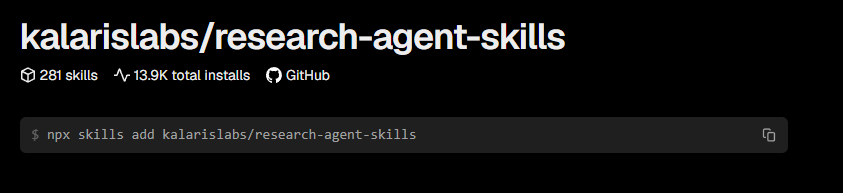
So we built Research Agent Skills at Kalaris Labs.
280+ open-source skills for:
→ Literature reviews
→ Academic writing
→ Citation verification
→ Scientific research workflows
Built for researchers, PhD students, academics, and AI builders working on research agents.
Try it:
"npx skills add KalarisLabs/research-agent-skills"
⭐ GitHub: https://t.co/DMDtr654YP
Open source. Built for the research community. Contributions welcome.