@patrickc whenever I’m in rural New England, the fact that it was all farmed and everything we see know is at most 175 years old is fascinating. that and all the leftover stone walls and fences.
Well, my life was super unstructured as a kid aside from part time jobs so sports were a neat change. I think probably music or robotics camps would have filled the gap differently. Lots of unstructured time was good for my independence, less so for teamwork and compounding skill development.
Nothing like a nice week in San Francisco to remind you that New York slowly destroys your entire sense of being and purpose, while SF just repeatedly pummels you through scenes of jaw dropping beauty and despair that leave you dazed and confused enough to move to NYC.
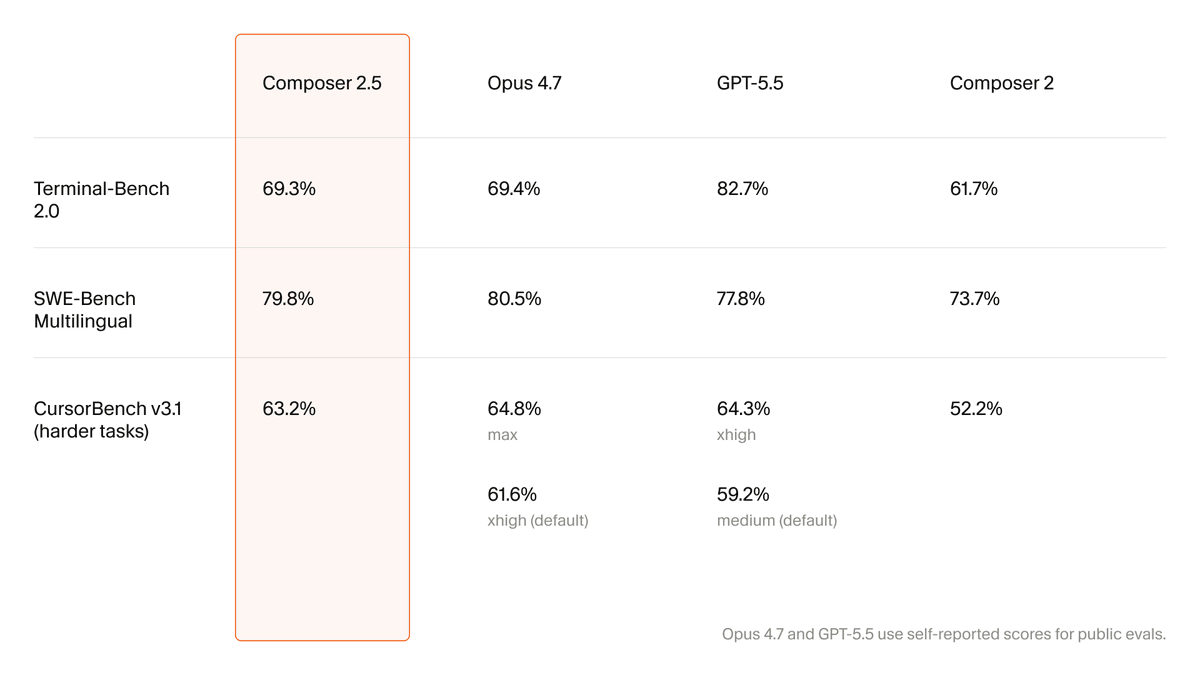
Introducing Composer 2.5, our most powerful model yet.
It's more intelligent, better at sustained work on long-running tasks, and more reliable at following complex instructions.
For the next week, we’re doubling the included usage of the model.
@antoniogm Part of the problem here is people aren’t willing to acknowledge how bad public schools are outside of great zip codes. And how far away those zip codes are from companies that value in-office work, long hours, and the kind of intensity that gets the high returns.
I think about this when I visit Germany. My ancestors fled right in time. Tragic, awful, yet now Germany has a huge population of Israeli immigrants, many working for Israeli tech companies.
That being said, I’m aware of the trouble Germany has with understanding its national identity now - and I hope they are able to rekindle a sense of pride and sovereignty that moves forward rather than is tied to the horrors of the past.
This is critical to all great companies - metrics are how you ensure the plane is flying safely and correctly but you need to use your own senses to understand where you are flying to.
Shopify CEO Tobi Lutke explains Goodhart’s law and why he doesn’t like KPIs or OKRs
“Goodhart’s law is real. The moment a metric becomes a goal, it’s no longer a useful metric… No metric by itself is a complete heuristic for a complex business. There’s a million different tensions in a company, and you can’t keep all of them in harmony by optimizing for one thing.”
For this reason, Shopify doesn’t use KPIs or OKRs. But as Tobi explains, this doesn’t mean they don’t value data and metrics.
“We are extremely data informed. We have invested enormous amounts of money and time into systems that give us basically everything at our fingertips… But what Shopify attempts to do is just not over-fit for what’s quantifiable.”
People love optimizing for highly-quantifiable things because there’s immediate gratification that comes from seeing a number go up. But Tobi thinks that the most important aspects of a product are rarely quantifiable:
“The overlap of the most valuable things you can do with a product and the things that happen to be fully quantifiable are like maybe 20%. Which leaves 80% of a value space unaddressable by the people who only look at quantifiable things.”
He continues:
“Shopify is comfortable with unquantifiable things like taste, quality, passion, love, hate… The sort of deep satisfaction that a craftsperson feels when they’ve done a job well is actually a better proxy if you allow it to be.”
They then have robust analytics systems that tell the company if something’s wrong or a new rollout breaks something.
“We think about it as a cockpit for a pilot. The decisions are still made by pilots, and we think this leads to better results… I think there needs to be more acceptance in business of unquantifiable things… And then metrics take a support function.”
Source: @lennysan (Feb 2025)