An update, 3 years into this next chapter of my career:
3 years ago in May 2021 — after nearly 20 years in traditional tech roles as an engineer and a product manager — I left Stripe to start this 2nd chapter of my career.
I don’t write often enough about this stuff, so here’s an update both for long-time followers and new followers:
- I absolutely love what I do
- What do I do? It’s hard to attach a convenient label to what I do now (and I think that is a good thing)
- But here’s how I spend my work time:
60% teaching
25% advising founders & execs
10% writing/content [0]
5% speaking engagements
- I work all 7 days of the week — but, I have very high flexibility for when I choose to work and how much I choose to work in a given week
- This lets me spend more time with my teenager (he is an only child) than I would have been able to if I had continued doing a traditional PM leadership role after Stripe
- I chose to start this next chapter of my career in 2021 because my son turned 13 that year and I realized that I only have 5 more years with him in the house — and by that time, I knew that these 5 years are going to go by very fast
- The flexibility I had as of 2021 allowed me to work on a big, overdue home remodeling project (my wife & I agree that for us it would have been impossible to tackle this project if both of us were doing our standard corporate jobs)
- This flexibility has also allowed me to take on more of the parenting duties from my wife (it was previously 50-50) — this means that over the past 3 years my wife has been able to spend more of her time on her career than she would have otherwise (she had taken a 5 year career break after our son was born, but has otherwise been working at tech companies throughout)
- What about FOMO on all the great things going on in tech right now?
The FOMO does show up every once in a while, but dissipates quickly as I reconsider the huge life trade-offs I would have to make to take on a fancy new role at a hot company (or to start a venture-funded startup)
- Of course, I still love tech, products, and leadership. I just get to express this love in a different way, more on my own terms. Coaching, teaching, speaking to groups within companies, running communities of product people & founders gives me a lot of breadth (way more than before) and my advising work gives me a fair degree of depth too
- Running a (small) business is really fun. I enjoy almost all parts of it (except chasing down invoice payments from corporate clients — with a few exceptions, the bigger they are, the more annoying it is — and Coupa’s supplier portal is an abomination of a product 😄)
- My principle is to keep the number of people who work with me for my business priorities to a minimum. Given my business revenue, I could hire 5X the number of people I currently work with. But more people to manage means more hassle, and at some point if I have to manage dozens of people, I might as well just go back to a corporate job
- Besides flexibility, being able to choose every single person I work with (both for whoever is helping with my business and the clients I take on) is a life-changer
- For instance, I choose not to take on certain advising assignments when I get the sense that we are not naturally aligned on principles and working style (the most frequent example is when a founder tells me they want my advice, but I get the sense from our first couple of calls that what they really want is confirmation / validation, not candid advice on what will make their product win)
- Even in this next chapter, there are many options for what I could do (angel investing, VC, real estate, etc.) So how do I choose what to focus on?
- After some experimentation in 2021 & 2022, I arrived at this rule of thumb which has worked fabulously for me: I will only focus on things at which I am (or I am confident I can be) world-class
- So that means I am not going to try to be a full-time angel investor or fund manager or VC, because I know what it takes to be world-class (i.e. top N in the world) at those things and I don’t have it in me
- So for the things I do choose to do, I am always operating in my zone of mastery (or in the zone of challenge, on the way to mastery)
- Among other things, this means that what I do and what I offer is extremely differentiated — pretty much impossible to find elsewhere. That means that I don’t have to spend most of my time on marketing / sales and instead can largely focus on making “my product” better, which is what I love most
- The combination of these factors means that I absolutely love this second chapter of my career, even more than I did the first chapter of my career
- What is my advice for others?
My main advice is not about whether advising is great or teaching is great or sharing content is great or whatever else.
Most of what I shared above on what has worked for me is because of an infinite string of random events over which I personally had zero control (and therefore can take zero credit for).
The only thing I really had some control over is to honestly recognize my superpowers, my weaknesses, and my true priorities — and to act in harmony with these things while resisting the grass is greener bias and not worrying about “getting left behind”. To play my own game and to let others play theirs.
And so if you are at a stage in your life where you are thinking about what your next chapter might be and are looking to take anything away from this post, I’d suggest not fixating on the specifics of what I did and what works for me.
Instead, focus on identifying your superpowers, weaknesses, and authentic priorities, and then summon the courage to act in harmony with whatever that is.
~
[0] While most people may know me via my public writing (and now my videos), a majority of my work is still very much behind the scenes, visible only to the few founders I work with and the people who join my courses. (It turns out this is not too different from when I worked as a product leader in the latter part of my career. I am quite introverted — I don’t enjoy being in the limelight and I love operating behind the scenes, so I have adapted my working style accordingly)
✍ ¿Qué opina nuestro Alumni?
Laura Lasheras, Scrum master, nos explica que el posgrado en IT & Business Agility le ayudó a afianzar conocimientos para lograr nuevos retos profesionales👇
"Me matriculé en este posgrado porque quería profundizar mis conocimientos en #agile. Llevaba 5 años trabajando como desarrolladora #Java en el marco de las #metodologíaágiles, pero sentía que me faltaba algo más para poder convertirme en #scrum master. Durante el posgrado me surgió precisamente esta oportunidad, cambiar de rol en mi empresa y pasar de desarrolladora a scrum master. El posgrado me dio herramientas para afianzar conocimientos y afrontar mejor mi trabajo diario en este nuevo rol. Destacaría sobre todo el hecho de aprender de profesionales con experiencias muy distintas; la mayoría de las clases son prácticas e interactivas, lo que permite que los conocimientos se "queden más"."
🗓️ 27/02. ¡Conéctate a la sesión informativa y conocerás todos los detalles del posgrado!
➕ INFO: https://t.co/3k45kudm45
Two i's
For a long time I’ve felt like the only thing worth working on is the next most important thing. Why spend time working on something that’s less important if there’s something more important that needs work?
I’ve changed my mind on this. I think it’s always good to be working on two things: The next most important thing, and the next most interesting thing.
It’s hard for an interesting thing to compete for your attention if your only criteria for attention is criticality. Interesting things are rarely critical. They’re exploratory. And if you only think in terms of what absolutely needs your attention right now, you’ll never leave room for things that might satisfy your curiosity. That’s important too, just on a different level.
We're taking this spirit into our 25th year of business in 2024. More experimental design, experimental tech, experimental business models, experimental strategies, experimental products, experimental experiments that may lead to brand new insights and outcomes we didn’t know we were capable of before.
I’m looking forward to the surprises.
Comprar y vender productos reutilizados es muy pero que muy bueno para el planeta. Mira lo que hemos conseguido entre todas las personas que usamos Wallapop: https://t.co/bvLfLhT6V1
This applies to product work too. Every product person should pay attention to the 2 tweets 👇🏾
Understand principles, be genuinely curious, adapt, create your own playbook, make it amazing. Instead of just trying to mimic / steal the tactics of “someone great”.
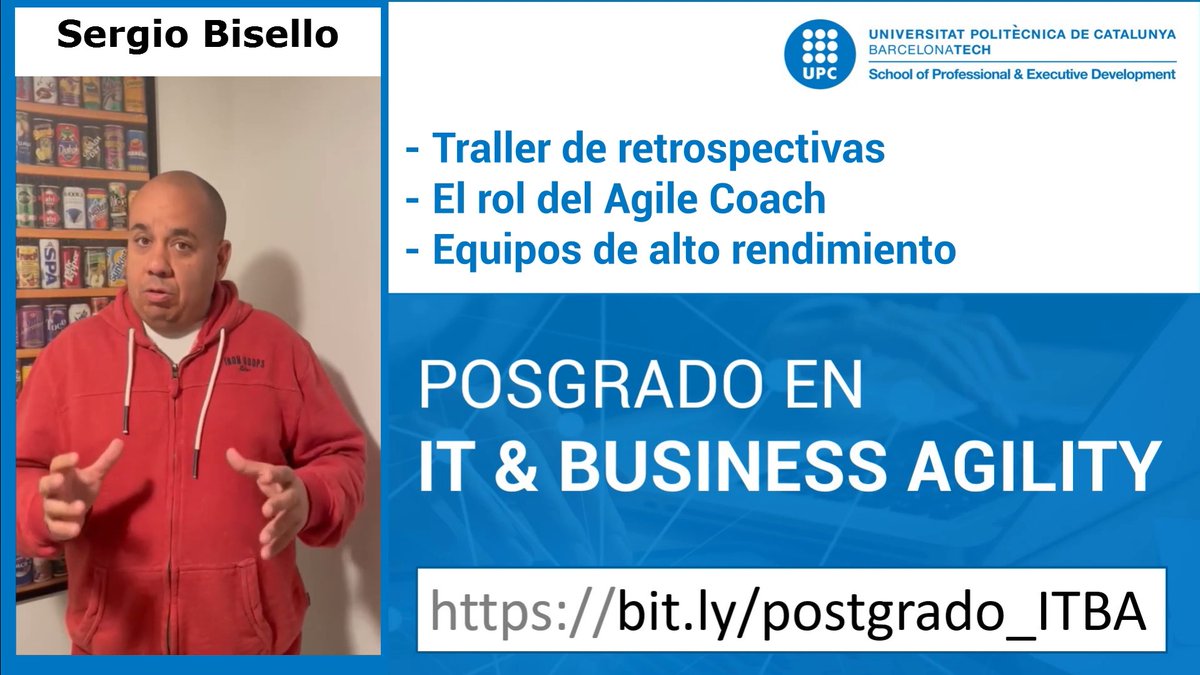
@sbisello nos explica sus clases en el postgrado Business & IT Agility en @UPC_School.
📆 Comienza el 21 de febrero en formato virtual, en horario compatible con España y Latinoamérica.
👉Vídeo: https://t.co/JOjZ5D7hte
💡Más info del postgrado: https://t.co/Lp9zTsfLJy
✔ Entrevista a @AlexBallarin76, experto en #businessagility y director del Posgrado en IT & Business Agility.
Conoce las principales características y utilidades de esta innovadora metodología.
¡No te pierdas la entrevista completa!
🔗 https://t.co/aV3lLfP8UZ
When it comes to annual planning, folks tend to spend the most time on which metrics to track. But @twilio CEO @jeffiel rebuffs this approach:
“Metrics are, in my opinion, the least important part of an annual plan because they aren’t very strategic."
https://t.co/RzWasE9hRv
if you own a decision that requires input, try a thing I learned from Russell Ackoff: "If we don't make a decision (by time T and/or between options X, Y, and Z), we will go with my plan. If you want us to do something different, you need to propose it and/or obtain consensus."
Extreme Programming Explained by @KentBeck is basically the bible for teams that pair program. Its reputation is well-deserved.
Even though helped popularize the idea of pairing, it actually only has two pages on the subject!
You'll probably be surprised by what it says:
In 1999, a little book by @KentBeck started explaining Extreme Programming (XP) to the masses.
23 years later, it's still true to every word.
But we, the developers, chose to ignore half of its learnings.
In this thread 🧵I'll fix that for you. 👇👇👇
Apart from delivery of technical projects via their team, another important responsibility and strategic priority of engineering manager is to hire, and retain tech talent effectively. Here are a few tips on how do it. #engineeringmanager#management#techlead#leadership#cto
Another common question I’m answering working with scaling tech companies is…
Q. What’s the worst leadership advice you’ve heard?
A. By far the worst is “Hire great people and get out of their way”.
Let me explain… 🧵 (1/32)