1/ The ultimate sleeping giant in crypto is about to wake up. $XNO (Nano) is quietly positioned to disrupt the market like no other coin. Here’s why I’m extremely bullish—and why this hidden gem could skyrocket into the top 10. Read on. 🧵
What would happen if @X wanted to adopt Nano for payments? Why would they do so? How would they do it in practice?
On the business side there are a few advantages to implementing Nano if you’re X.
1. Decreased payment processing cost.
2. Instantly settled payments.
3. Larger group that can pay X.
4. No reliance on outside parties.
5. Price appreciation of Nano holdings.
Scenario 1: X implements Nano for paying for Premium.
The simplest way to implement Nano would be to only offer it for paying for Premium.
How much would X save in this scenario?
We don’t have exact numbers, so we have to make some assumptions. Let’s say there are 1 million people paying $10 a month on average to X.
X uses Stripe, which generally has a charge of ~$0.29 + 2.9%. For $10, that comes out to $0.58, or about 5.8% payment processing costs. There might be added optional costs for currency conversion.
X likely has some deal in place decreasing these costs a bit, so an estimate of $580k a month might be the high estimate but is likely not off that much. This comes out to over $6 mln a year in just payment processing costs for Premium.
Nano, as many know, is feeless. In the implementation that X is likely to prefer they would want to convert to USD, which can be done for ~0.5% fees, possibly a fair bit lower. That would be $50k a month or $600k a year, a saving of ~90% over the payment processing they currently have in place.
It’s unclear how much it is worth to X to have access to the money instantly, rather than having to wait for credit card payments to settle, but it’s a nice bonus. So is the added bonus of people not being able to dispute the credit card payments. There are no figures on how often this happens but one might expect this to be a factor in the “verified bot accounts” which pop up and quickly disappear again.
There is also potential revenue from implementing Nano in this scenario.
A lot of people do not have access to credit cards but might still want to get Premium. This is currently not possible, which Nano would solve immediately. Expanding access like this means increasing potential revenue from Premium, making X less reliant on advertisers.
There is an added beauty in using a decentralized digital currency like Nano in that it decreases reliance on outside parties. We’ve seen countless examples of how businesses can be pressured by credit card processors. @elonmusk and X are often controversial and have taken a clear stand in the freedom of speech debate, which can lead to (and has led to) political pressures.
X can’t be shut off from Nano, and Nano can’t be shut down being a decentralized network.
Finally, X might want to buy Nano before implementing it into X for payments. There are many reasons this would make sense: to test practical implementation, to test liquidity, because they anticipate a price increase in Nano, or because they plan to have a stack to instantly exchange into USD as payments come in.
Implementing Nano into X would likely cause a big price increase for Nano, which X would profit from as a one-off gain, and would give X access to a non-debaseable form of money going into the future.
Scenario 2: X implements Nano for paying for Premium and Creator payouts.
Building on the previous example, X could enable Nano for Creator payouts and tipping. Creator payouts have minimums now and come with similar payment processing costs as paying for Premium does.
Paying out in Nano means creators can get 100% of the payouts, attracting more content creators to Twitter and allowing for smaller content creators to start getting a share of earnings from Twitter. Decreasing these minimums to $1 might feel inconsequential, but there are a lot of creative minds in the world that would love to be able to earn even such small amounts.
Scenario 3: X implements Nano for paying for Premium, Creator payouts and Tipping
Payouts to content creators ties in to tipping. Back when we had the Nano TipBot on Twitter it was used a lot to tip what people saw as great content posted on Twitter. I had my fair share of tips sent to me, by people simply replying “@NanoTipBot 1” to send 1 Nano.
If you can have a Nano balance on Twitter and there’s a button underneath posts to tip the creator people would be far more likely to do so.
Alternatively it could even be used as an additional revenue source. There are posts that I like so much that I’d like to super-retweet it, but that’s not possible. If I could tip a few Nano to the post to get it spread more widely, even if all that money went to X, I would often gladly do so.
It would allow to crowdsource advertising, to let people put their money where their mouth is.
While these three scenarios are solely built on technology X already has in place or could easily implement in the near future, there are more ways this could be extremely beneficial in the future.
If X expands to allow commerce to take place on or via X, what more attractive way to attract merchants than offering zero (or very low) payment fees, with a currency that anyone in the world can use and spend? What if you could send money to anyone in the world, anywhere, anytime, using just their X handle?
Implementing Nano, coincidentally with currency symbol Ӿ, would allow all this. There is no other crypto, no other form of money in the world, that can offer zero fee, instantly settled payments using a payment network that can’t be stopped and can’t be censored.
"X will start charging a small fee for posts".
We recently looked into the processing costs for $1 payments. It's ~$0.20-0.30.
Nano would make so much sense for this.
Following up on this: after being in contact with @wholemars they've refunded the $999 and I'll be returning the Nano people sent in.
They were afraid of taking a crypto sponsorship since there are so many scams and sketchy things going on in crypto, and asked me to explain a bit more about Nano.
I told them how they could try it, some of the history around it, and what makes me enthusiastic about Nano. Unfortunately I think the bad connotation of crypto won out, so they decided to refund the money.
To be clear, I don't blame WholeMarsBlog for this in any way. Crypto has a very negative connotation, crypto is filled with scams, and crypto can lose people a lot of money. It's unfortunate that we have to constantly fight against this, but I very much respect WholeMarsBlog for sticking to their principles and literally refusing money because they're afraid it would cause harm to others. In this case it works out badly for us, but taking an outside perspective this is what I'd love to see more of, not less.
Overall this has still been positive, I would say.
• We showed how awesome the Nano community is by being able to raise funds for something that makes us all enthusiastic, raising it very quickly, with many different people from all around the world contributing sums both small and large. Very grateful to all of you, also for the trust put in me!
• Since Nano is feeless, I can send all funds back to all of you without any loss. I will be doing so right after this post.
• If nothing else, WholeMarsBlog learned about Nano and it has perhaps become a bit more credible to them.
I'd also love for us to think about other ways we could productively promote Nano. It's clear that the community is okay with making funds available to do so, and it's clear to most of us that once you try Nano and learn about Nano, you like it.
Again thanks to all of you who sent in funds, very much appreciate the trust put in me, and I'll send the funds back now (to hopefully be used at some later time)!
Goal alignment in crypto: incentives rule the world.
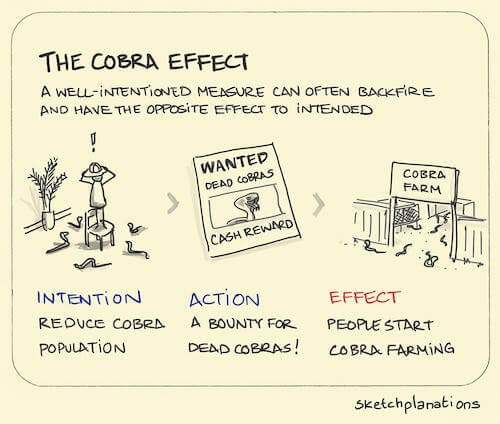
When British colonial rulers wanted to reduce the number of cobras in Delhi, they offered a bounty for every dead cobra. Initially, this seemed to work as large numbers of snakes were killed for the reward.
Soon however, people began to breed cobras to earn more money. When the government became aware of this and stopped the rewards, the breeders released the snakes, leading to an even greater cobra population than before.
The goal was to decrease the cobra population. The incentive was to breed more of them.
History is riddled with examples of misaligned incentives that seem obvious in hindsight. But are we not making a similar mistake in crypto?
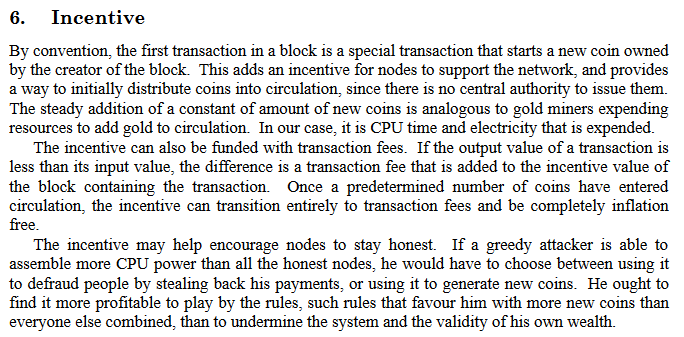
Satoshi on incentives
Paragraph 6 of the Bitcoin whitepaper (https://t.co/0vdwTUzTfa) is about incentives.
Goal alignment in Bitcoin means aligning incentives between (A) holders and (B) miners.
(A) holders want one thing above all. For their Bitcoin to remain valuable, and to become more valuable. This means low debasement and high security. Low debasement is locked in the protocol, while security is gained through decentralization.
(B) miners want one thing above all. To make a profit. In an ideal world, their profit is maximized by mining fairly, winning block subsidies and fees while causing little debasement to holders.
The cobra rears its head
Mining Bitcoin is a competitive business where revenue comes from a commodity. The market price of Bitcoin is a given, the cost side can be optimized.
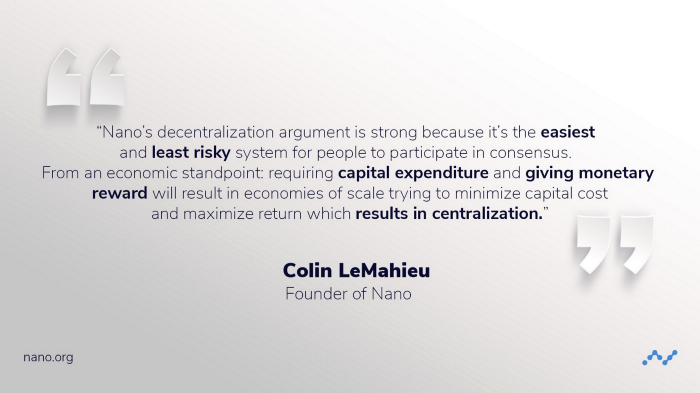
In optimizing the cost side, economies of scale dominate.
Economies of scale mean:
• Access to cheaper capital
• Discounts on bulk mining machine purchases
• Cheaper per-unit rack space
• Cheaper per-unit maintenance
• Reduced administrative expenses
• More favorable energy contracts
These advantages are often mentioned by miners themselves (https://t.co/hBDQLNNNuS).
Holders want miners to stay small and to increase in number. Miners instead want to grow to get more economies of scale and make more profit. Goals are misaligned.
The risk of misalignment
Bitcoin derives its value from decentralized consensus. If a small group of miners has the majority of validation power, they can censor the network and have effective control over Bitcoin as a store of value. A store of value where you can't withdraw hasn't stored anything.
Censorability is in many ways exactly what Bitcoin was designed to solve. Take away Bitcoin's decentralization, make it stoppable, and you take away its value.
Goal alignment with outsiders
So far, we looked at two within-system groups of (A) holders and (B) validators. There's also a group of (C) outsiders.
These outsiders are similarly motivated by profit. They don't particularly care for Bitcoin. They would buy it if they knew it would become worth more, they would short it if they knew it would become worth less.
How did outsiders see Bitcoin in the past?
Outsiders might have seen a system that was difficult to profitably attack. To censor the network through a 51% attack they might have needed to convince 100 miners to collude, and these miners were making good money from mining Bitcoin.
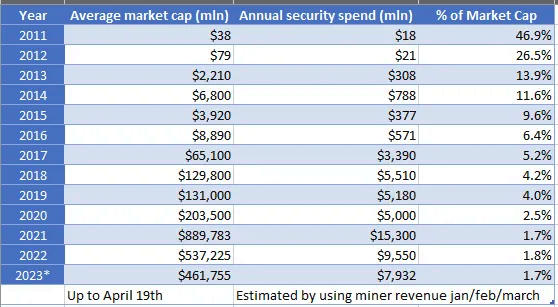
In 2014, miners had revenue of $788 million per year, and the total market cap of Bitcoin was $6,800 million.
Attacking was not that attractive:
• Options for going short, where you profit from a declining price, were limited.
• Mining was more decentralized than it is now, so a larger group of miners would have to be coordinated to attack.
• Total market cap was relatively low, so potential profit was limited.
• Miners were making relatively good money as a percentage of market cap (11.6% per year), so bribing or coercing them would be expensive relative to the profit to be made from shorting.
What do the incentives look like now?
• Bitcoin has become easier to short.
• Mining has become more centralized.
• Market cap is higher, so the potential profit is higher.
• Miners are making far less money as a percentage of market cap (1.7% now vs 11.6% previously).
This adds up to a far more attractive proposition for a 51% attack: the relative cost has gone down, potential profit has gone up.
Current goal alignment between miners and outsiders
The incentives of miners and outsiders are aligning more and more. Validators do not necessarily care about Bitcoin. They run a business where they provide an input (hashrate) and receive an output (BTC) that they can convert to cash instantly.
They do not need to, and often do not want to hold Bitcoin. That is not part of their business proposition. They do not necessarily have goal alignment with holders.
If a miner has:
• $800 mln annual revenue (~10% of the total hashrate)
• $200 mln annual profit
Then a one-time payoff of $4 billion (20 times their annual profit) might seem very attractive for such a miner. At such figures, performing a 51% attack on the Bitcoin network would cost just ~$20 billion.
If we assume a market cap of $500 billion for Bitcoin and being able to open a short position on $100 billion of that, an attack would need just a 20% drop in BTC's value to turn this into a profitable proposition.
Given that Bitcoin's value derives from being a decentralized store of value, its value might drop far more than 20% when successfully attacked.
Future goal alignment
Given the incentives embedded in the Bitcoin protocol for miners to scale up, further centralization of miners seems like a safe assumption, one that is backed in practice by research.
Given increasing financialization of Bitcoin, increasing possibilities for going short on Bitcoin seem like a safe assumption.
Given that block subsidies in Bitcoin decrease over time through the "halving" and that fees are barely increasing, miner revenue (cost to attack) as a percentage of market cap (potential profit to be made) will decrease further as it has so far.
This is clear goal misalignment between Bitcoin miners and Bitcoin holders. Worse, this goal misalignment is at the very core of the Bitcoin protocol.
Proof of Stake's attack resistance
In Proof of Stake (PoS) it is far harder to profitably attack the network. While PoW miners exist outside the protocol and do not necessarily hold Bitcoin, validators in PoS exist within the protocol and hold the coin.
Going profitably short is therefore far harder if not impossible. To 51% attack the network, you need to hold the coin meaning you would be attacking your own holdings.
Yet in PoS, similar to PoW, goals are not perfectly aligned.
Redistributive power in staking
Validators in PoS are generally paid a combination of i) new coins being minted and ii) transaction fees.
To be a staker, you generally need to fulfil some requirements:
• Have a certain minimum amount of coins
• Be willing to lock up those coins for a period of time
• Run a dedicated computer or server that is online 24/7
If you can do so, you receive maximum rewards, let's say a 10% annual return.
For those that lack any of the above, there are generally options to stake with third parties. These tend to take a fee for providing this service.
This could mean you receive 9% or 8% instead of the 10% that the larger holders get.
That's still better than what those that don't stake at all receive, which is 0%. In Ethereum only ~20% of coins are staked.
In the long term, this is worrying. Those that hold most receive most rewards, both in absolute and relative terms, and this exponentially grows over time. Compound interest is the eight wonder of the world.
Goal alignment in staking
Staking presents more goal alignment issues. As a holder of Ethereum, I now have two different goals. I want the network to remain as decentralized as possible, but I also want maximum rewards on my coins.
What if I can stake for a slightly higher reward, but it means staking with an already large staker? My goals conflict.
What is good for me is not good for the network.
This tragedy of the commons scenario also exists in global warming, overfishing, antibiotics and countless other examples. Individual's goals conflict with group goals.
The goal of maximizing ROI within the protocol conflicts with the goal of decentralization. Both as a tragedy of the commons, and through the redistributive power of staking.
Solving goal alignment in crypto
Many Proof of Work and Proof of Stake crypto are designed to minimize the impact of the lack of goal alignment. However within PoW and PoS none have true goal alignment between holders and validators.
One crypto that I would argue has solved this is Nano. Similar to in Bitcoin and Ethereum, holders of Nano want one thing above all. Low debasement, high security, meaning decentralization is needed.
As opposed to Bitcoin and Ethereum though, miners/validators do not receive monetary rewards. Accruing a large percentage of validation power providies no income, no ROI.
Similar to in Ethereum, validation power is coin-based and a 51% attack is therefore difficult to profitably perform.
Validators exist within the protocol, but unlike in PoS and PoW they are unable to extract value from the protocol.
Remove redistributive power, remove the tragedy of the commons
Without monetary rewards being paid, there is no inbuilt redistribution towards larger holders and no incentive to become a bigger validator.
Without monetary rewards, for the past 7 years validators have been run by those that profit from the value inherent in the network itself:
• Exchanges run a node to confirm deposits really happened.
• Businesses run a node to be independent and self-sufficient.
• Holders run a node to trustlessly use the network and secure their Nano.
Goal alignment between all holders
Holders that choose not to run a node themselves can use their Nano to vote for a validator of their choice.
Their incentive is clear. There is no individual incentive of wanting the highest possible return. Instead, their incentive is to vote in a way that maximises the value of their Nano by voting for smaller validators, increasing decentralizationd security of the network.
There is no return versus security trade-off, no tragedy of the commons.
Every Nano holder's incentives are aligned with those of every other Nano holder in prioritizing decentralization and security above all.
Incentives rule the world
In the short term, lacking goal alignment is not an apparent problem. We might even think things are going well.
More cobra heads are turning up, so we must be getting rid of the cobra infestation.
In the long run though, the monetary incentives built in to most of crypto are terrible. The centralization over time and the tragedy of the commons is what degrades decentralization and decreases security. It only gets worse over time.
It's a price holders pay, and only when we solve it can we see a crypto as a truly long-term option.
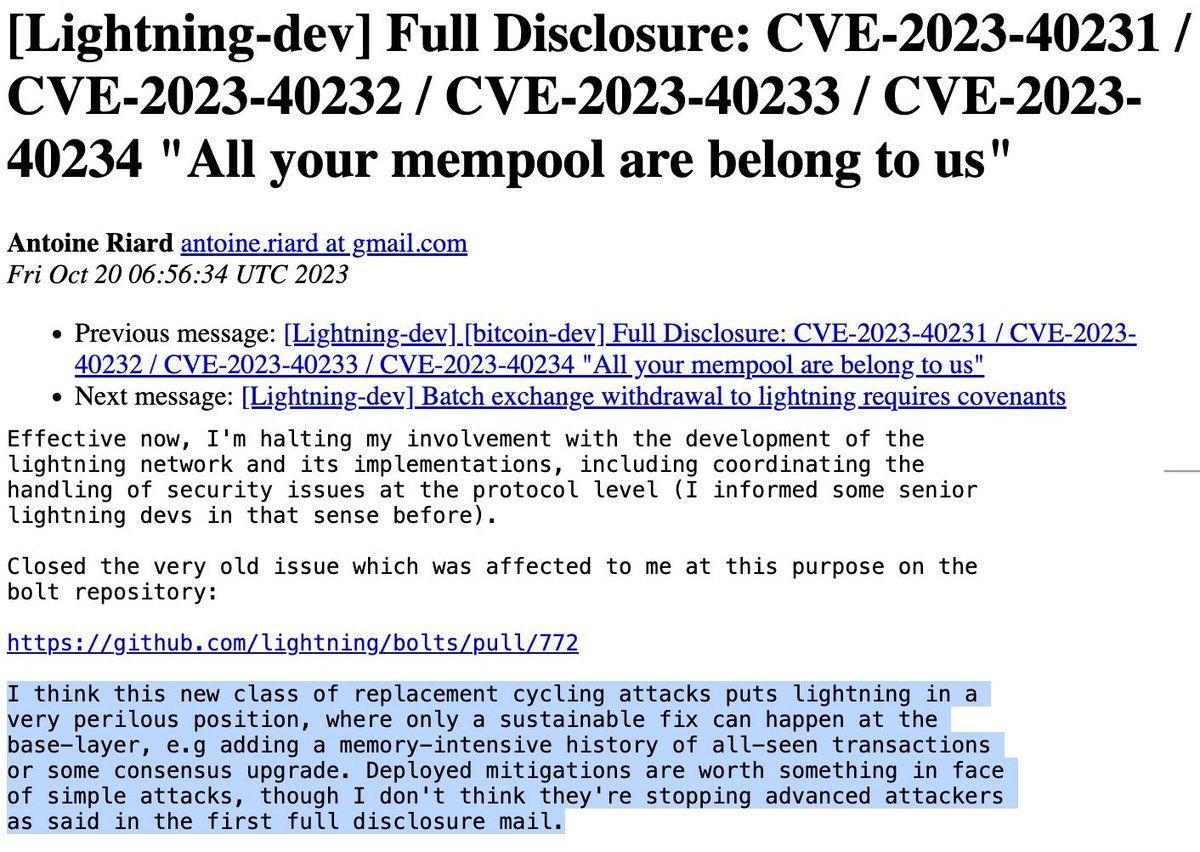
Antoine Riard, a Lightning Network security researcher and developer, withdraws from LN's development and implementations:
💬"This new class of replacement cycling attacks puts lightning in a very perilous position, where only a sustainable fix can happen at the base-layer".
Nano $XNO has introduced a #cryptocurrency that was designed to provide decentralized transactions without any fees.
This article is a full guide to @nano, its features, perspectives and plans for development 👉🏼 https://t.co/nkL2aEgpp6
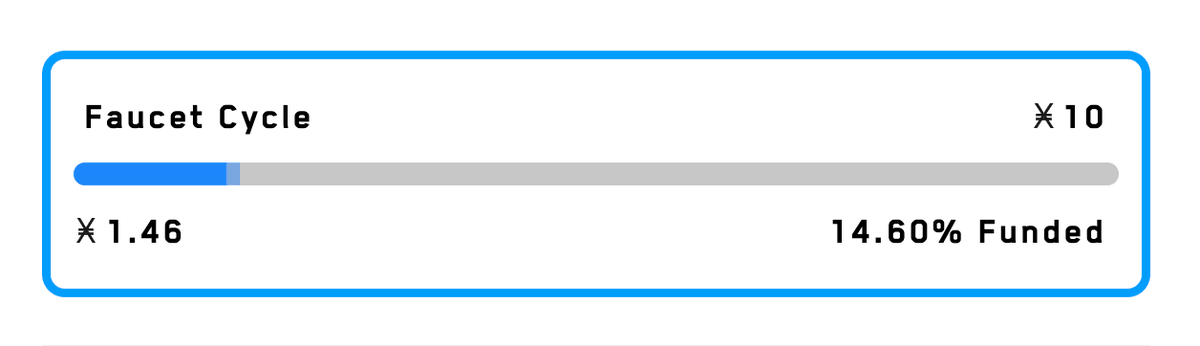
https://t.co/nA0bh1eqD6 & https://t.co/OfcA6FVHWX are independent #Nano faucets operated by https://t.co/AtlqwiCp6S.
A cycle is when the Faucet fills up then promptly gets distributed equally.
Don't forget you can see all the amazing things that have happened in the world of #nano $XNO on our great News Page!
Filter by date to see what happened in the last week, month, quarter or year! Or even filter by category! 📅
https://t.co/YbX0hlUGAB
The #Nano V26DB24 beta is here! Discord screenshot from @gr0vity_dev 💖 #cryptocurrency
The two focus areas are recovery from a desynced state & steady network throughput, which are requirements for Nano to be "commercial grade" 🍻
Nice article from @postgrowth Institute about recent #FreeMoneyDay 2023! 🙌
It was amazing to see the #nano community join in on this collaboration to spread $XNO around the globe in many different ways, including using @WeNanoApp 🌍
Recap coming soon!
https://t.co/0m5ED7L48m
One of the best (and longest) thread I've ever read on this topic!
Addressing economic concepts, fundaments, game theory, security, decentralization, and more.
Totally worth it to read.
#bitcoin#nano🅧 #BTC#XNO🅧 $XNO 🅧 #crypto
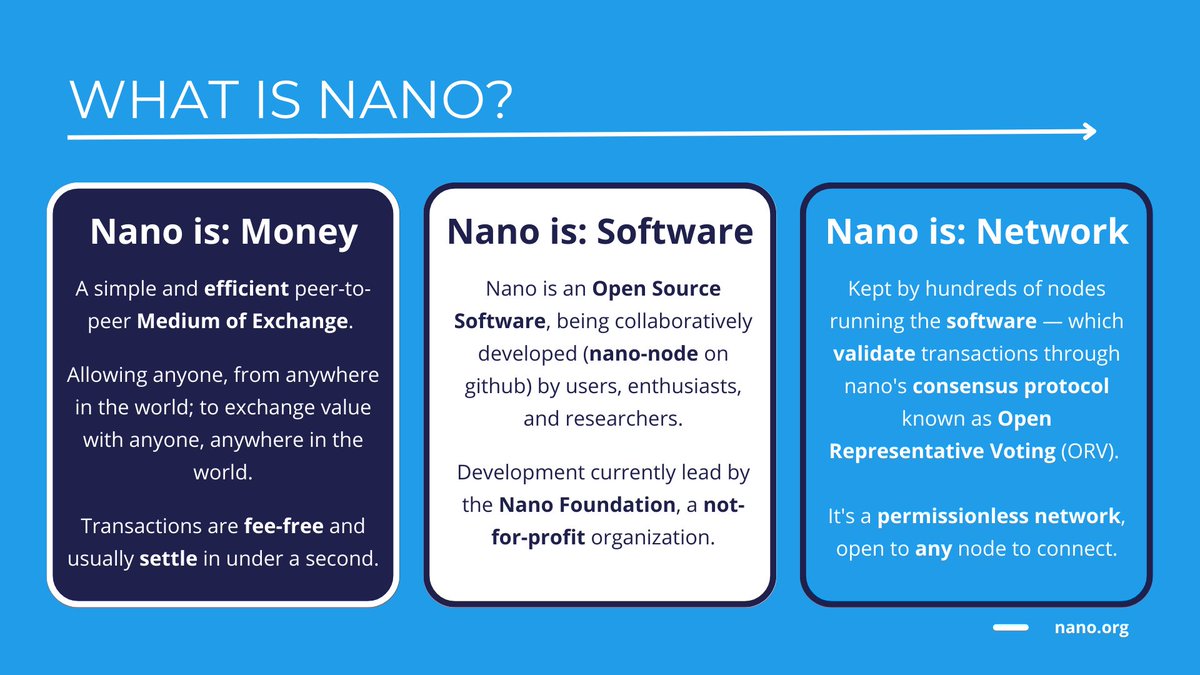
What is #nano (ticker $XNO)?
→ #Money: a borderless, fee-free medium of exchange with sub-second settlement.
→ #Software: an #OpenSource Software created by a non-profit, and collaboratively developed.
→ #Network: a permissionless and open network ran by hundreds of nodes.
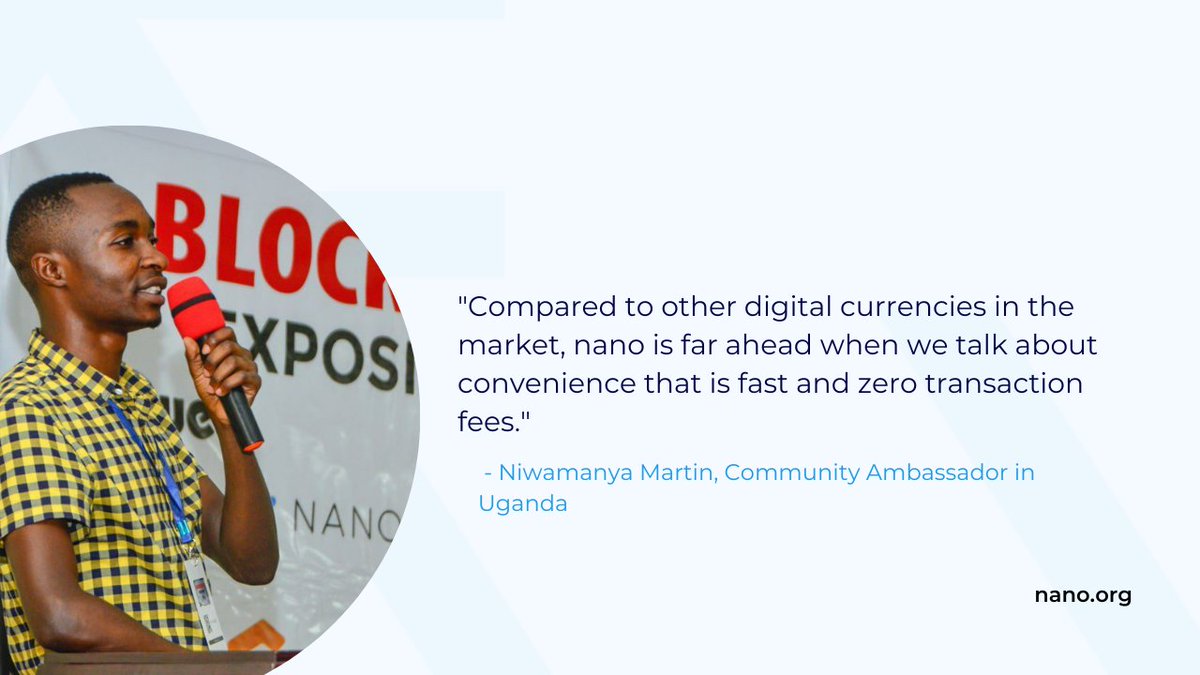
Our ambassador in Uganda, Niwamanya Martin (@NiwamanyaMarti6) has been doing amazing work spreading awareness of #nano $XNO in #Uganda!
Hosting nano meetups, presenting nano at blockchain events, and even introducing @SafeBoda drivers to nano! 🙌
Nice work, Martin!
The popular #nano app @WeNanoApp & the additional @WenanoBusiness app for businesses got some updates that allow for more ways for business owners to promote their business, connect with customers and receive payments.
$XNO
Read the full update here
https://t.co/ZcV8KoqLc1