Sixty years ago today, the Kansas City Athletics selected Arizona State's Reggie Jackson with the No. 2 overall pick in the MLB Draft.
@mroctober, who made his big league debut a year later before earning five World Series rings, was destined for Cooperstown.
A 24-year-old Polish tennis player arrived in Paris last week ranked 114th in the world, with no sponsors, no guaranteed income, and no certainty she could even pay for her hotel room.
She had to win three qualifying matches just to enter the French Open main draw. Prize money is only paid at the end of the tournament, so a Polish sports drink brand quietly stepped in and covered her hotel bill.
Her name is Maja Chwalinska. And today, she plays in the French Open final.
Before this tournament, she had won exactly one Grand Slam main draw match in her entire career. She had battled depression so severe that in 2021 she couldn't get out of bed. She underwent knee surgery in 2022. She spent years grinding through small tournaments across Europe just to stay afloat.
Then she arrived in Paris, won three qualifiers, and kept winning. Zheng Qinwen. Elise Mertens. Maria Sakkari. Diana Shnaider. Nine straight matches. One set dropped.
She is now the first qualifier in French Open history to reach the final. The last time a qualifier reached a Grand Slam final, it was Emma Raducanu at the 2021 US Open. Raducanu won.
By simply making the final, Chwalinska has earned more prize money than her entire career combined. The runner-up cheque alone is $1.6 million. If she wins today, she takes home $3.25 million.
One week ago she couldn't pay for her hotel room.
A British biologist looked at 200,000 years of human history and found that the entire reason humans broke out of poverty was not intelligence, not language, not even agriculture, but one mechanism so simple a 6-year-old could explain it.
His name is Matt Ridley.
He is a zoologist by training, an evolutionary biologist by career, and in 2010 he wrote a book called The Rational Optimist that quietly argued the most important fact about human progress had been hiding in plain sight for the entire history of economics.
Naval Ravikant has been telling people to read everything Ridley has ever written for the last 15 years. The reason is the argument inside this one book.
For 200,000 years, anatomically modern humans walked around with the same brain you have right now. Same skull size. Same neural architecture. Same raw capacity for language, planning, and abstract thought.
For roughly 190,000 of those years, almost nothing happened. Generation after generation lived and died inside the same Stone Age toolkit their great-great-grandparents had used. Then somewhere around 50,000 years ago, the line on the chart of human progress started to tick upward. Then it bent. Then it exploded.
The question Ridley spent years on was the only question that mattered. What changed.
It was not the brain. The brain had been the same for 190,000 years. It was not language, which had existed long before the takeoff. It was not even agriculture, which arrived only 10,000 years ago and was actually preceded by the upward bend, not the cause of it.
What changed was that humans started trading with strangers.
This sounds too small to be the answer. Ridley argues that it is the answer to almost everything. The moment one human exchanged a useful object with another human from a different group, something happened that no other species on earth had ever done.
Two ideas that had developed in isolation came into contact. The flint knapper learned what the spear maker had figured out. The fisherman from the coast learned what the hunter from the forest had figured out. The two pieces of knowledge fused into something neither side could have produced alone.
Ridley calls this ideas having sex. The phrase sounds frivolous and it is meant to. The point is that ideas, like genes, get better when they combine with other ideas from different lineages.
An idea sitting inside one head, no matter how brilliant the head, eventually hits a ceiling. The same idea exposed to ten thousand other ideas does something genes do under sexual reproduction. It mixes. It recombines. It produces offspring nobody planned.
The cleanest proof of this argument is the most uncomfortable case study in the book. Tasmania.
Around 10,000 years ago, rising sea levels cut Tasmania off from mainland Australia. A population of roughly 4,000 humans was now isolated on an island, with no possibility of contact with the rest of humanity. They had the same brains. The same language. The same starting toolkit as their cousins 150 kilometers north. The natural experiment was now running.
What happened next is something no economist or geneticist had ever predicted.
The mainland Australians kept inventing. Boomerangs. Spear-throwers. Fishing nets. Bone needles for sewing fitted clothes. Watercraft with paddles. Their technology compounded slowly across the centuries.
The Tasmanians went the other way. They did not just fail to invent the new tools their cousins were developing. They started losing the tools they already had. Fishing was abandoned within a few thousand years. Bone tools disappeared. Fitted clothing disappeared. They forgot how to make fire from scratch and started carrying lit firebrands from camp to camp instead, relighting their fires from a neighbor's whenever their own went out.
By the time European explorers arrived in the 17th century, the Tasmanians had the simplest toolkit of any human society ever recorded. Their material culture had gone backward for 8,000 years.
The archaeologist Rhys Jones called it a slow strangulation of the mind.
Joseph Henrich at Harvard later proved with formal mathematical models that there was nothing wrong with Tasmanian brains. There was something wrong with their network. A toolkit requires a critical mass of people exchanging skills to maintain itself.
The act of teaching a skill is imperfect. Every generation loses a small percentage of what the last generation knew. If your population is large enough and trading widely enough, those losses get caught and corrected by someone else who still remembers.
If your population shrinks below a certain threshold and stops mixing with outsiders, the small losses compound until entire technologies disappear.
This is the part that should haunt anyone reading this in 2026.
Intelligence is not a property of the individual brain. Intelligence is a property of the network the brain is connected to. A genius in isolation will produce less than a mediocre thinker inside a dense exchange of other mediocre thinkers.
The thing your ancestors needed in order to break out of 190,000 years of stagnation was not better brains. It was better connections between brains they already had.
The implication for any individual is direct and uncomfortable. If you are smart and isolated, you will be outproduced by people half as smart who are connected.
The most successful people in any field are almost never the smartest people in it. They are the ones positioned at the intersection of the most idea flows. They are reading more authors than their competitors. They are talking to more people from more disciplines. They are in the rooms where ideas from different lineages bump into each other.
Ridley ends the book on the line that sounds optimistic but is actually a warning its this "The future will be invented by people who connect ideas, not by people who guard them."
🚨 The most powerful man in the world had a secret morning ritual.
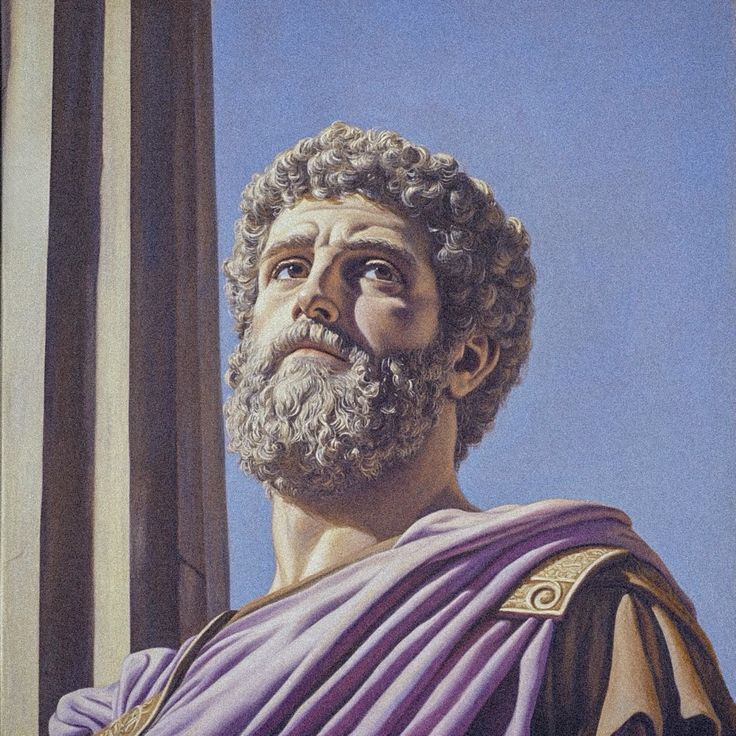
Every day before sunrise, Marcus Aurelius (Emperor of Rome, commander of 400,000 soldiers, the most absolute ruler on Earth) sat alone with a wax tablet and reminded himself that he was going to die, that everything he loved would disappear, and that none of it was under his control.
He called it Memento Mori. It was 1 of 10 techniques he used to stay sane through plague, war, and the slow corruption of his only son.
I turned the 10 into Claude prompts.
You describe whatever emotional weather you're facing... and it runs you through the same exercise Marcus did at sunrise in his tent.
Here are all 10:
> Be Richard Feynman
> Born in Queens, New York.
> Teaches young Richard to see patterns in everything. Not facts. Patterns.
> Richard never forgets the difference.
> Fixes radios in the neighborhood as a kid. Not because he's told to. Because broken things bother him.
> Gets to MIT. Then Princeton.
> His PhD thesis is later ranked one of the most influential physics papers in history.
> He's 24 years old when he writes it.
> Then the government shows up.
> They're building a nuclear bomb in the desert.
> They need the smartest minds in America.
> Feynman packs a bag and goes to Los Alamos.
> While working on the most classified project in human history—
> He breaks into the safes containing nuclear secrets. Not to steal anything.
> Just to prove the security is terrible.
> Leaves notes inside to prove he was there.
> The military is furious. Feynman is delighted.
> His wife Arlene is dying of tuberculosis in a hospital 100 miles away.
> He drives to see her every weekend through the desert.
> She dies the same month the bomb is tested.
> Feynman watches the first nuclear explosion in human history
> and then drives back to his empty room
> and sits alone.
> Wins the Nobel Prize in Physics in 1965. For work so complex that even most physicists couldn't follow it.
Could have spent the rest of his life being important. Refuses.
> Teaches undergraduate physics at Caltech instead.
> Peers think it's beneath him.
> Feynman thinks confused 19-year-olds are more interesting than academic conferences.
> He's right.
> Learns to play bongo drums. Gets good enough to perform professionally.
> Learns to draw. Exhibits under a fake name so people judge the art, not the physicist.
> Goes to Brazil and teaches for a year.
> Learns Portuguese to do it properly.
> Spends time in a sensory deprivation tank.
> Studies his own hallucinations like they're data.
> Picks up a biology textbook at 40 and starts doing original research. Just because it's interesting. Just because he can.
> 1986. Space Shuttle Challenger explodes on live television.
> 73 seconds after launch.
> 7 astronauts dead.
> NASA spends months deflecting blame with bureaucratic language.
> Feynman joins the investigation commission.
> Gets handed the runaround.
> Ignores the politics.
> Goes and talks to the engineers directly.
> The ones NASA told not to talk to him.
> Sits in the televised hearing.
> Pulls out a piece of O-ring material.
> Drops it into a glass of ice water.
> Leaves it there while other commissioners talk.
Pulls it out. Shows it's lost its elasticity in the cold.
> Challenger launched in 28-degree weather. Case closed. No PowerPoint. No committee. No press conference.
> Just a glass of ice water and a piece of rubber. On live TV. In front of the entire world.
> Gets diagnosed with two rare forms of cancer simultaneously.
> Doctors say it's terminal.
> Feynman says: "I'd hate to die twice. It's so boring."
> Refuses a final dialysis treatment that would have bought him a few more weeks.
> Says he'd rather die than be kept alive just to suffer.
> Dies on his own terms. February 15, 1988.
> Never chased a prize in his life. The prizes chased him.
> Never performed intelligence. Just followed curiosity wherever it went. Into nuclear deserts. Into bongo bars. Into O-rings. Into the deepest structure of reality itself.
Feynman mastered curiosity so the world couldn't contain him.
Unbothered. Undefeated. Unchained.
Feynman was built different.
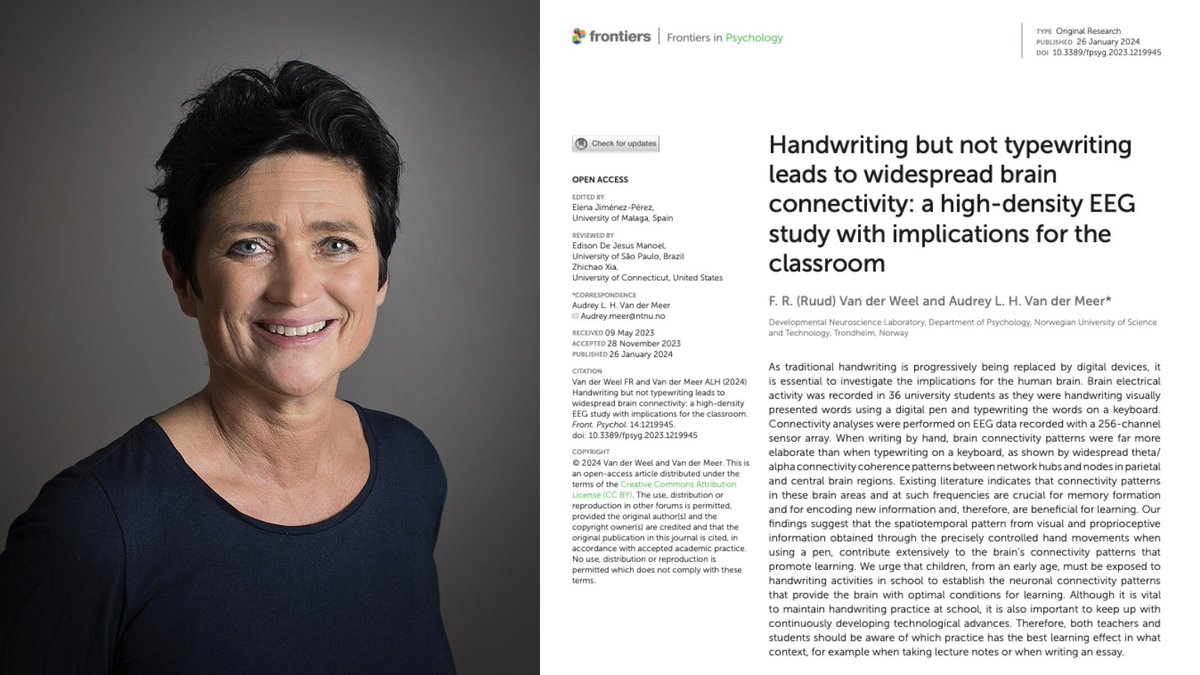
A Norwegian neuroscientist spent 20 years proving that the act of writing by hand changes the human brain in ways typing physically cannot, and almost nobody outside her field has read the paper.
Her name is Audrey van der Meer.
She runs a brain research lab in Trondheim, and the paper that closed the argument was published in 2024 in a journal called Frontiers in Psychology. The finding is brutal enough that it should have changed every classroom on Earth.
The experiment was simple. She recruited 36 university students and put each one in a cap with 256 sensors pressed against their scalp to record brain activity. Words flashed on a screen one at a time.
Sometimes the students wrote the word by hand on a touchscreen using a digital pen, and sometimes they typed the same word on a keyboard. Every neural response was recorded for the full five seconds the word stayed on screen.
Then her team looked at the part of the data most researchers had ignored for years, which is how different parts of the brain were communicating with each other during the task.
When the students wrote by hand, the brain lit up everywhere at once.
The regions responsible for memory, sensory integration, and the encoding of new information were all firing together in a coordinated pattern that spread across the entire cortex. The whole network was awake and connected.
When the same students typed the same word, that pattern collapsed almost completely.
Most of the brain went quiet, and the connections between regions that had been alive seconds earlier were nowhere to be found on the EEG.
Same word, same brain, same person, and two completely different neurological events.
The reason turned out to be something nobody had really paid attention to before her work. Writing by hand is not one motion but a sequence of thousands of tiny micro-movements coordinated with your eyes in real time, where each letter is a different shape that requires the brain to solve a slightly different spatial problem.
Your fingers, wrist, vision, and the parts of your brain that track position in space are all working together to produce one letter, then the next, then the next.
Typing throws all of that away. Every key on a keyboard requires the exact same finger motion regardless of which letter you are pressing, which means the brain has almost nothing to integrate and almost no problem to solve.
Van der Meer said it plainly in her interviews.
Pressing the same key with the same finger over and over does not stimulate the brain in any meaningful way, and she pointed out something that should scare every parent who handed their kid an iPad.
Children who learn to read and write on tablets often cannot tell letters like b and d apart, because they have never physically felt with their bodies what it takes to actually produce those letters on a page.
A decade before her, two researchers at Princeton ran the same fight using a completely different method and ended up at the same answer. Pam Mueller and Daniel Oppenheimer tested 327 students across three experiments, where half took notes on laptops with the internet disabled and half took notes by hand, before testing everyone on what they actually understood from the lectures they had watched.
The handwriting group won by a wide margin on every question that required real understanding rather than surface recall.
The reason was hiding in the transcripts of what the two groups had actually written down.
The laptop students typed almost word for word, capturing more total content but processing almost none of it as they went, while the handwriting students physically could not write fast enough to transcribe a lecture in real time, which forced them to listen carefully, decide what actually mattered, and put it in their own words on the page.
That single act of choosing what to keep was the learning itself, and the keyboard had quietly skipped the choosing and skipped the learning along with it.
Two studies. Two countries. Same answer.
Handwriting makes the brain work. Typing lets it coast.
Every note you have ever typed instead of written went into your brain through a thinner pipe. Every meeting, every book highlight, every idea you captured on your phone instead of on paper was processed at half depth.
You did not forget those things because your memory is bad. You forgot them because typing never woke the part of the brain that would have made them stick.
The fix is the thing your grandmother already knew.
Pick up a pen. Write the thing down. The slower road is the faster one.
@Kseniase_@ylecun@logic_int Preferences are optional and subject to constraints, whereas constraints are neither optional nor subject to preferences.
- Papic
EBM are so back!
@ylecun has been pointing here for years: AI reasoning needs systems that check structure before they answer.
Aleph from @logic_int now leads the major formal reasoning benchmarks – let me explain what it is -> 📺
Bertrand Russell on what he'd tell future generations:
In a 1959 BBC interview, the philosopher Bertrand Russell was asked what he'd want to pass on to descendants watching the film "like a Dead Sea scroll in a thousand years time."
His answer came in two parts.
One intellectual, one moral.
On the intellectual side, Russell said:
"When you are studying any matter, or considering any philosophy, ask yourself only: 'What are the facts, and what is the truth that the facts bear out?' Never let yourself be diverted, either by what you wish to believe, or by what you think would have beneficial social effects, if it were believed. But look only and solely at: 'What are the facts?'"
The trap he's pointing to is subtle.
It's not just wishful thinking that distorts our view of reality. It's also the temptation to believe things because believing them would be useful.
Russell rejects both. The only question that matters is what's actually true.
On the moral side, his message was simpler:
"Love is wise, hatred is foolish. In this world, which is getting more and more closely interconnected, we have to learn to tolerate each other. We have to learn to put up with the fact, that some people say things that we don't like. We can only live together in that way."
He closes with a warning that lands harder with each passing decade:
"If we are to live together and not die together, we must learn a kind of charity and a kind of tolerance, which is absolutely vital to the continuation of human life on this planet."
Two disciplines, then, for anyone hoping to live well and leave the world intact:
Look at the facts as they are, not as you wish them to be.
And extend tolerance to people whose views offend you. Not because they're right, but because the alternative is that we don't survive each other.