@CooperGMacBride@DineshDSouza He wasn’t speaking of Calvinists but anyone who is prideful. The first question controls the reading that follows and his conclusion, “and any of us may at any moment be in this death trap”.
As one of Dinesh’s apologists, it’s striking that the essence of Soteriology101’s defense amounts to protecting the libertarian free will of the evil perpetrator while the innocent victim is violated. And I’ll quote Dinesh from the debate:
“[Stopping evil assaults/events] would require God to be regularly intervening in the world, on a customary basis, millions of times a day. Because the truth of it is, millions of evil acts occur in the world every day.” (See comments for clip)
👆This position rightly admits man should stop evil acts if he is able, and that failing to do so would be immoral. But God? Apparently there’s simply too much evil to stop, so He omnipresently sits beside each evil act, in dark alleys, bedrooms, and concentration camps, in an odd attempt to preserve the evil perpetrator’s libertarian free will at the expense of the victim’s libertarian free will.
Their very attack on the view of God they hate, a sovereign God with purpose behind everything (“…who works all things according to the counsel of His will” - Eph. 1:11), exposes the very view they love: a sort-of-sovereign God, more like a human king, whose overriding concern seems to be preserving man’s libertarian freedom, even when an evil man uses that freedom to violate the will of his victim.
Their double standard is palpable. The basis of their entire hit piece against Calvinism is that they think it makes God immoral, yet their own stated moral standard condemns God on their own view, in their own words. 🚨
Can those in the back see the central thesis yet? Protect man’s libertarian freedom at all costs.
Oh, and let’s be honest. Soteriology101 misrepresents Calvinism constantly, and its followers even more so. 😀 Bignon distinguished between different senses of causation. Sot101 constantly collapses them into one and applies that single sense to every instance.
@AmericanTorah@jdvik@DineshDSouza So God didn’t have a relationship with Adam and Eve before they sinned? And in heaven, where there is no sin, they are all Lego sets and don’t have a relationship with God?
@CraigHarry02@HwsEleutheroi Lacks any sort of reference? The reference is literally mentioned and quoted multiple times. It’s Martin Luther’s Bondage of the Will.
You might also find it strange, @DineshDSouza (many will surely find it ironic here) that Martin Luther—who championed the Reformation’s key idea that salvation is received by faith alone—preached God’s unconditional election of individuals to salvation years before John Calvin was even a Protestant.
Does this mean that Luther himself attacked the Reformation? That would be strange, wouldn’t it?
And yet, on August 19, 1527, a little over a month after Calvin’s 18th birthday, during the year by which his friends were acquainting him with Luther’s teachings for the first time, Luther preached the following on 1 Peter 1:1:
“St. Peter declares that they are chosen. How? Not by themselves but according to God’s arrangement. For we shall not be able to bring ourselves to heaven or to create faith in ourselves. God will not admit all men to heaven; He will count His own very exactly. Now the human doctrine of free will and of our own powers no longer amounts to anything. Our will is unimportant; God’s will and choosing are decisive.”
— “Sermons on the First Epistle of Peter,” Luther’s Works (LW) 30:6.
Calvin (1509-1564) was a young humanities student at the University of Paris’s Collège de Montaigu when Luther (1483-1546) preached this. He wouldn’t become a Protestant for another five or six years (late 1532 or 1533).
Luther, on the other hand, was still serving as Professor of Theology at the University of Wittenberg and as a preacher at the Wittenberg City Church nearly 10 years after he posted the Ninety-Five Theses, going on 7 years since his clear declaration of justification through faith alone in The Freedom of a Christian, nearly 6½ years after his stand at the Diet of Worms, and coming up to 2 years after he published The Bondage of the Will, in which he referred to,
“…that hidden and awful will of God whereby he ordains by his own counsel which and what sort of persons he wills to be recipients and partakers of his preached and offered mercy. This will is not to be inquired into, but reverently adored, as by far the most awe-inspiring secret of the Divine Majesty, reserved for himself alone and forbidden to us…”
— LW 33:139.
And, of course, The Bondage of the Will was Luther’s contribution to the Luther-Erasmus debate you said you were studying 11 days ago, and as you scored it, “Luther wins on points” (although you said you’d “rather have dinner with Erasmus”).
Your remark here is interesting since The Bondage of the Will is an extended polemic against the notion that the fallen human will can do anything good, which includes having true saving faith, apart from a sovereign act of God’s supernatural grace.
In it, Luther wrote:
“Now take the saying of Christ in John 6[:44]: ‘No one comes to me unless my Father draws him.’ What does this leave to free choice? For he says that everyone needs to hear and learn from the Father himself, and that all must be taught by God. He plainly teaches here, not only that the works and efforts of free choice are fruitless, but that even the message of the gospel itself (which is what this passage is about) is heard in vain unless the Father himself speaks, teaches, and draws inwardly. ‘No one can come,’ he says, ‘no one’; and thus that power by which a man is able to make some endeavor toward Christ, or in other words, toward the things that pertain to salvation, is asserted to be no power at all.”
— LW 33:285-286.
Thus, for Luther the only way a sinner can have true faith in Christ is if God gives it to him, and the only sinners He gives it to are those he’s chosen—the elect, or predestined.
So, is Luther “attacking” his own Reformation? Or is he perhaps just being inconsistent?
Neither, as far as he was concerned.
In fact, he believed he was being eminently consistent because he considered sinful man’s total inability to be the actual heart of the matter concerning salvation, so much so that he was grateful to Erasmus for bringing it into the spotlight by challenging it:
“Moreover, I praise and commend you highly for this also, that unlike all the rest you alone have attacked the real issue, the essence of the matter in dispute, and have not wearied me with irrelevancies about the papacy, purgatory, indulgences, and such like trifles (for trifles they are rather than basic issues), with which almost everyone hitherto has gone hunting for me without success.”
— LW 33:294.
Yes, the same Luther who inspired the adage, “Justification is the article by which the church stands and falls” (though that’s not an exact quote of what he said) also repeatedly declared that the sinner’s inability to believe is an even more fundamental truth:
“You and you alone have seen the question on which everything hinges, and have aimed at the vital spot; for which I sincerely thank you, since I am only too glad to give as much attention to this subject as time and leisure permit.”
— Ibid.
More people probably know that Calvin regarded man’s inability to believe as foundational than know that Luther affirmed the same view.
Fewer probably know that Calvin used the same “hinge” metaphor that Luther uses here for that inability, except to declare the importance of the doctrine of justification by faith alone:
“The theme of justification… is the main hinge on which religion turns…”
— John Calvin, Institutes of the Christian Religion 3.11.1, Battles translation, 1:726.
This is because Calvin wasn’t “attacking” the Reformation any more than Luther was.
He was getting right to the heart of the matter.
Justification by faith alone is vital to true religion because it establishes the means of our right standing before God in Christ.
The self-induced (and therefore totally culpable) Total Inability that results from our Total Depravity is foundational to understanding why God must give us that faith that justifies us in Christ.
It’s tragic how few long-time professing Christians today have even the slightest awareness of this.
🔗: https://t.co/K7LhbMGdxc
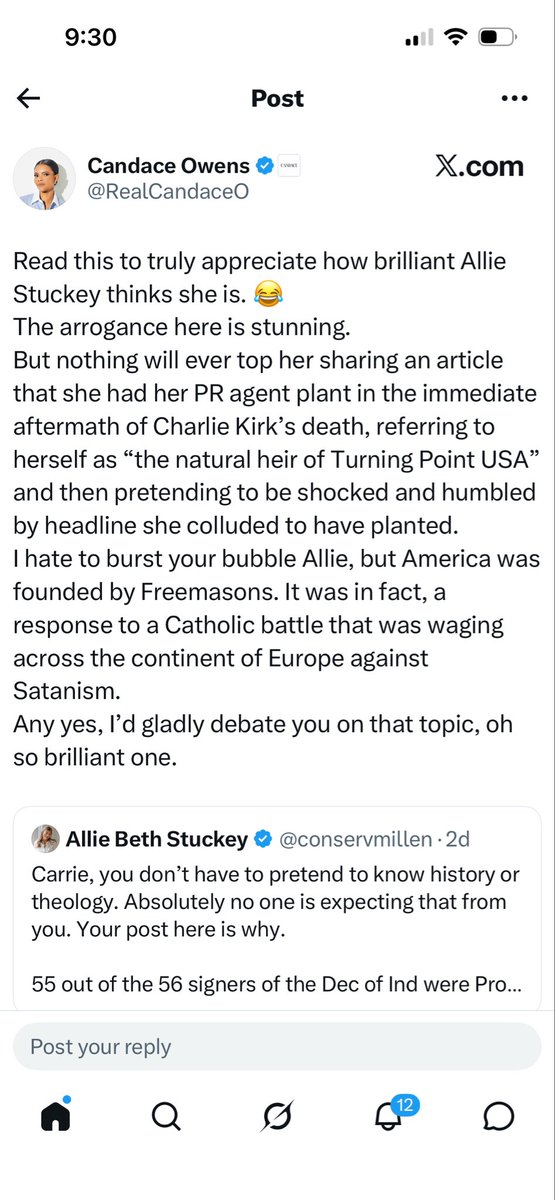
@CarriePrejean1 But according to Candace, America was not rooted in all those things, it was founded by Freemasons according to Candace. So it was not founded by Protestants OR Catholics and all the things you cite are from the Freemasons. Y’all need to get your history straight


![IrrTruth's tweet photo. As one of Dinesh’s apologists, it’s striking that the essence of Soteriology101’s defense amounts to protecting the libertarian free will of the evil perpetrator while the innocent victim is violated. And I’ll quote Dinesh from the debate:
“[Stopping evil assaults/events] would require God to be regularly intervening in the world, on a customary basis, millions of times a day. Because the truth of it is, millions of evil acts occur in the world every day.” (See comments for clip)
👆This position rightly admits man should stop evil acts if he is able, and that failing to do so would be immoral. But God? Apparently there’s simply too much evil to stop, so He omnipresently sits beside each evil act, in dark alleys, bedrooms, and concentration camps, in an odd attempt to preserve the evil perpetrator’s libertarian free will at the expense of the victim’s libertarian free will.
Their very attack on the view of God they hate, a sovereign God with purpose behind everything (“…who works all things according to the counsel of His will” - Eph. 1:11), exposes the very view they love: a sort-of-sovereign God, more like a human king, whose overriding concern seems to be preserving man’s libertarian freedom, even when an evil man uses that freedom to violate the will of his victim.
Their double standard is palpable. The basis of their entire hit piece against Calvinism is that they think it makes God immoral, yet their own stated moral standard condemns God on their own view, in their own words. 🚨
Can those in the back see the central thesis yet? Protect man’s libertarian freedom at all costs.
Oh, and let’s be honest. Soteriology101 misrepresents Calvinism constantly, and its followers even more so. 😀 Bignon distinguished between different senses of causation. Sot101 constantly collapses them into one and applies that single sense to every instance.](https://pbs.twimg.com/media/HR9No0GX0AUcn--.jpg)
![ronhenzel's tweet photo. You might also find it strange, @DineshDSouza (many will surely find it ironic here) that Martin Luther—who championed the Reformation’s key idea that salvation is received by faith alone—preached God’s unconditional election of individuals to salvation years before John Calvin was even a Protestant.
Does this mean that Luther himself attacked the Reformation? That would be strange, wouldn’t it?
And yet, on August 19, 1527, a little over a month after Calvin’s 18th birthday, during the year by which his friends were acquainting him with Luther’s teachings for the first time, Luther preached the following on 1 Peter 1:1:
“St. Peter declares that they are chosen. How? Not by themselves but according to God’s arrangement. For we shall not be able to bring ourselves to heaven or to create faith in ourselves. God will not admit all men to heaven; He will count His own very exactly. Now the human doctrine of free will and of our own powers no longer amounts to anything. Our will is unimportant; God’s will and choosing are decisive.”
— “Sermons on the First Epistle of Peter,” Luther’s Works (LW) 30:6.
Calvin (1509-1564) was a young humanities student at the University of Paris’s Collège de Montaigu when Luther (1483-1546) preached this. He wouldn’t become a Protestant for another five or six years (late 1532 or 1533).
Luther, on the other hand, was still serving as Professor of Theology at the University of Wittenberg and as a preacher at the Wittenberg City Church nearly 10 years after he posted the Ninety-Five Theses, going on 7 years since his clear declaration of justification through faith alone in The Freedom of a Christian, nearly 6½ years after his stand at the Diet of Worms, and coming up to 2 years after he published The Bondage of the Will, in which he referred to,
“…that hidden and awful will of God whereby he ordains by his own counsel which and what sort of persons he wills to be recipients and partakers of his preached and offered mercy. This will is not to be inquired into, but reverently adored, as by far the most awe-inspiring secret of the Divine Majesty, reserved for himself alone and forbidden to us…”
— LW 33:139.
And, of course, The Bondage of the Will was Luther’s contribution to the Luther-Erasmus debate you said you were studying 11 days ago, and as you scored it, “Luther wins on points” (although you said you’d “rather have dinner with Erasmus”).
Your remark here is interesting since The Bondage of the Will is an extended polemic against the notion that the fallen human will can do anything good, which includes having true saving faith, apart from a sovereign act of God’s supernatural grace.
In it, Luther wrote:
“Now take the saying of Christ in John 6[:44]: ‘No one comes to me unless my Father draws him.’ What does this leave to free choice? For he says that everyone needs to hear and learn from the Father himself, and that all must be taught by God. He plainly teaches here, not only that the works and efforts of free choice are fruitless, but that even the message of the gospel itself (which is what this passage is about) is heard in vain unless the Father himself speaks, teaches, and draws inwardly. ‘No one can come,’ he says, ‘no one’; and thus that power by which a man is able to make some endeavor toward Christ, or in other words, toward the things that pertain to salvation, is asserted to be no power at all.”
— LW 33:285-286.
Thus, for Luther the only way a sinner can have true faith in Christ is if God gives it to him, and the only sinners He gives it to are those he’s chosen—the elect, or predestined.
So, is Luther “attacking” his own Reformation? Or is he perhaps just being inconsistent?
Neither, as far as he was concerned.
In fact, he believed he was being eminently consistent because he considered sinful man’s total inability to be the actual heart of the matter concerning salvation, so much so that he was grateful to Erasmus for bringing it into the spotlight by challenging it:
“Moreover, I praise and commend you highly for this also, that unlike all the rest you alone have attacked the real issue, the essence of the matter in dispute, and have not wearied me with irrelevancies about the papacy, purgatory, indulgences, and such like trifles (for trifles they are rather than basic issues), with which almost everyone hitherto has gone hunting for me without success.”
— LW 33:294.
Yes, the same Luther who inspired the adage, “Justification is the article by which the church stands and falls” (though that’s not an exact quote of what he said) also repeatedly declared that the sinner’s inability to believe is an even more fundamental truth:
“You and you alone have seen the question on which everything hinges, and have aimed at the vital spot; for which I sincerely thank you, since I am only too glad to give as much attention to this subject as time and leisure permit.”
— Ibid.
More people probably know that Calvin regarded man’s inability to believe as foundational than know that Luther affirmed the same view.
Fewer probably know that Calvin used the same “hinge” metaphor that Luther uses here for that inability, except to declare the importance of the doctrine of justification by faith alone:
“The theme of justification… is the main hinge on which religion turns…”
— John Calvin, Institutes of the Christian Religion 3.11.1, Battles translation, 1:726.
This is because Calvin wasn’t “attacking” the Reformation any more than Luther was.
He was getting right to the heart of the matter.
Justification by faith alone is vital to true religion because it establishes the means of our right standing before God in Christ.
The self-induced (and therefore totally culpable) Total Inability that results from our Total Depravity is foundational to understanding why God must give us that faith that justifies us in Christ.
It’s tragic how few long-time professing Christians today have even the slightest awareness of this.
🔗: https://t.co/K7LhbMGdxc](https://pbs.twimg.com/media/HRxlNhRaQAAGiIa.png)