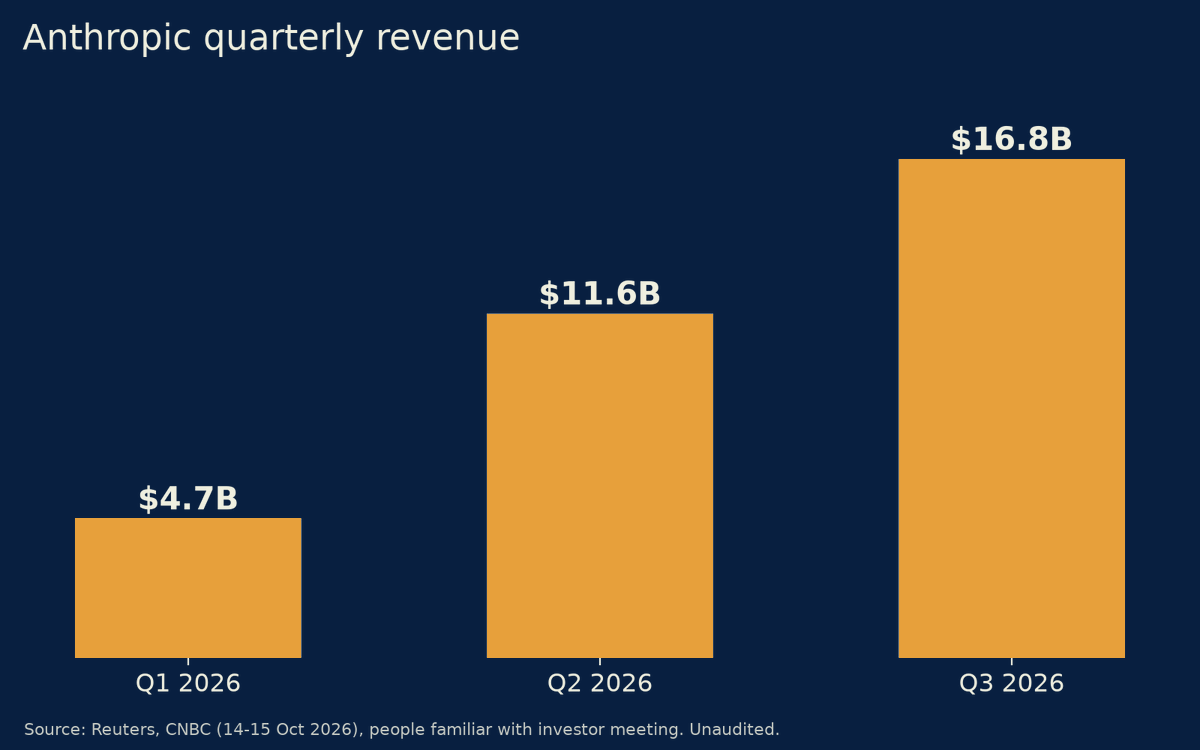
Anthropic told investors on Wednesday that it made $16.8B of revenue in Q3. That's up 45% from $11.6B in Q2.
Total revenue in first 9 months stands at $33 vs full 2025 revenue of $4.6B.
On an adjusted basis, gross margin was 85%, operating margin was above 11%. Free cash flow was positive.
Per the FT, it made $1.70 of revenue for every $1 spent on compute.
Per Reuters expecting $110B annual run rate by year-end. This is very bullish news for entire AI space.
Anthropic has committed at least $518B to compute and cloud over about a decade.
@CKCapitalxx Memory looks so undervalued yet it keep selling. Looks like the selling will exhaust soon. Hopefully soon we get some indication about next year capex.
Everyone's worried about "CoreWeave pays 15% interest." It doesn't.
$35.6B of debt. Only one loan is at 15%: $1.3B left, due 2028, and shrinking every quarter. The bonds pay 8.5- 9.75%. The 15% is the secondary-market yield on the 2031 and 2032 bonds.
So what's the real picture?
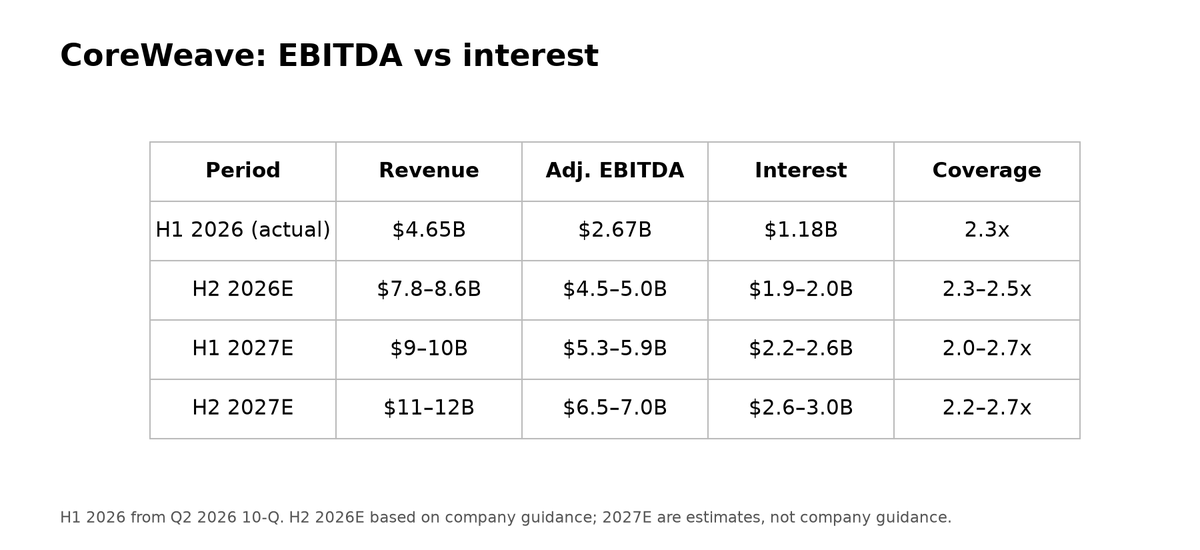
Interest is covered. H1 EBITDA was $2.67B against $1.18B of interest, about 2.3x. Gross margin is around 66%, so renting GPUs makes money. Depreciation and interest are what turn it into a loss. Refer the table for 2027 interest coverage projection.
The real problem is funding the growth. 2026 capex guidance is $35 to 39B. By my math, about $3 to 9B still has to be raised this year. Most of it can come from GPU-backed loans tied to customer contracts, not 15% bonds.
The risks I'd actually watch:
1. Delays. Money is borrowed and spent months before a cluster goes live and starts paying.
2. Customer concentration. Two customers are 62% of revenue.
3. Contracts average about 3 years, some loans run 5. Renewals may come at lower GPU prices.
4. About $3 to 9B still has to be raised this year to fund the buildout.
My read: no near-term solvency issue. $104B of backlog and no big bond maturities until 2030. The real risk isn't demand. It's timing. $CRWV
@michaelsikand Don't see any short term risk. Probably NVIDIA will infuse some more capital if required than sending a wrong signal tom the market. It already owns 11.5% equity. Details on $CRWV debt position: https://t.co/wQgyzUt2oJ
Everyone's worried about "CoreWeave pays 15% interest." It doesn't.
$35.6B of debt. Only one loan is at 15%: $1.3B left, due 2028, and shrinking every quarter. The bonds pay 8.5- 9.75%. The 15% is the secondary-market yield on the 2031 and 2032 bonds.
So what's the real picture?
Interest is covered. H1 EBITDA was $2.67B against $1.18B of interest, about 2.3x. Gross margin is around 66%, so renting GPUs makes money. Depreciation and interest are what turn it into a loss. Refer the table for 2027 interest coverage projection.
The real problem is funding the growth. 2026 capex guidance is $35 to 39B. By my math, about $3 to 9B still has to be raised this year. Most of it can come from GPU-backed loans tied to customer contracts, not 15% bonds.
The risks I'd actually watch:
1. Delays. Money is borrowed and spent months before a cluster goes live and starts paying.
2. Customer concentration. Two customers are 62% of revenue.
3. Contracts average about 3 years, some loans run 5. Renewals may come at lower GPU prices.
4. About $3 to 9B still has to be raised this year to fund the buildout.
My read: no near-term solvency issue. $104B of backlog and no big bond maturities until 2030. The real risk isn't demand. It's timing. $CRWV
Everyone's worried about "CoreWeave pays 15% interest." It doesn't.
$35.6B of debt. Only one loan is at 15%: $1.3B left, due 2028, and shrinking every quarter. The bonds pay 8.5- 9.75%. The 15% is the secondary-market yield on the 2031 and 2032 bonds.
So what's the real picture?
Interest is covered. H1 EBITDA was $2.67B against $1.18B of interest, about 2.3x. Gross margin is around 66%, so renting GPUs makes money. Depreciation and interest are what turn it into a loss. Refer the table for 2027 interest coverage projection.
The real problem is funding the growth. 2026 capex guidance is $35 to 39B. By my math, about $3 to 9B still has to be raised this year. Most of it can come from GPU-backed loans tied to customer contracts, not 15% bonds.
The risks I'd actually watch:
1. Delays. Money is borrowed and spent months before a cluster goes live and starts paying.
2. Customer concentration. Two customers are 62% of revenue.
3. Contracts average about 3 years, some loans run 5. Renewals may come at lower GPU prices.
4. About $3 to 9B still has to be raised this year to fund the buildout.
My read: no near-term solvency issue. $104B of backlog and no big bond maturities until 2030. The real risk isn't demand. It's timing. $CRWV
No doubt it’s a solid long term bet but in short term can see some more pain. Next year eps will be lower than current PE. Also AI spend depreciation will kick in for next few years keeping the EPS stagnant. We may get better entry opportunity but it’s going to 5Tn market cap for sure in a few years.
@ThierryBorgeat Things are different now with freehand to print as much money as they can. If market corrects it will be more like Covid recovery than 2001 like correction
BlackRock's research arm cut US stocks to neutral on Monday.
The posts going around say it's because of AI. That's half right.
It closed a long-held US overweight "to manage potential volatility around the AI buildout."
But inside US stocks it still prefers AI and tech.
Part of the money goes to Treasuries, mostly short-dated.
The 10-year yield is up 110 bps this year, to about 5.3%.
It blames part of the jump in real rates on "intensifying competition for capital."
It still favors AI-related companies and listed infrastructure, citing scarcity in critical infrastructure.
Sept CPI came in hotter than expected.
Headline: 3.7% YoY vs 3.6% expected
Core: +0.3% MoM vs 0.2%, 2.6% YoY
My read: a hold is still the base case. One hot core print rarely forces a hike two weeks out. But the market is now taking a hike seriously.
$ASML reported a record Q3 earnings.
Sales: $13.2 billion (€11.7 billion), in line with consensus. Up 56% year on year and 25% quarter on quarter.
Earnings per share: $14.60 (€12.95) vs $12.13 (€10.58) consensus, a 22% beat.
Gross margin 57.5%, above its own guidance.
Q4 guidance: sales of $16.0 to $17.2 billion (€14.2 to 15.2 billion), above the $15.85 billion consensus. Full year 2026 is now €44 to 45 billion.
The big line: ASML says its planned supply for 2027 and 2028 won't meet customer demand, and it's looking at adding capacity beyond the 30% increase already planned.
Foreigners dumped 4.53T won of Korean stocks yesterday. Biggest single day since July.
And 3.72T of it was two stocks SK hynix and Samsung.
Over the last 15 sessions they've sold 24T won. The won appreciating from 1,530 to 1,345 per dollar since June, it further incentivises foreign investors to take profit.
So who's buying all that?
Mostly the companies themselves. Buybacks soaked up roughly 19T. Retail added 2.9T, local institutions 1.7T.
Samsung's buyback ended Oct 6, however the retail buyers are coming back which is a good sign.
Nothing in the numbers broke. Samsung just reported a record 107T won quarterly profit. Memory supply is moving onto 3 to 5 year contracts. That cash funds the next round of buybacks.
SK hynix reports Oct 27. With buyback resuming from SK Hynix and Samsung and momentum from retail investors, we may see the market recover in coming days.
The S&P 500 is 0.2% from its record high.
But 78% of the stocks in it are at least 10% below their own highs, and 41% are down more than 30%.
A handful of giant companies are holding up the index while most of the market is in a correction.
This is not particularly negative rather this is how the US economy is moving. It's the tech that is growing and not the rest of the economy.
Broadcom's CEO just did the simplest math on AI I've seen.
He estimates the world spends about $200 billion a year running AI models and gets about $150 billion back in revenue.
His per-gigawatt version is more interesting. Anthropic makes about $30 billion a year per gigawatt of computing. That gigawatt costs about $10 billion a year in chips and data centers, so the model maker keeps the other $20 billion.
The money is moving up to the model makers, not down to the hardware.
@ParadisLabs Semis market is too fragile and trading mostly on sentiments after the big run up over the months. I think next trigger would be capex visibility for next year which will give confirmations in earnings expectations.