Good fits: guardrails before tool calls, support triage, retrieval filtering, moderation, tool selection.
Best of both: run SnapJudge first, send only low-confidence cases to a bigger model.
Apple silicon, Python, MIT. Feedback welcome!
Most "decisions" in an AI app aren't generation: route this ticket, block this tool call, is this passage relevant?
I built SnapJudge to answer those on-device: calibrated probabilities in ~0.3 s on a Mac, no API call.
Open source, MIT 🧵
https://t.co/9PwzG2UhXJ
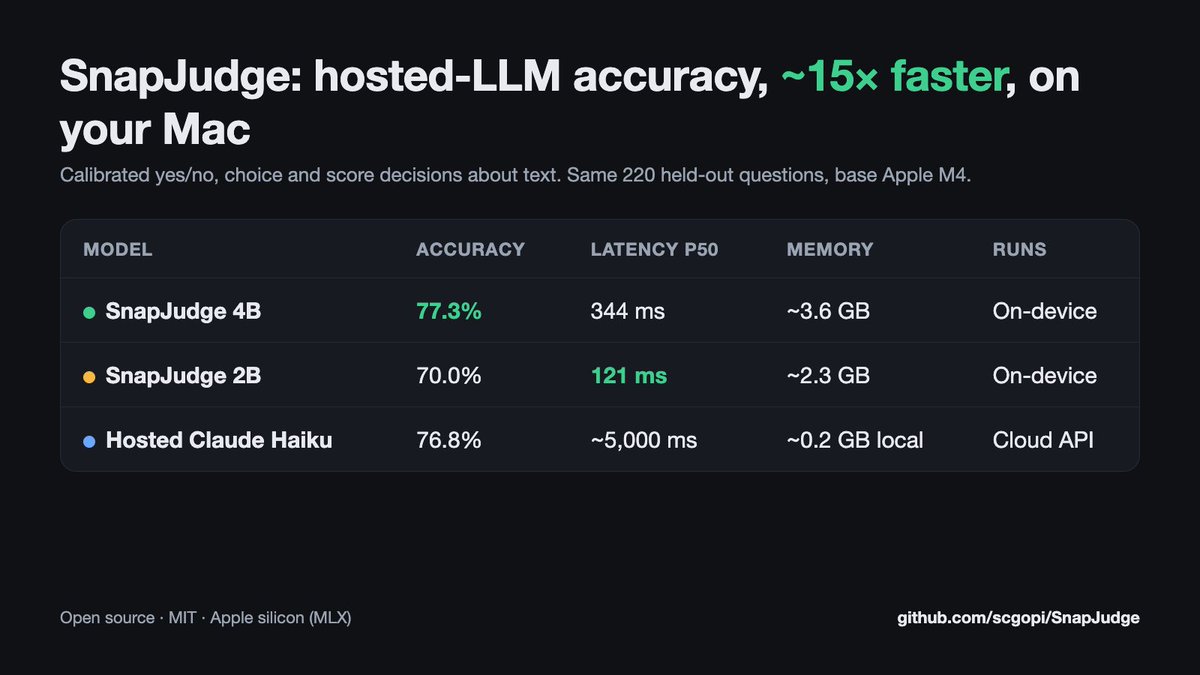
Same 220 held-out questions, base M4:
🟢 SnapJudge 4B: 77.3%, 344 ms
⚡ SnapJudge 2B: 70.0%, 121 ms
☁️ Hosted Claude Haiku: 76.8%, ~5 s
Local matched hosted accuracy at ~15× the speed. The hosted model still wins on fine-grained ratings.
@DanielSmidstrup You can continue using harness of Codex and Claude Code. Yet you can communicate with these two harnesses efficiently using https://t.co/slQBoWKUEZ
Codex can ask review the work from claude, opencode or pi. Same can be done the other way as well
GraphCode now supports Pi (@pidotdev) as a fifth agent.
Put Pi loops on the same graph as Claude Code, Codex, Copilot CLI and OpenCode, and hand work between them. Pi loops show live status in the sidebar and resume their conversation after a restart. @badlogicgames
@AL3D1N@DanKornas In GraphCode, every node can talk every other node, not just children or to parent. Even the nodes from remote machine like codespaces. Apart from talking they also exchange emails, and the nodes can be from any provider like Claude,codex,opencode or copilot. Give a try
@freedomcabbage@DanKornas@grok As a GraphCode creator, I can answer this. This app supports Claude, Codex, Copilot and OpenCode. Pi and Hermes coming soon
As a GraphCode creator I can answer this. With GraphCode, there are couple of options.
- We can create one node as an orchestrator and create child nodes and as the orchestrator to monitor them.
- GraphCode also has a concept of the Mailroom, where the nodes can exchange regular emails, the one node can be deleted when drifting.
Running several coding-agent tasks shouldn’t mean losing the ability to steer them.
GraphCode is a macOS app, daemon, and CLI for organizing connected Claude Code sessions as a graph of live terminal-based loops.
It helps you coordinate work across agent sessions while staying able to attach, review, and correct them, using graph nodes for tasks and edges for hand-offs, messages, or spawns.
Key features:
• Four loop types – choose turn-based, goal-based, time-based, or composite loops for different ways of handing off work
• Live terminal sessions – each node is a real CLI coding-agent session rather than a headless job
• Graph-based hand-offs – connect loops with hand-off, message, or spawn edges, including conditions and cycle guards
• Persistent sessions – zmx-backed terminals can survive quitting the app and rebooting, then resume their conversations
• UI and CLI access – use the graph canvas and terminal workspace or the `graphcode` CLI for the same daemon
Public GitHub repo. The app and daemon use FSL-1.1-MIT; GraphcodeKit and graphcode-cli are MIT.
Link in the reply 👇
@Steve_Yegge https://t.co/slQBoWKUEZ simplifies these terminals closer to how human brain thinks in their mind splitting folders etc. We work with graph of terminals (It could be codex/claude/opencode/copilot) and they all can talk each other through mailrooms or through 1:1 communication.