Arize began with the mission to make the world’s AI work.
Today, we’re excited to share that we have signed a definitive agreement for Dynatrace to acquire Arize to help accelerate our mission.
The two worlds of AI and software observability are coming together to create this next chapter.
Arize exists because of the trust of our users, contributors, and community. Thank you for trusting us with your most important AI systems and building this category with us. You make our products better everyday.
Read more from Jason in: https://t.co/q0i3zicBhW
Jason and I started Arize 6+ years ago with a simple proposition that headlined our seed deck:
“We Make the World's AI Work”
Today we are announcing we’ve entered into a definitive agreement to be acquired by Dynatrace to accelerate that vision.
We made a bet years ago that the explosion of AI would require bespoke infra tools. We knew AI systems weren’t going to behave like traditional software because we were building the next generation of intelligence. That bet became the market's first AI Observability platform.
Fast forward to 2026. The world has changed dramatically. Every company in the world is scaling up its use of agents. AI is everywhere and agents are reshaping business after business.
What wasn’t clear years ago and is crystal clear today is that agent systems and software are deeply connected together in ways that none of us fathomed.
- The best general agents are coding agents.
- Skills and tools for agents are mixtures of prompts and code.
- Prompts that control agents live in code repos.
- The logs and traces used to debug your software also help you debug your AI systems.
- The path to AGI is likely through coding agents.
The two worlds of AI and software observability are coming together to create the future of observability.
Lots more to share in the coming days, but I wanted to thank folks who made this possible:
To the Arize team - startups are about the people you build with, and I’ve never met a better group of humble rockstars. The markets changed, our product evolved, but the camaraderie of the team through this journey is what I’m really proud of.
To Jason, being in the trenches with you for the past 6 years has been the journey of a lifetime. You’re a visionary, and the best entrepreneur I know. Everything I know about entrepreneurship comes from watching you execute day in and day out - you always figured it out. Arize wouldn’t be Arize without you.
To our customers, thank you for trusting us and building this category with us. You made the product better everyday, and inspired us with the products you’re building.
To the open source community around Phoenix and OpenInference, developer trust and open standards are the foundation this category gets built on.
And to our investors, advisors, and early believers who backed us when AI observability was not a budget line or even a real category yet, thank you.
Onwards to the next chapter! https://t.co/OBZSsnX8pu
Over the past 6 months we've maniacally prepped our repos to be coding agent friendly. Here are some things that worked.
1. Make CI blazing fast. Use every Rust, Zig, or Go ported tool that lets agents verify their work. This means UV, oxfmt, Typescript 7. Move integration tests to post merge hooks.
2. Trigger coding agents automatically based on triage labels. A coding agent should setup a proof of concept or repro steps automatically so an engineer can pick up the issue seamlessly.
3. Setup crons for things devs hate doing. Setup agents to fill SDK gaps, skill tuning, filling in critical regression checks.
4. Give agents ways to prove their work. Add screenshotting skills, agent-browswer, cloud storage for storing assets.
5. Make it possible to hermetically deploy your app, preferably multiple at a time. If a coding agent can deploy the app locally, the faster it can work.
6. Give the agents realistic production "simulation" data. Agents will work much better when they are working against data that looks like how your users use the product.
AI Engineer World’s Fair by day. World Cup watch party by night. ⚽️
Join us Wednesday, July 1 for our AIE afterparty: arcade games, swag, food, drinks, and the Team USA World Cup game on the big screens.
Spots are limited, RSVP before it fills up: https://t.co/mRhEwstGKy
Up next we have our Product Manager Fuad @tofuadmiral on how to use Arize skills and build self-learning loops for agents (hot topic alert!)
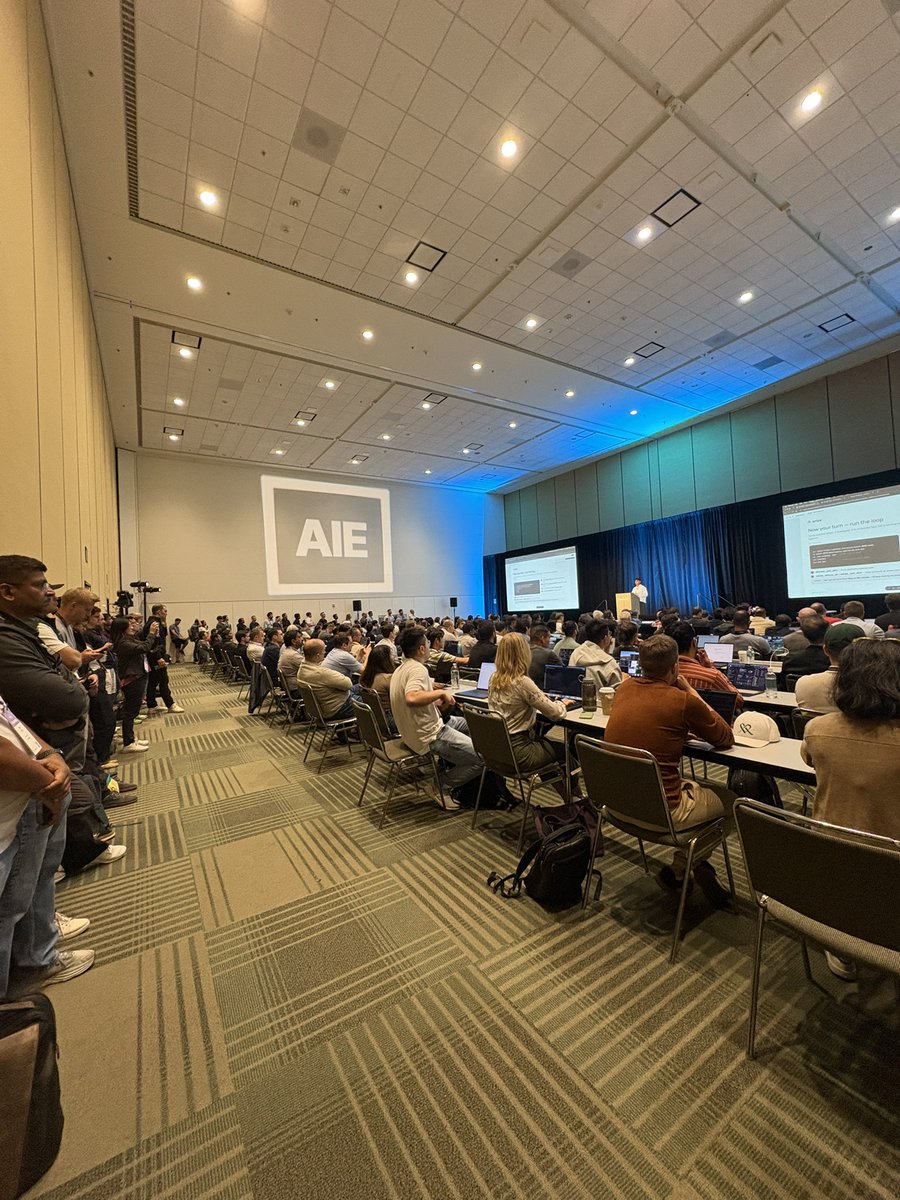
Yet another full house workshop in Room 2010 🚀
What if all your traces look healthy but your agent is failing silently?
@dat_attacked walked us through how we used Signal to debug our own AI engineering agent, Alyx.
Signal identified that empty returned strings were putting the agent into a loop, grouped the traces where the issue occurred as evidence, proposed a fix, and opened a PR that was merged.
That’s what a self-improving agent loop looks like in practice.
Next up: Fuad @tofuadmiral at Expo Stage 2 on how to evaluate voice agents. Catch it live.
Our co-founder and CEO @jason_lopatecki walked through the full anatomy of a self-improving agent: event evidence (traces and evals), context and skills, and a trigger to decide when it runs.
Coding agents are now the ones consuming telemetry data, identifying issues, and opening the PRs to fix them.
That’s the shift we built Signal for.
Evals - Room 2005 was packed ‼️
Come early to grab a seat for the upcoming sessions.
Our co-founder & CPO @aparnadhinak talked about the future of evals on the @aiDotEngineer MainStage keynote!
As agents get more complex, the eval method we use should also be adaptive and dynamic: the eval we need is switching from LLM-as-a-judge to agent-as-a-judge.
Come to the Evals Track - Room 2005 for more!
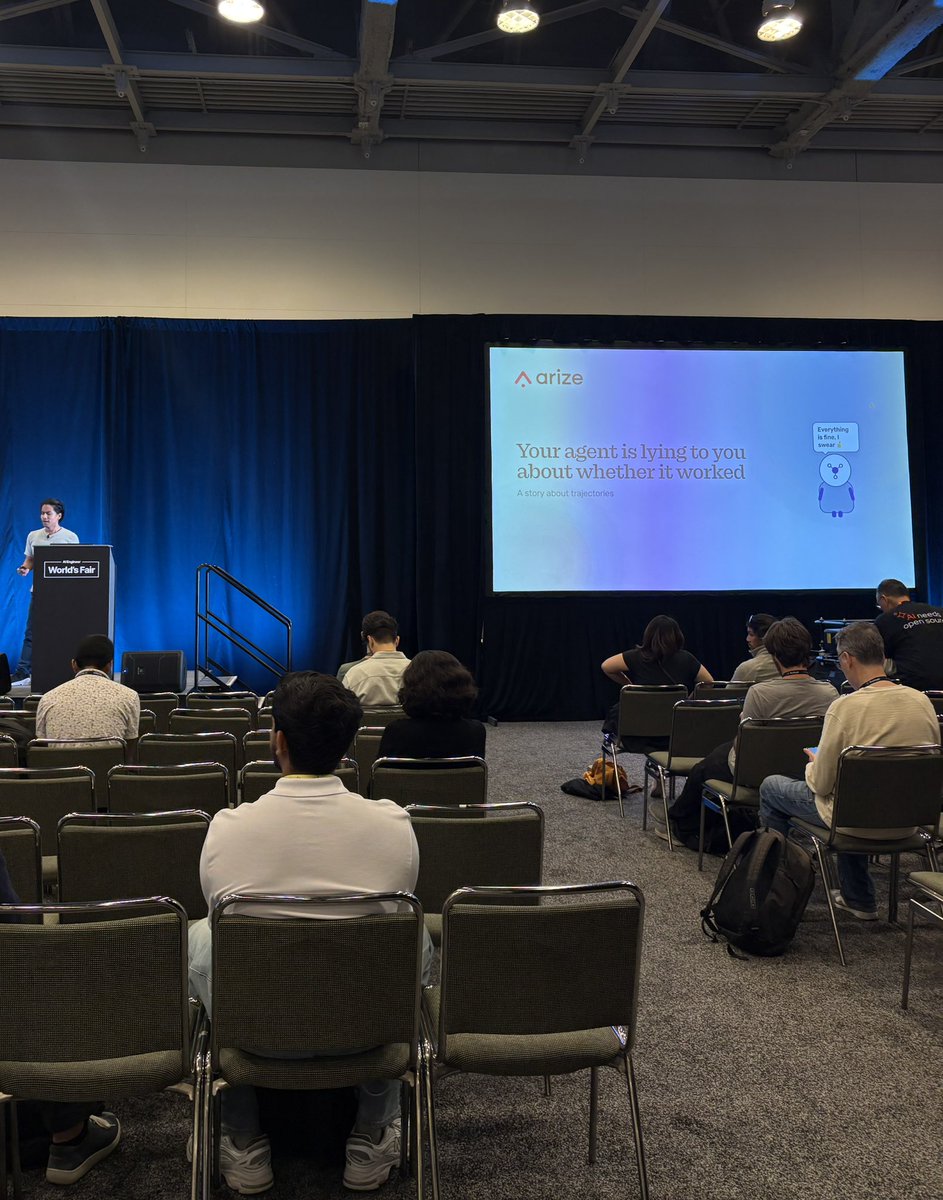
Laurie @seldo just kicked off @aiDotEngineer for Arize with Workshop 101: From vibes to production: evaluating and shipping Al agents that work.
Room is at capacity! Workshop 202 is at 2:20-4:20 Room 2010. Come early if you want to grab a seat 🙃
We just released a new Prompt Tutorial for Arize AX: create, test, and optimize prompts with real data and evaluation.
It's easy to tweak a prompt until it "feels" better without knowing if it actually improved.
This tutorial walks you through a repeatable create → test → optimize workflow:
💻 Create: System and user message templates, variables, save to Prompt Hub with versioning
🧪 Test: Run on a dataset, add LLM-as-a-Judge evaluators, see how it performs
📈 Optimize: Improve from evaluation feedback, compare versions, validate before production
If you're building with LLMs and want a clear path from first prompt to production, this tutorial covers the full workflow in Arize AX.
Get started below ⬇️
https://t.co/NmzUu7ahtr
We just released a new Tracing tutorial for Arize AX: a practical walkthrough for instrumenting, inspecting, and evaluating your AI applications with end-to-end traces.
If you’re building agents/LLM apps, it’s hard to improve what you can’t see. This tutorial shows how to go from those black-box outputs to fully traceable, debuggable workflows. It covers:
🔍 Sending your first traces: Instrument your application and start capturing spans, inputs, outputs, and metadata in just a few steps
🧵 Understanding trace structure: Break down agents into spans for models, tools, retrieval, and custom logic so you can see exactly what happened
📝 Adding annotations & evaluations: Layer in human feedback, code-based checks, or LLM evaluators directly on traces
🔄 Analyzing sessions end-to-end: Group traces into sessions to debug multi-step interactions and user journeys
Get started below ⬇️
Phoenix 13.0
Phoenix 13 is a major release centered around Dataset Evaluators, a new system that turns your datasets into reusable evaluation suites. This release also introduces custom model providers, OpenAI Responses API support, and dozens of Playground and experiment UX improvements.
In our latest Evals Series webinar, we shared an Evaluation 101 primer for teams building agents.
We covered the full eval workflow: starting from real data, defining specific + actionable metrics, and using LLM-as-a-Judge thoughtfully (prompt design, model selection, tradeoffs).
We wrapped with a live Arize AX walkthrough — building an evaluator and running it against real trace data to show how evals plug directly into agent reliability workflows.
Watch the recording here:
https://t.co/PpbUXYZbd8