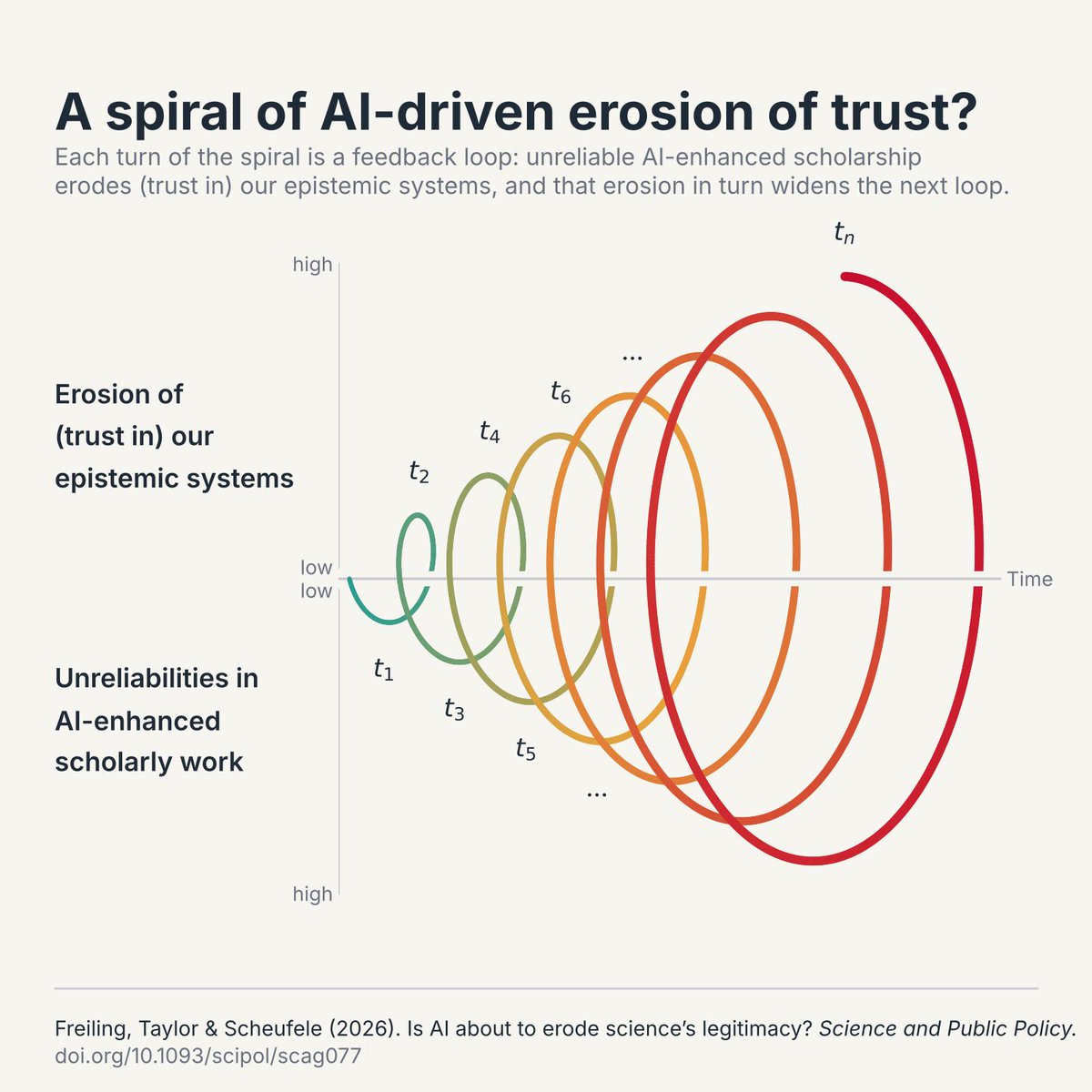
Flawed #AI-enhanced research is, at this very moment, training the next generation of LLMs. And the compounding effects may have us spiraling toward science that the public rightfully mistrusts. Our latest, led by @Isa_Freiling.
https://t.co/0d1OPrtvGJ
#scipol#replicability
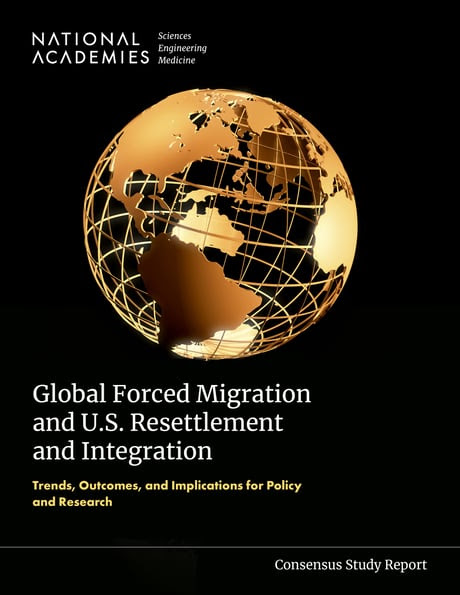
"[R]efugees demonstrate sustained socioeconomic integration, with employment rates and hours worked eventually reaching or exceeding those of comparable U.S.-born people."
Migration and integration as empirical rather than ideological questions. Glad to have played a very small part in preparing this important @NASciences consensus study.
https://t.co/2gnpLC1Wyo
#immigation #forced #migration #integration #refugees
As a woman in science, the ripple effect of cases like this sets us backwards.
It’s already hard enough to be heard. When a jury awards $6M for defamation and tortious interference after years of career destruction, the rational response from men is quiet avoidance: fewer mentorships, fewer close collaborations, fewer opportunities extended to women.
That chill shrinks the network and visibility women still need.
SHAME ON @MIT. They treated the allegations as career-ending for @DMSabatini before a jury ever examined them — yet Knouse remains on faculty after the verdict found she defamed him and interfered with his work. Thank you @SciGuardians for exposing the truth.
"The many billions being poured into #AI by Big Tech, combined with escalating national security concerns in both East and West, have decisively shifted the momentum of AI development into the hands of the most ambitious and least cautious."
Important essay by @NoemaMag's Nathan Gardels.
https://t.co/K5Iag08FnJ
Bizarre to me how much of this discussion has centered on the personal injury to Sabatini (tbf: the actual topic of the suit he won) rather than the revelation that a professor maliciously destroyed the career of another, that she lied and withheld relevant information, and that the net result of these revelations is not only that MIT apparently ran a kangaroo court but that it has no interest in restoring a reputation it harmed, in punishing sociopaths on the faculty, or even in re-allowing a gifted and extraordinarily productive scientist to continue his work. This has much deeper implications about publicly funded science than a simple episode of workplace drama.
45 alumni of @DMSabatini's lab at @MIT@WhiteheadInst signed this 4/22 open letter repudiating the smear campaign against him. That witch hunt was so intense these accomplished people had to sign anonymously — and many more were too fearful even for that.
https://t.co/w3l4pNYHGU
Google published a paper that might end the PhD.
It’s called “ScientistTwo”
For centuries, the bottleneck to human knowledge has been the human brain.
It takes five years of grueling labor to read the literature, find a gap, formulate a hypothesis, run the experiments, and write the paper.
But, Google automated the entire pipeline.
They built an AI that reads a problem, forms hypotheses, runs experiments, writes the paper, AND simulates its own peer review. no human touches it.
It reads millions of papers to find blind spots in the current science.
It generates novel hypotheses.
It designs the experiments. It writes the code to test them.
When the code fails, it debugs itself.
When the results come in, it analyzes the data, generates the charts, and writes the final academic paper.
It even simulates a brutal peer-review process to critique and improve its own work before it considers the project finished.
This isn't an LLM summarizing a PDF. This is a fully autonomous digital scientist.
What takes a human candidate half a decade of massive intellectual effort... the AI accomplishes in a fraction of the time, at a fraction of the cost.
The implications are staggering.
If you can spin up 10,000 autonomous researchers overnight, the rate of scientific discovery is about to go vertical. We are moving from artisanal, human-speed research to industrialized knowledge creation.
But it raises an uncomfortable reality for academia.
When an AI can read the literature, design the experiment, execute the code, and write the paper...
What exactly is the human supposed to do?
Genetically-enhanced dogs for U.S. warfare?
“Warhound is modernizing America's working-dog program by delivering a vertically integrated program, combining @colossal 's enhanced genetics platform and secure biobanking capabilities of America's top-performing dog arsenal, controlled delivery through cloning with best-in-class training and animal care.”
https://t.co/FhcvTJCuZY
Let’s call it like it is. The evidence that was not available was available. The investigator simply ignored one of the most basic rules of inquiry— demand disclosure of the full record rather than letting a complainant select what will be disclosed. If that basic rule had been followed, all of the emails would have been available. If Knouse refused to disclose them, an adverse inference would naturally arise.
Scientific research has an artificial intelligence problem, and it goes well beyond AI-assisted writing.
Generative AI can now produce convincing scientific images, fabricate experimental datasets and invent academic references, making fraudulent research more difficult to identify and raising questions about the reliability of published findings.
A study published in Scientometrics in October 2026 estimated that the proportion of research papers containing AI-assisted writing rose from 9.8% in 2024 to 23.5% in 2025. While such assistance does not itself constitute misconduct, the technology's capacity to manufacture scientific evidence presents a far more serious challenge.
The problem is compounded by longstanding pressures within academia. Researchers are rewarded for publishing frequently, while commercial publishers can benefit financially from accepting more manuscripts.
Meanwhile, scientific journals are turning to AI-powered screening tools to detect manipulation and support peer review, creating a technological contest between increasingly sophisticated fabrication and detection.
Through interviews with research-integrity investigators Ivan Oransky, Elisabeth Bik and Michal Wojcik, The Beiruter examines how AI is amplifying existing vulnerabilities in scientific publishing.
Can scientific institutions protect the credibility of research without confronting the incentives that made the system vulnerable in the first place?
Read the full article by Katharine Sorensen below.
#TheBeiruter #AI #ScientificFraud #ResearchIntegrity #AcademicPublishing #Science #ArtificialIntelligence
https://t.co/RJbMrx5j9d
"[R]educing science communication to curing what the scientific community identifies as public pathologies ... might short-circuit the kinds of societal debates that are needed to align the scientific development of technologies like AI or human genome editing with the values and policy preferences of the publics they will affect."
Everyone denounces knowledge deficit thinking, but it has remained the default model for paternalistic #scicomm, driven by scientists' own ideological and policy preferences. Grateful to @tpn1818 and @DeclanFahy10 for including my thoughts in their latest book:
https://t.co/owFjUdm3CD
Scientists from across the globe are calling on MIT to review its decision to terminate the tenure of David Sabatini after a jury verdict vindicated the ousted scientist and rebuked #MeToo era claims from a former colleague. https://t.co/Wmiin11Atp
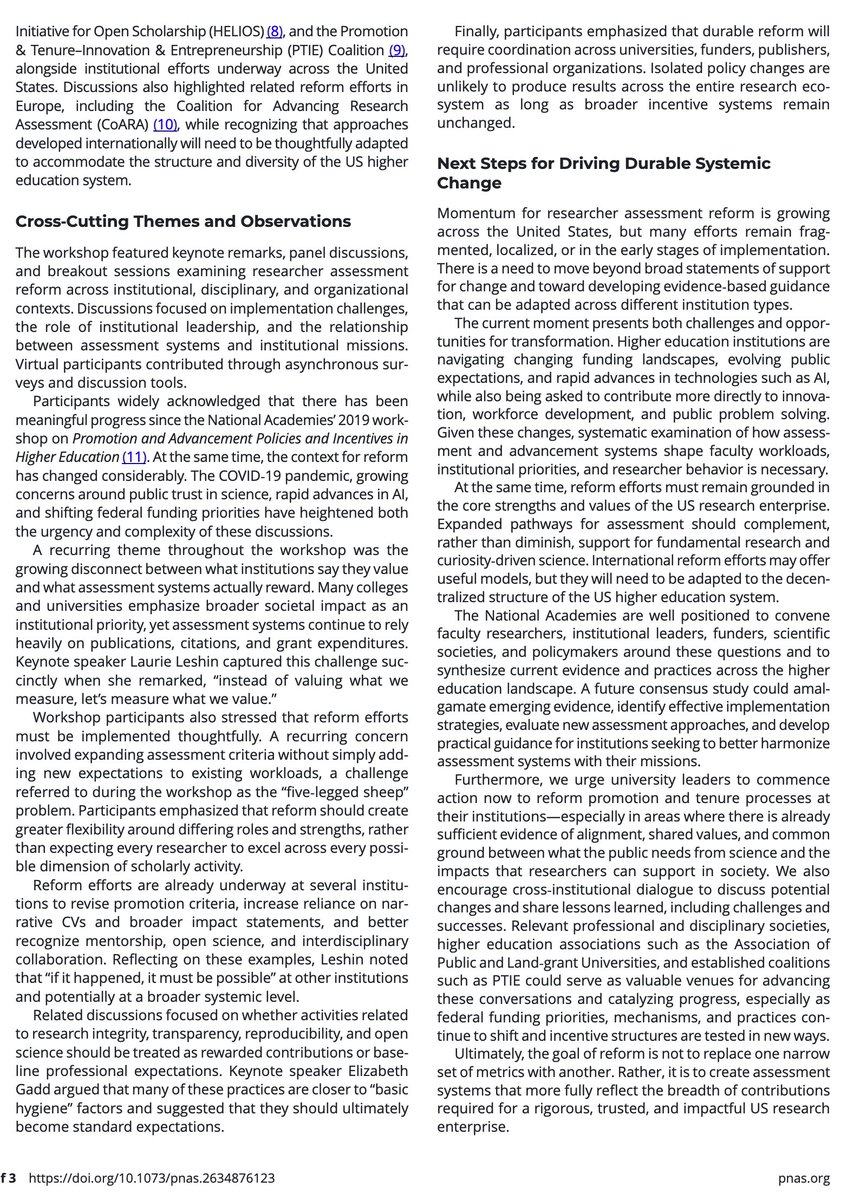
We need a holistic reform of researcher assessment and incentives at academic institutions
There is a growing disconnect between what institutions say they value and what assessment systems actually reward. Many colleges and universities emphasize broader societal impact as an institutional priority, yet assessment systems continue to rely heavily on publications, citations, and grant expenditures.
“instead of valuing what we measure, let’s measure what we value.”
Reform efforts are already underway at several institutions to revise promotion criteria, increase reliance on narrative CVs and broader impact statements, and better recognize mentorship, open science, and interdisciplinary collaboration.
We need this at a broader systemic level. Creating a better academic and scientific culture should be part of our evaluation.
https://t.co/MZRJdkXtbL
Unfortunately, hallucinations still are. Also should science consider 1% AI-inflicted error rates (on top of all other errors) acceptable? Interesting mixture of #metascience and #riskcomm questions.
As we’ve said in writing so many times, we’re building bodies of non-replicable research and journals are in an arms race over who can publish most of it. Science is gambling with its most valuable currency and will lose its second must valuable currency in the process: public trust.
#openscience #ai #replicability #reproducibility #trust
How long does a finding about LLMs stay true?
We re-tested 50 widely cited findings about LLM behavior (various biases, hallucination, etc). Within 15 months, most no longer held or had substantially reduced effects.
LLM findings has short shelf life https://t.co/MUWm6INyX8
Great job by @oq_35!
"The results are disturbing. Across the four analytical decisions, experts chose the AI’s preferred option 86% of the time. Afterwards, half of the experts rated the final recommendation as more their own than the AI’s, and only 15% mentioned the AI in any explanation."
#AI #science #metascience #replicability
https://t.co/0Gb7ixOwP6
Neither @Google nor @Grok did any election denying for me. This is a perfect example of either hyper-targeted AI search results or inconsistent information curation by platform providers, even over the course of a few hours. The fact that our alarm bells, as scientists, are not going off for AI-based scholarship using the exact some frontier models, claiming replicability and reproducibility, is deeply troubling.
#openscience #AI #trust #highered