ONLINE FIRST & OPEN ACCESS! How did perceptions of elite manipulation influence resistance to COVID-19 reporting and the spread of misinformation? This study by @marlis_st, @Isa_Freiling, and Jörg Matthes examines how audiences in 🇦🇹 resist news evidence.
https://t.co/wjnvJXW9C3
Please consider helping the Comm Theory and Methodology division by signing up as a reviewer for #AEJMC25! We need you :) To sign up, please
(1) fill out this survey: https://t.co/I0OMhWXOSy and
(2) create an account on AllAcademic: https://t.co/rLjr2zJnbe
Please consider helping the Comm Theory and Methodology division by signing up as a reviewer for #AEJMC25! We need you :) To sign up, please
(1) fill out this survey: https://t.co/I0OMhWXOSy and
(2) create an account on AllAcademic: https://t.co/rLjr2zJnbe
Isabelle Freiling, one of the inaugural cohort of One-U Responsible AI faculty, is working to understand the black box of algorithm-driven information environments and the ripple effect of implications for researchers and the broader public. https://t.co/VQsC6ZhVfM @Isa_Freiling
This week,@UofUComm Assistant Professor @Isa_Freiling will be presenting on "Generative AI, Social Media Algorithms & Misinformation" at LSC's #scicomm Colloquium.
Join us in person or follow along on X at #UWLSC700
Learn more at: https://t.co/jT9mM904Xn
Our inability to meaningfully study algorithmic info ecosystems, and why it matters for #scicomm. Pre-publication version of our forthcoming PNAS piece with Nicky Krause and Isabelle Freiling : https://t.co/BqeM1I07oC (a 🧵)
Honored to receive this fellowship and so excited to work more on responsible AI across @UUtah campus!
This allows me to fund a graduate student next year, so if you are considering #gradschool and interested in #AI and #scicomm, please apply: https://t.co/YEBpGNP3bq
"The scientific community must also better recognize that it may not be helpful to emphasize consensus in policy reports’ recommendations when the underlying values are not universally shared." Could not agree more with @theNASciences's @Marcia4Science.
https://t.co/x0Kd6cUa6O
As @meta studies in @ScienceMagazine and @Nature come under increasing scrutiny, it's worth asking two questions posed by Holden Thorpe in 2022: “whether the data in a paper is reliable or not ... [and] who has been responsible for generating that data." https://t.co/EvRb6oBw2S
It’s bad for various fields of social science who — during an ongoing replicability debate — should have learned by now to not trust suspiciously shiny findings from a single data source, especially one curated by an industry partner with obvious COIs. https://t.co/ktqz03D1dw
It’s bad for the journals who published this in spite of referees pointing out this very problem during peer review, and are not retracting, as of now. https://t.co/nyg5ijoLHS
63 algorithmic interventions designed to make #Facebook temporarily provide less polarizing and more reliable content likely distorted the data sets that @Meta fed to academic researchers and helped get publish with Meta employees as co-authors. https://t.co/XTmEIGrvZk
"[A] baby step forward in the direction of data transparency." Amid pushback against industry-controlled settings for studying algorithmically-curated information environments , @meta is trying to do damage control. Great piece by @TheAtlantic's @mimbsy. https://t.co/22HOqjcRxN
In Tech in Society, I argue w/ J. Matthes for a narrower definition of citizen social science to avoid overlap w/ commonly used #socialscience methods: The inclusion of volunteers needs to go beyond merely collecting data. #citizenscience@youcountproject
https://t.co/fz1w1xCvdH
Most importantly, we need to evaluate metrics and interventions empirically with reliable social science. Otherwise, we’ll just “pied-piper” academia toward the next iteration of dysfunctional #openscience tools, as our paper led by @Isa_Freiling outlines: https://t.co/8fnNhFtxjH
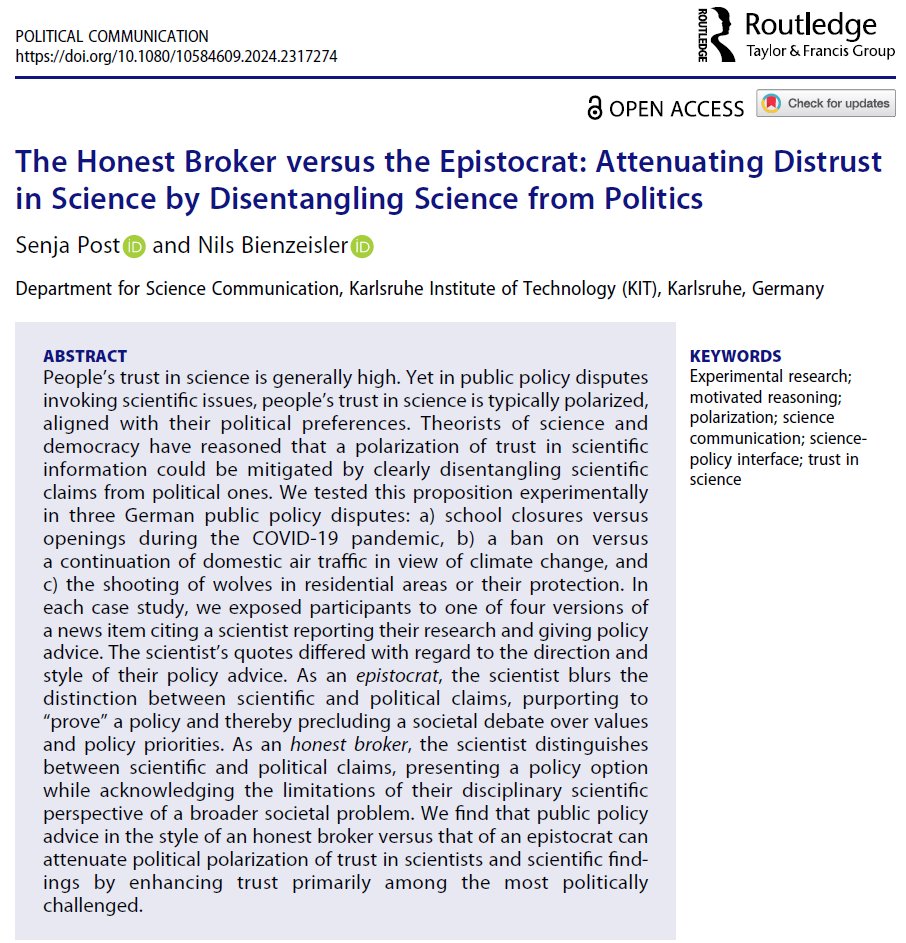
New study with @NilsTokolosh. Based on experiments in three controversies, we show that an attitudinal polarization of trust in science can be mitigated when scientists adopt the styles of honest brokers versus that of epistocrats when giving public policy advice, i.e.... (1/2).
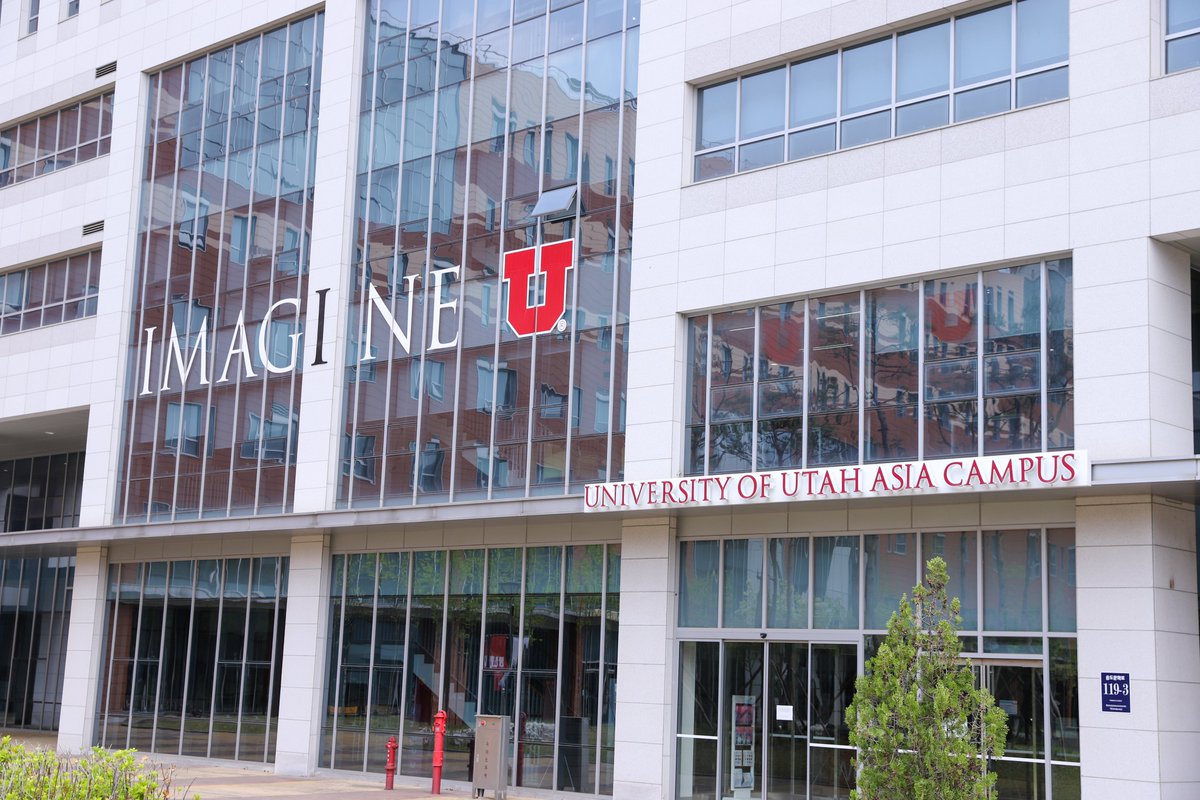
The University of Utah is excited to announce the extension of the Master of Communication program at its U Asia Campus in Incheon, South Korea. Applications are now open for the professional program. https://t.co/wNmFtUbVjd