Really enjoying this double conference IGES and ASHG trip so far! Come to poster 8006 at 2.30 to hear about how where we carry fat tissue influences our risk of cancer! #ASHG2024
We are re-advertising for an exciting 3-yr postdoc post at @imperialcollege using molecular #epidemiology to understand adiposity-driven pancreatic #cancer. Competitive salary and hybrid working options. Deadline 4/11. Email if interested!
Pls retweet🙏https://t.co/a9lkof1DX3
Interested in combining genetic epidemiology with other methods to identify modifiable causes of disease? If so a research fellow post with @mrc_ieu with @explodecomputer and me now available https://t.co/72Eijz9HxP
We have an exciting 3-yr postdoc position at @imperialcollege using molecular #epidemiology to understand adiposity-driven pancreatic #cancer. Possibility of hybrid working. Deadline 24/07 @Mattias31@r_martin_ @Karl_SmithByrne @EmmaEVincent Pls retweet🙏
https://t.co/GXUhF1j6Rm
1/4 Excited to share our latest preprint where we used observational and Mendelian randomization methods to explore the role of metabolites as intermediates between adiposity and endometrial cancer using data from UK Biobank (@uk_biobank). https://t.co/k6WLXYga5I
We are seeking a mol/genetic epidemiologist or bioinformatician to work at @mrc_ieu in Bristol, UK. Please get in touch if you are interested! #datascience#Bioinformatics https://t.co/AtOfP60MmP
Really pleased to see our paper published in @eBioMedicine this week. We found that weight loss in people recently diagnosed with type 2 diabetes altered levels of cancer-related proteins in blood🩸.
https://t.co/HBXwcHq1AY
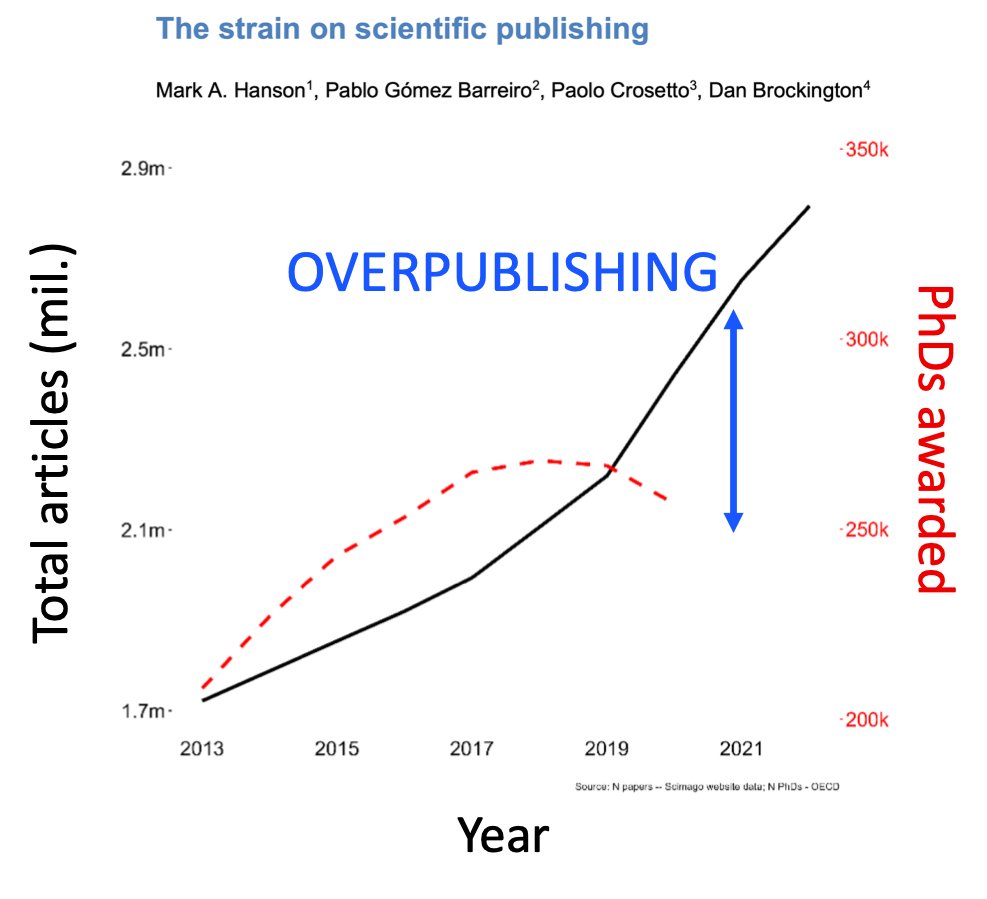
Overpublishing puts enormous stress on students and PIs.
And brings tons of money to publishers in STEM.
A new study shows that the number of papers is increasing FASTER than the number of #PhD graduates.
It’s an amazing work with very useful statistics. Huge kudos to the authors!
▫️
Main outcomes:
1️⃣ In 2022 the number of articles is 47% higher than in 2016. The amount of writing, reviewing and editing workload per scientist is increased enormously.
2️⃣ “Special issues” is a strategy for publishing lots of papers with reduced review time. This is possible due to the “publish or perish” pressure and clearly benefits the publishers.
3️⃣ The publishing time varies widely!
MDPI = 37 days. Frontiers = 72 days. Elsevier = 134 days. Springer = 157 days. Nature = 185 days.
4️⃣ The article rejection rates do not seem to correlate with publisher growth. However, rejection rates decline with increased use of special issue publishing.
5️⃣ Certain for-profit gold-open-access publishers create an increasing number of special issues, with uniquely reduced turnaround times, and in specific cases, high impact inflation and reduced rejection rates.
6️⃣ The authors suggest a new metric - Impact Inflation, which is reflected in self-citation within the same journal. For example, MDPI has a high impact inflation due to excessive self-citation compared to other publishers.
Conclusions and my opinion:
- Scientists have to spend a lot more time on reviewing and writing than before (on average).
- The more papers are published, the more the quality is compromised.
- Scientific progress has become partially bound to the business models of publishers and their revenue (a sad reality today).
- There is a huge lack of transparency. Much of these data had to be ‘web-scraped’ from numerous sources in order to get a full picture. We clearly need regulators to mandate open access to publisher’s statistics.
- Reduce the number of special issues! Those typically have low standards.
▫️
Science, publishing and funding make a trio that is very hard to disentangle.
However, research quality is controlled by the community.
This is why preprint + community review can make a big difference.
#AcademicTwitter #AcademicChatter
Big new article from me in @PLOSBiology on the past, present and future of science publishing.
6n 🧵 on what I try to do here. (RTs appreciated). 1/n
https://t.co/QSVrHMWZEz
Do you consider doing a PhD in statistical human genetics in a wonderful location? My lab [https://t.co/F4hvsX9ygI] has open position(s) to explore human interactions, region-specific effects, evolutionary optimal transcript levels by developing advanced causal inference methods
We have a new short preprint up examining two commonly used non-linear Mendelian randomisation approaches using negative controls in the wake of recent concerns about their performance https://t.co/PR5VdNHr4M
Our data note describing the inflammation proteomics dataset measured by @OlinkProteomics in 9000 @CO90s participants is now out in @WellcomeOpenRes https://t.co/EclETdfD9X 1/3
New pre-print available: "Violation of the constant genetic effect assumption can result in biased estimates for non-linear Mendelian randomization" available at https://t.co/GQ3NC6itwE. An update that no scientist ever wants to give. Thread follows:
How many of you know what Cruella Braverman's Public Order Bill contains?
It's frankly unbelievable: legislation you might expect in Russia, Iran or Egypt. Here's a summary from my column today:
Super excited to say that our new paper is out on medRxiv! We apply and discuss the use of Mendelian randomization to estimate the causal role of the gut microbiome in colorectal cancer. #Mendelianrandomization#colorectal#cancer https://t.co/A75ZKjGdjF





![zkutalik's tweet photo. Do you consider doing a PhD in statistical human genetics in a wonderful location? My lab [https://t.co/F4hvsX9ygI] has open position(s) to explore human interactions, region-specific effects, evolutionary optimal transcript levels by developing advanced causal inference methods https://t.co/E56Vv6pm3t](https://pbs.twimg.com/media/F7Mxh9WXMAA9K42.jpg)


