A community-driven open science initiative to reclaim and democratize science publishing. Now reviewing and curating published preprints @BiophysicsColab.
"In this emerging paradigm, literature reviews are no longer retrospective summaries but become dynamic scaffolds for real-time reasoning across the scientific process for a faster, fairer and more connected research ecosystem."
https://t.co/Bb8lhIrMmc
"The traditional academic publishing system evolved in an era of printing presses and cadence-based journals. The Publish Review Curate (PRC) model offers a way to finally drag this system into the age of an open, collaborative, real-time Internet."
https://t.co/avo22R0FAq
"The answer is to fix peer review so it meets the needs of modern science, not to scrap it entirely or pretend it can work ad hoc in the comments section of a preprint."
https://t.co/6BHxJRyvDB
via @scholarlykitchn
Here's our final evaluation of the #preprint by @AlanRKay and @s_aminzare from @uiowa:
Kay and Aminzare discuss a claim made in a prior publication that macromolecular condensation acts as a water buffering mechanism in cells to compensate for the effects of osmotic shock.
1/3
Here's our final evaluation of the #preprint by @zhihuihe11 and colleagues:
The study by He et al. explores the structure and mechanisms of MRS2, predicted to form Mg2+-selective channels in the mitochondrial inner membrane based on homology to the CorA family.
1/4
This #preprint by @zhihuihe11, @YuanLabSinai, Ming-Feng Tsai and colleagues has recently been reviewed by @BiophysicsColab
You can read the report by clicking on 'TRiP Peer Reviews' in bioRxiv:
https://t.co/mthIqjsQ9C
It's #PeerReviewWeek, and at Sciety, we're all about championing preprint peer review! 🎉 In our Roll Call, we honour all our partners in community preprint peer evaluation — starting with Sciety groups A-M. Follow the links to check out the communities’ evaluation activities 🔍
@paldhous: "my view is that the formal scientific paper, set in stone at the moment of publication, is an anachronism in the Internet age. The more we can move toward ways of publishing research as “living” documents, informed by constructive critical comment, the better."
Join us today in congratulating the 10 winners and 4 runners-up of this year’s Ben Barres Spotlight Awards! 🎉
Learn all about them and their work here 👇 1/19
https://t.co/YR1Tqbxksq
The 2024 Ben Barres Spotlight Awards close in a couple of days – don’t miss out!
Up to $5,000 is available to support researchers from groups traditionally underrepresented in research and countries with limited funding.
Share and apply today!
https://t.co/DeHGxgN94j
This #preprint by Shray Vats, Raitis Bobrovs, Pär Söderhjelm and @bhakatsoumendr1 has recently been reviewed by @BiophysicsColab
You can read the report by clicking on 'TRiP Peer Reviews' in bioRxiv:
https://t.co/G55KEsMc8y
Never have I so enjoyed reading & providing feedback on a framework of recommendations to improve equity in open access publishing.
I highly encourage everyone take a look! https://t.co/KXmhxE9wwD #OpenAccess#Equity
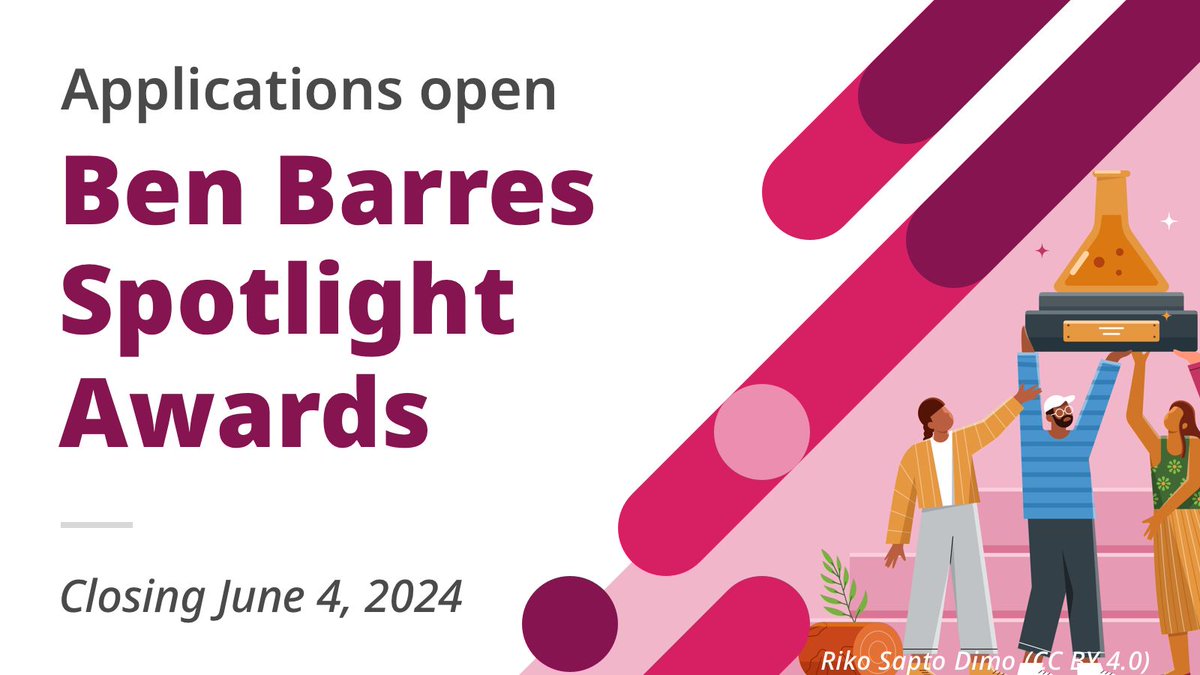
We’re proud to open our sixth Ben Barres Spotlight Awards 🎉
The awards provide up to $5,000 to support researchers from underrepresented backgrounds and countries with limited funding to help increase visibility. Apply today: https://t.co/DeHGxgN94j