People really just say things on here, don't they? Why would you say this when you haven't even bothered to look into the evolutionary history of spiders?
Anyway, let me introduce everyone to Megachelicerax, a stem-chelicerate. Chelicerates are the subphylum spiders belong to. Stem basically means a lineage that is on the evolutionary branch leading toward a particular group, but is outside the group itself. Think of it like an "uncle" in terms of relationships.
It looks virtually nothing like a spider, but it had chelicerae, the three-segmented, pincer-like mouthparts that spiders have at their mouths.
It also had plate-like respiratory structures that are believed to have been the precursors to the book-lungs spiders have.
This was not a direct ancestor of spiders. Like I said, it's closer to an uncle, if anything. Probably more distant than that, actually. But this demonstrates that the characteristic chelicerate anatomy that spiders inherited has extremely deep evolutionary roots.
The evolutionary sequence probably went something like this:
Cambrian stem arthropods
↓
early chelicerate relatives
↓
(Megachelicerax fits in somewhere here)
↓
later chelicerates
↓
Arachnida
↓
stem spiders
↓
true spiders
Few things would demonstrate the destruction of academia more clearly than if Ghent University decides to fire Nathan Cofnas for exposing a professor at a different university for extreme plagiarism, fraud, and other grandiose lies, who later killed himself out of embarrassment.
Per Allison, the key is that the choice isn't simply between “this literally happened” & “Matthew knowingly wrote a metaphor.” Allison’s historical judgment is that Matthew 27:51b–53 didn't happen as narrated. An event involving “many” resurrected saints appearing to “many”...🧵
This guy desperately wants it to be 2020 again. He got rich back then selling his book to white liberals who needed something to display prominently on their bookshelves during Zoom meetings to make sure nobody suspected them of wrongthink.
He's got nothing else to offer.
Universal Common Descent and Transmutation of Species are scientific developments with ancient precedent that philosophically function as natural extensions of a monotheistic worldview which insists upon the uniformity of nature. Monotheism and unity of substance are intuitive concepts that’ve always existed. Polytheism doesn’t lend itself to such uniformity. It is only the high-quality, monotheistic-leaning pagans like the Greeks and Romans who entertained or developed similar ideas in any meaningful way. Our worldview drives us in this direction. Even if belief in uniformity of nature and/or scientific inquiry are present, a fundamentally pagan worldview* doesn’t drive toward either.
*Total rejection of a supreme being and/or creature-Creator distinction.
You can just google these questions, you know...
There are a number of scientific papers detailing the theories & hypotheses on how sexual reproduction evolved.
I will share them below for anyone who (unlike me) can understand the complicated scientific terminology and is interested.
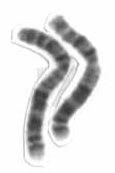
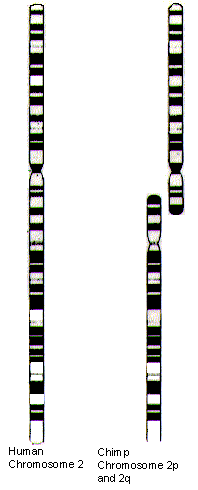
Human Chromosome 2 (Image 1) is evidence that man and chimpanzees share a common ancestor.
As you know, all great apes have 24 pairs of chromosomes, while humans only have 23. Chromosomes are packages of DNA containing genes.
To view all the chromosomes in a cell, scientists use what's called a karyotype which lays them all out to see in matching pairs. By arranging them in order like this, they can see if a person has any missing, extra, or deformed chromosomes.
The light and dark bands are a result of staining, appearing as light or dark depending on how each region absorbs the staining: tightly packed DNA tends to stain darkly, and loose packed stains lighter.
Staining is used to identify chromosomes and locate specific regions or genes. A chromosome has a "waist" (centromere) which divides it into two "arms": a long and a short, labeled Q and P respectively.
p arm
|
|
● ← centromere
|
|
|
q arm
Now, if you look at Image 2, you'll notice something: Chromosome 2 has the same pattern of banding as Chimp Chromosome 2p and 2q when lined up.
This is evidence of the origin of human chromosome 2: Chromosome Fusion. It's believed that at some point in our evolutionary history, two separate ape chromosomes joined end-to-end, creating a single larger chromosome.
Another piece of evidence is a vestigial centromere on Chromosome 2 in the location where one would expect to find the second "waist" from the fusion. Having two waists would be unstable, so it's believed that over time, one of them became inactive.
The third piece of evidence is the presence of telomere sequences in the middle of Chromosome 2. Think of telomeres as like "caps" on the ends on chromosomes. If two were to fuse together end to end, you would expect to find these "caps" in the middle, and that is exactly what we find in C2, in the q13 band, far from either end.
"We conclude that the locus cloned in cosmids c8.1 and c29B is the relic of an ancient telomere-telomere fusion and marks the point at which two ancestral ape chromosomes fused to give rise to human chromosome 2." - Jacob W. Ijdo, 'Origin of human chromosome 2: an ancestral telomere-telomere fusion'