Alert, this is a proud PI moment. 😃 Our latest paper on novel ligand scaffold and activation mechanism of GPR183 is out in Nature Communications https://t.co/CKdybk2Utq
We're hiring!🚨Our lab @SydneyChemistry is looking for two new #chempostdoc for our drug discovery program:
1) Synthetic/Med Chem (small molecule hit-to-lead)🧪
https://t.co/ADZ4CcIEAC
2) Chemical Biology (peptide inhibitors)🦠
https://t.co/X68qCM9PD1
Pls spread the word!🙏
ESMEC 2025 URBINO - European School of Medicinal Chemistry: June 29 – July 3, 2025
Tentative Programme Available and REGISTRATION is nor OPEN!
For all the info: https://t.co/E5ciGg7qc2
We are waiting for you in Urbino!
@DCFSCI@EuroMedChem@YoungSciNet@SciGiovani
On the issue 1 cover is work by Sabrina Taliani, Floriana Morgillo, @scoscona & co on the discovery of c-MET/SMO modulators in EGFRi-resistant non-small cell lung cancer, take a look⬇
https://t.co/BoFNNgNTZS
📍@unicampania@Unipisa
Read the full issue👉https://t.co/7CryXKroIl
Discovering Dually Active Anti-cancer Compounds with a Hybrid AI-structure-based Approach @JCIM_JCTC
1/ In this study, a novel hybrid AI-structure-based approach was developed to identify compounds that can target both G-quadruplex (G4) structures and the poly(ADP-ribose) polymerase (PARP1) enzyme, opening the door to innovative cancer therapies with dual action.
2/ The innovative two-step virtual screening protocol integrates machine learning and structure-based methods. PyRMD, an AI-powered tool, identifies potential PARP1 inhibitors from vast chemical libraries, then evaluates them for their G4 stabilization potential.
3/ By combining AI and structure-based screening, the study identifies four compounds with dual PARP1 inhibition and G4 stabilization activity, offering a multipronged strategy to disrupt cancer cell proliferation.
4/ The identified compounds show significant antiproliferative activity, particularly against cancer cell lines with BRCA1 mutations, suggesting the potential for targeting tumors with DNA repair deficiencies.
5/ One compound, in particular, demonstrated activity against telomerase-positive HeLa cells, hinting at its broader applicability across different cancer types, making it a versatile therapeutic candidate.
6/ This study showcases the potential of hybrid AI-driven approaches in drug discovery, emphasizing the power of combining machine learning with classical structure-based methods to develop multitarget anticancer compounds.
@scoscona
📜Paper: https://t.co/hUueUrZw21
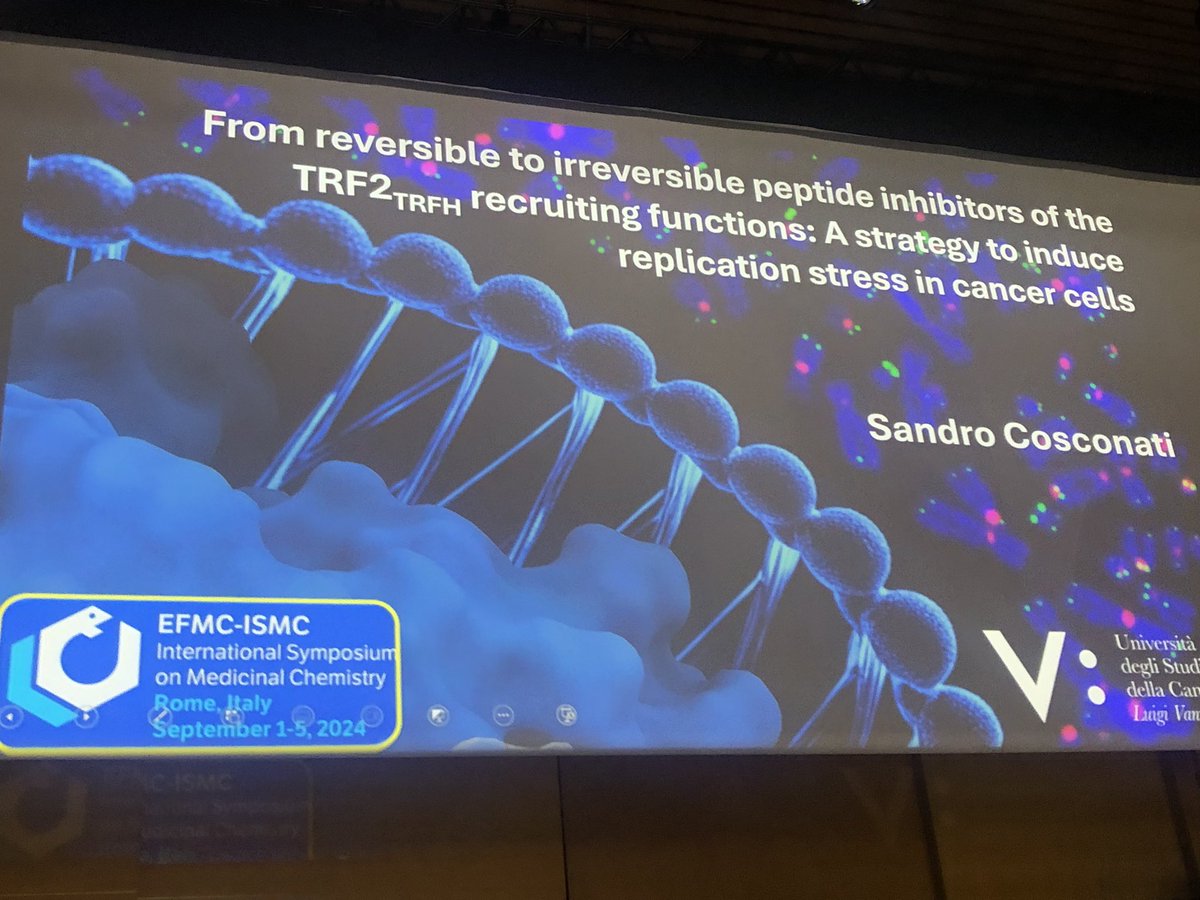
📣 Session 9 – Prof. Sandro COSCONATI from @unicampania is now on the stage for talk titled “From Reversible to Irreversible Peptide Inhibitors of the TRF2TRFH Recruiting Functions: a Strategy to Induce Replication Stress in Cancer Cells”. Stay tuned! 🔬💡
#EFMCISMC24#MedChem
Next talk in the peptide session at #EFMCISMC24 is given by Sandro Cosconati (@scoscona), describing his strategy to induce replication stress in cancer cells, from reversible to irreversible peptide inhibitors of the TRF2TRFH recruiting functions.
@EuroMedChem@DCFSCI
Online now! Irreversible inhibition of TRF2TRFH recruiting functions by a covalent cyclic peptide induces telomeric replication stress in cancer cells by Alexander Sobinoff, Salvatore Di Maro, @hildaApickett, @scoscona, et al https://t.co/65FtEhAxCf #chembiol
Co-treatment with the G4 stabilizing agent RHPS4 amplifies APOD53's effects on telomeric replication stress, offering a potential combination strategy for cancer treatment. The interplay between TRFH targeting peptides and replication stress inducers is explored.
Our latest paper in @CellChemBiol unveils APOD53, an antiproliferative cyclic peptide co-discovered with @PicketHilda and @TheCesareLab to bind TRF2. Kudos to first authors @sadimaro80 and Alex Sobinoff! Special thanks to @AIRC_it for their support. https://t.co/i4ir1sBrtD
APOD53's impact goes beyond inhibiting TRF2; it blocks the interaction of RTEL1 and SLX4 with TRF2, inducing replication stress, DNA damage, and telomere fragility. This sets the stage for a robust telomeric DNA damage response.