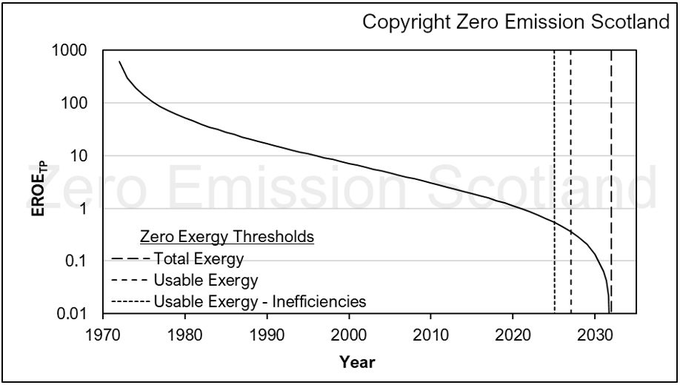
@AKGupta_001@aeberman12@NJHagens @MarcoRaugei LCA typically gives single/sparse EROI data over time. Engineering analysis + good data provides minimum production energy cost on a monthly/yearly basis defining a trend. Energy return can be deduced from oil composition. Hence, EROI plots like this for Norway may be derived.
@NafeezAhmed Our thermodynamic analysis of EROI for North Sea oil production shows that energy in exceeded energy out in 2022. For oil AND gas the date is 2031.
The countries that produce the technologies you count on also go through a similar dynamic.
Energy systems have to be autopoietic.
With US shale production peaking, Adrian Day warns there are no new major sources of oil supply. This sets the stage for potential price spikes in the future. #Commodities#Energy Full Video: https://t.co/UF8crLX2XB
@akmaciver If Blair as PM had had the foresight to commission a physics/engineering assessment of the net energy potential of North Sea oil & gas production as we have done, we wouldn’t be in the predicament we are now nor would he and others in the political space be so ill informed.
@derrick_dao@ChathamHouse@fbirol@IEA … and the industrial capacity to convert those raw materials into the basic components required.
Electrification is a strategy that hasn’t been thought through.
Indeed, the FPS is impressive.
Using @NSTAuthority production data and @GeolSoc reservoir data (temperature) the increasing energy cost of oil extraction can be calculated (thermodynamics).
As of 2022, oil from the UK North Sea took more energy to produce than it contained.
The Forties Pipeline System (FPS)
This is the pipeline system that carries most of the oil from the North Sea to the UK.
It collects the oil from 85 different North Sea oilfields, and flows around 550,000 barrels of oil per day back to the UK mainland. For context, in total the North Sea has around 400 offshore platforms between the UK and Norway, producing and exporting both oil and gas.
FPS is a British oil pipeline system.
Exploration drilling for North Sea oil is currently banned on the UK Continental Shelf. It has been since the current government came to power.
As a result of the drilling ban, the Forties Pipeline System is currently uninvestable according to its owner INEOS. They haven’t invested in its upkeep for 2 years.
INEOS have said the pipeline will close by 2035, but without investment maybe as early as 2030, which is now just 3.5 years away.
550,000 barrels / day is equivalent to 38.96 GW of primary energy.
This is 10x more energy than the UK’s new Hinkley Point C nuclear power project, which is projected to cost £48 billion for 3.2GW of electrical power.
Electrical energy is joule for joule more valuable than chemical energy, but the comparison of scale is real.
38.9 GW is more energy than the entire National Grid carries. The largest energy system in the UK is not the grid it is this underwater pipeline system.
With drilling banned, and the North Sea entering a period of forced closure, the Forties Pipeline System is going to close in the not too distant future.
Once the pipeline is no longer economical, the entire Central North Sea oil production will collapse with it. This isn’t something that closes down gracefully, the entire Central North Sea basin reaches market through a single pipe.
BP recently announced they are selling up their remaining assets and getting out, Exxon, Chevron, etc are all already long gone. Nobody wants their brand near this collapse.
The tax rate is 78%, the government wants this national infrastructure to shut down. It will.
The German Chancellor recently called their nuclear fleet closure a “Strategic Blunder”, interesting choice of words. But I think it was obviously a blunder to anyone outside their propaganda bubble.
Likewise the UK’s North Sea.
The German nuclear fleet averaged 10.3 GW of primary energy output over its operational life, which is around 1/4 the primary energy of the Forties Pipeline System.
The UK has a few other pipeline systems but this one is by far the largest and the most critical. Now this infrastructure, isn’t supposed to last forever. But when it goes you should have a plan.
In the UK nobody talks about this. It’s taboo.
A lot of people think “yeah but they won’t let that happen”… well it happened in Germany, and it happened in Japan.
A lot of people want it to happen, and a lot of those people are in politics.
So what replaces this? Nothing?
Is the UK just going to go silently into the night?
@Object_Zero_@NSTAuthority@GeolSoc Expand the analysis out to include UK natural gas production and the thermodynamic dead state for the entire system is reached by 2031.
See our pinned ‘tweet’ for Norwegian oil.
Prix des carburants : "On va devenir un monde où voyager en avion va devenir un produit de luxe", anticipe @thierry_bros, professeur à Sciences Po. #ChaqueVoix
@thejohnhannah@IndyScotParty Fortunately, we have a set of solutions to address this problem, climate change and environmental degradation.
Watch the video in the link below:
https://t.co/SK5wspI4Ax
@thejohnhannah@IndyScotParty Depletion of energy resources is a major factor in economic, societal & personal wealth decline.
Scotland is at a pivotal moment.
Indigenous oil & gas will provide no net energy to the economy by the end of the forthcoming Scottish Parliamentary term.
https://t.co/MBN1jbv98p
@ChathamHouse The electrification path the British state is following shifts dependency to international supply chains for grid infrastructure equipment in particular.
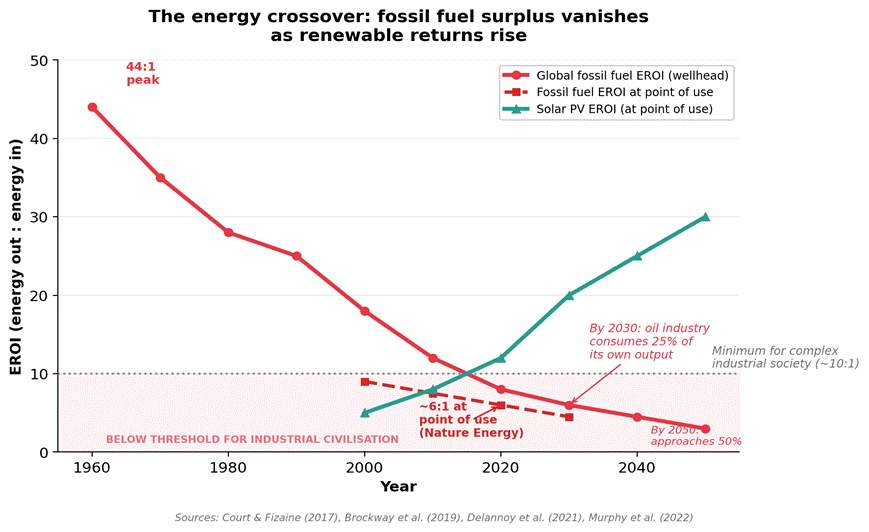
5/Civilisation runs on the surplus between what oil produces and what it burns to produce. Every hospital, harvest, supply chain. That surplus is vanishing. The crises of 2008, 2020, 2022, 2026 are not separate events. They are the same curve, arriving faster.
4/ EROI - Energy Return on Investment - has been collapsing for decades. In 1960s, oil returned 44 units for every one spent. Today, per a Nature Energy study: as low as six to one. In just 4 years, the industry burns a quarter of everything it produces just to keep producing.