🆕 Why some digital payment systems replace cash and others don’t
Today on VoxDev, @dargente05 (@YaleSOM), Paula González-Alvarez, Esteban Méndez (Universidad de Costa Rica) & @DianaVanPatten discuss instant payments in Latin America:
https://t.co/CGCuaXvB2Q
I do not want you to code X by hand, but I want to know that you are capable of reasoning through tradeoffs and deriving design from first principles.
For my initial interview screen I ask candidates to code by hand. We do have LLM-assisted portions of our interview, but I want to see how you reason with just the meat computer.
The problem is constructing a version of a primitive that 99% of engineers have used but have never deeply inspected. The solution is ~50 lines of code, the best candidates one-shot it in ten minutes, and I can see the joy on their faces from working on a genuinely novel problem.
I am anti-leetcode. I don't want to know that you can memorize something. I want to know you can reconstruct a primitive that requires some level of systems thinking.
I can coach anyone through solving this problem in ~20 minutes with hints. But the worst candidates complain about the validity of the problem, that they would never have to implement it in their day to day, and that they don't get to use a coding agent.
If you want to get the job, complaining to your interviewer about the question is a sure fire way to make sure that doesn't happen.
Incentives to replicate articles are so bad. Even when your comment leads to the retraction of a PLOS One article, the reward is a (10 days late) email with a thank you at the bottom.
Retraction notice: https://t.co/JZYtD7IvVg.
But we are not complaining about PLOS One 🧵
(1/6) 🧵 Join our "The Micro and Macro Perspectives of Labor Market" Virtual Reading/Workshop Group co-organized with Jesse Wedewer at @DukeEcon!
It allows PhD students to connect with peers outside their home department. Here's how it runs:
#EconTwitter
Very happy to announce that my JMP has finally reached its final destination after a 7-year journey. Many thanks to my advisors @raquel1fernan and @glviolante!
https://t.co/XhuUGdPHVo
This is a spectacular paper by Johannes Boehm @johannesmboehm and Thomas Chaney. A brilliant example of how economics can augment and enrich work in history and archeology, just as those disciplines inspired and enriched the work done here. It is also a perfect example of how economic history and historical economics represent one of the most exciting dimensions of current economic research.
Very excited to share this. One of the big challenges in studying geoeconomics is measuring how firms respond to pressure. The new GCAP Geoeconomic Monitor uses earnings calls + LLMs to track firm exposure and responses to tariffs, sanctions, and export controls in real time.
🧵1/7) On the difference between dynamical systems in #physics vs #economics. Example 1.
The case of Ramsey-Cass-Koopmans (RCK).
Instability and learning the initial condition for c.
🧵1/ Our first meta-science paper (with 350+ coauthors) is published today in Nature. It presents one of the largest-ever reproducibility projects in economics & political science.
Here’s what we found 👇
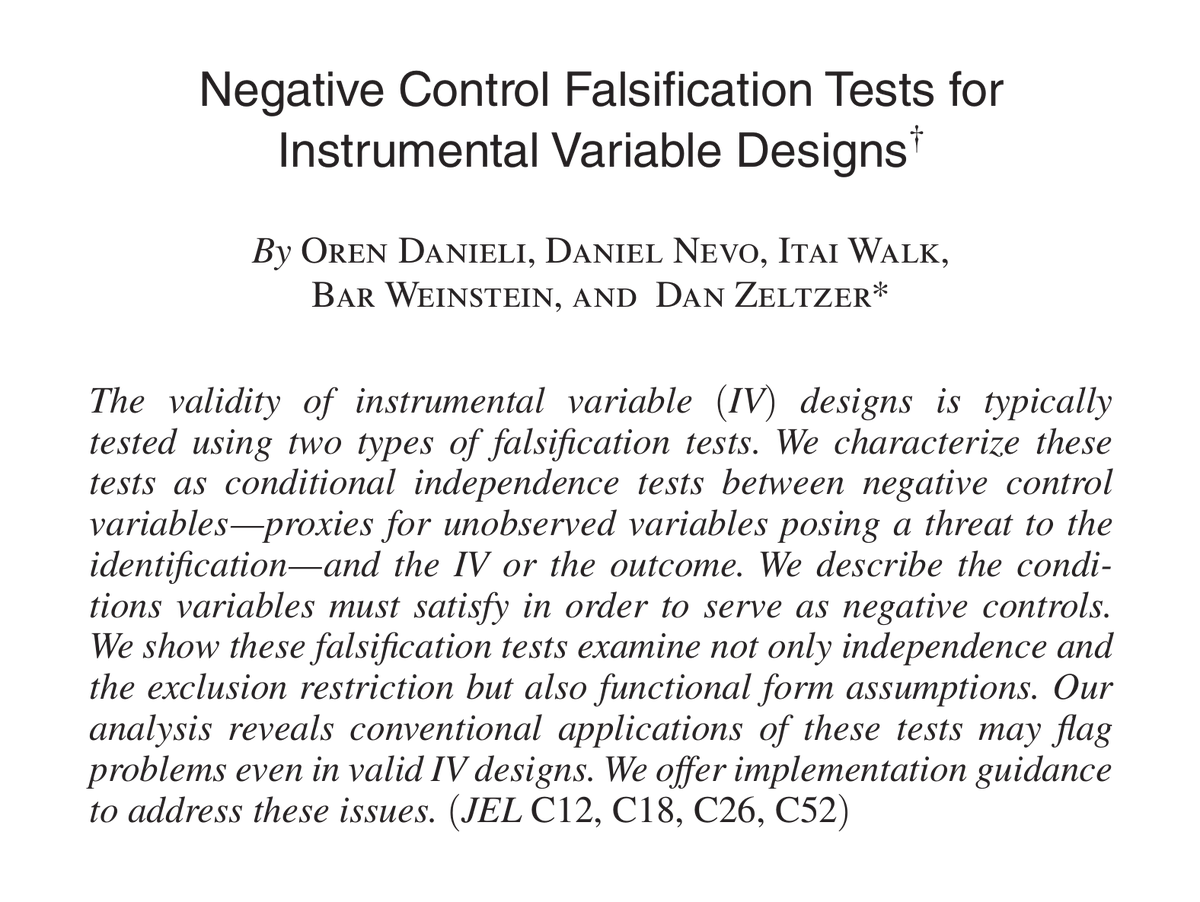
🚨New in AER🚨: "Negative Control Falsification Tests for IV Designs" (@DanieliOren, @DanielNevo, Itai Walk, Bar Weinstein, @danzeltzer). https://t.co/3Go8Ax1AHX
Common placebo test implementations may reject valid IVs.
We're coming to save your IVs! 🧵
By now, I have published a fair number of papers, and one more acceptance would have close to zero marginal impact on anything that matters professionally. But getting my survey on “Deep Learning for Solving Models” accepted into the Journal of Economic Literature made me genuinely happy, for reasons that have nothing to do with my CV.
I had the misfortune of studying my undergraduate degree in economics at a quite awful institution. Two professors, David Taguas and Alfredo Arahuetes, were outstanding, and I owe them a great deal. The rest were well below any reasonable professional level, and some violated the basic standards of ethical conduct. They had no business teaching economics at any level, let alone at a university that charged tuition and claimed to prepare students for professional life.
I had to work out most of my education on my own. The surveys published in the Journal of Economic Literature were how I did it. I spent hours in the library’s reading room going through one survey after another on topics I had never been properly taught. Some helped more than others, but collectively they gave me a solid enough foundation that, when I arrived at Minnesota for my PhD, I discovered, to my considerable surprise, that I was ahead of nearly all the other first-year students, including some who held master’s degrees, despite the fact that I had finished my undergraduate degree just six weeks before. I owe the Journal of Economic Literature a debt I will never be able to repay. Publishing a survey there is the closest I can come to trying.
So, the thought that some student somewhere, working on her own in a library or on a laptop, might find my survey useful gives me tremendous satisfaction.
But there is a broader point worth making. Even in the world of AI, the profession has an important mission in making educational material widely available. Textbooks, surveys, teaching slides, these are public goods in the economist’s sense: high social value, insufficient private incentive to produce. This is also why I post all my slides and teaching material online:
https://t.co/jcFH9WK9Qu
We do not reward these activities nearly enough, and their supply is well below what any reasonable social planner would choose. I do not have a good proposal for changing this, and I would welcome suggestions.
What I do find heartbreaking is that many of the great economists of the past couple of generations never wrote textbooks on their areas of expertise. I do not mean this as criticism. All of them maximize, and perhaps they all suffer from the same bias I suffer from: the belief that one can always do it next year. But I often think about the hours of pure intellectual pleasure I would have had reading “Time Series Econometrics: An Advanced Textbook” by Chris Sims or “Methods in Structural Estimation” by Pat Bajari. Those books do not exist. They should.
I want to up the ante on this. If you have a large document collection, I will digitize it for you, for free (you pay for inference), on one condition: that we make the data publicly available immediately.
We are pleased to share the release of a major open data resource on Harvard Dataverse:
Indian Census Data Collection, 1901–2026: Digitised Subnational Population and Administrative Datasets
DOI: https://t.co/zsSOTCGyuD
#OpenData#India#Census#SocialScience
What’s included?
• Population time series (1901–2011)- Census A02 (cleaned and strcutured)
• first time digitization of Primary Census Abstract tables (state & district level)-1961, 1971, and 1981
• 2026 subdistrict-level administrative directory linked to census data (2011)
#DataInfrastructure #ResearchData
David Lagakos and I have a new review of development accounting (https://t.co/sCHTGS5fGh). We ask: what have we learned in the two decades since Caselli’s seminal Handbook chapter? (1/7)
Now accepted at JDE!
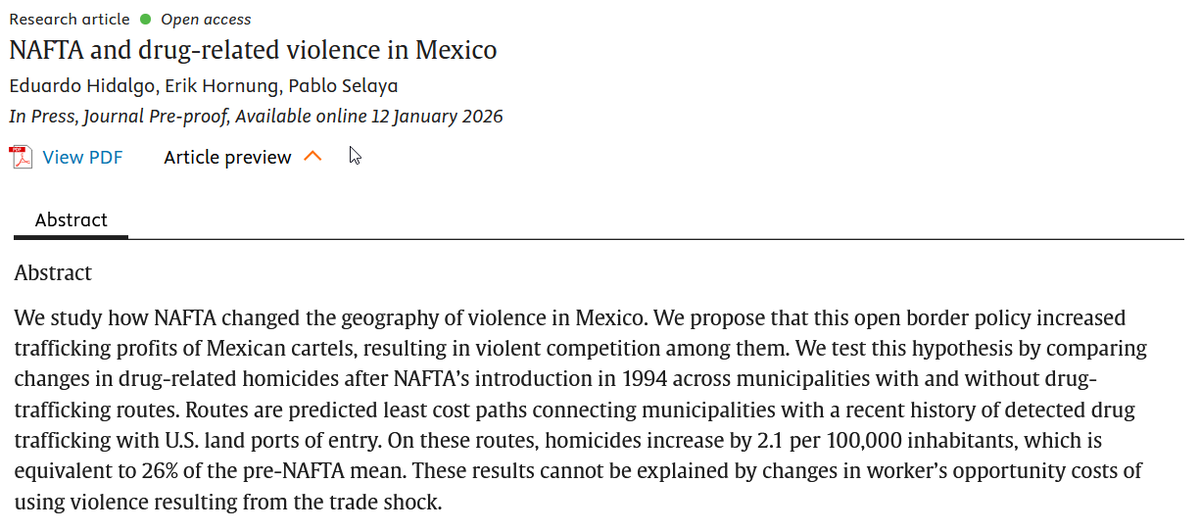
This paper (with @pablo_selaya and @eduhidalgo31) shows that NAFTA reshaped the geography of drug-related violence in Mexico after 1994. Homicides rose by 2.1 per 100,000 along trafficking routes (≈26%)
Open access! https://t.co/ZrZlNrzsEQ
Officially out at #QJE: "Ideas Have Consequences: The Impact of Law and Economics on American Justice", with Daniel L. Chen and Suresh Naidu.
We study the early law-and-economics movement, and how it has shaped judicial behavior in U.S. federal courts.