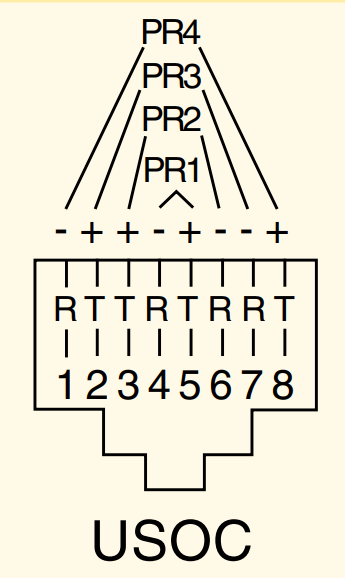
@TracketPacer I had to learn pin/socket and plug/receptacle when I started working with 38999, 26482, and 83723 connectors. Even pins/sockets gets confusing for coaxial/etc. contacts.
@TracketPacer No, not a fraud; you're a hardware developer who hasn't quite realized it yet. But I'm really excited for every step you take towards the right side.
I'm an electrical engineer. A crucial part of my job responsibilities is to make pictures of stickers, and then make pictures to show where to place the stickers.
As a software developer, you may be called upon to perform some of these tasks in your career.
How well a CS degree prepares you for these tasks (and whether it even should prepare you for these) is left as an exercise to the reader.
🧵
1/
@TracketPacer However, this Leviton PDF gives a different arrangement for 8P8C of -++-+--+. I don't know how reliable that is, but they have great pictures of how to terminate jacks without untwisting each pair. I also liked the General Installation Tips section.
https://t.co/40DjBIYxal
@TracketPacer This video shows the USOC polarity as +++-+--- for an 8P8C. I don't know why the polarity of line 1 is different from the other lines; USOC also seems to do that for 6P4C and 6P6C
https://t.co/3eflGolZdV
@TracketPacer I'm going to guess a bit: since blue is defined as pair 1, orange as pair 2, etc., 568B causes line 2 (pins 3/6) to be transmitted on pair 3, which would make splicing into structured wiring impossible to follow the USOC telephone standard.
@TracketPacer I've tried chasing down why 568A is supposed to be more compatible with 2-line USOC standard, but having never read either standard I've not been able to find a satisfactory answer. I wouldn't expect the twist rate differences between the pairs to matter that much for phone.
As winter approaches, here's a story about why hardware is hard. ❄️🥶
About a year ago, we started getting reports from the field about undesirable behavior when our robots were turned on. They would behave unpredictably.