Today we go live on mainnet with the Fusion Rollup, the world's first multi-ledger rollup, connecting 74 blockchain networks in one unified environment, built for institutions.
When I started @quantnetwork in 2015, the vision was simple: make blockchain work for institutions at scale across any network, without the complexity and fragmentation that's held the industry back.
For years, institutions had two bad options: bet everything on a single chain, or stitch together insecure bridges across many. Fusion refuses that trade-off. It connects to many networks at once, moving assets, settling transactions, and messaging across chains as built-in capabilities, not workarounds.
The breakthrough is unified assets. A example of a stablecoin like USDC or tokenised fund like BUIDL or any other digital assetspread across 7 chains collapses into one: uUSDC or uBUIDL. One asset, one liquidity pool, instead of 7 copies and 7 fragmented pools. Each stays anchored to its origin chain and is withdrawable anytime. No custody or compliance trade-offs.
This isn't another layer 2 or a blockchain. It's a new category of infrastructure and it's live.
Read more on: https://t.co/MGfs1FgA6T
→ https://t.co/OQBfu2CEZb
→ https://t.co/4o9nnaA7zc
#QuantFusion #EnterpriseBlockchain #MultiLedgerRolleUp #FusionRollup
The UK is rebuilding the infrastructure of money in real time.
At City Week, the Bank of England outlined what's happening: a #digitalgilt, #stablecoin rules this year, 16 firms going live in the Digital Securities Sandbox, and a synchronisation service settling tokenised transactions in central bank money by 2028.
As Sarah Breeden put it, RT2 is a "parked Ferrari", and it's now out on a test drive.
When every asset is tokenised, the question of who is authorised to move value, and under what conditions, becomes foundational.
That's the design question we've been building for.
https://t.co/oe24PbPst1
#DigitalFinance #Tokenisation #FinancialInfrastructure
Collateral management is under pressure. Capital sits trapped in silos, settlement failures are rising, and operations teams spend more time managing process noise than managing risk.
Tokenisation fixes the core problem. When assets settle in hours, firms hold less collateral, move faster, and free up capital that could be put to work elsewhere.
The technology is proven and the regulatory path is clearing. The gap now is operational, getting from pilot to production.
Our new whitepaper sets out exactly how to close it: https://t.co/bT6JznOETt
#CollateralManagement #CollateralMobility #Tokenisation #CapitalMarkets
There are some cases where volatility is a huge problem and so a stablecoin is a better choice than a cryptocurrency. Similarly there are some cases where a regulated asset with a trusted counterparty is a benefit.
But cryptocurrencies have three big advantages over stablecoins.
1) A stablecoin can only be stable with respect to one currency and a stablecoin denominated in the fiat you need it to be stable relative to may not exist with the qualities you want. Applications that involve multiple jurisdictions with different native fiats don't benefit as much from the stability.
2) A stablecoin can be frozen or clawed back by its issuer. Ripple, for example, can't refuse a US court order. And the US courts may decide that other things matter more than you do even if you've done nothing wrong. For example, if some country asserts that you've supported terrorism and claims secret evidence, is a US court going to protect you even if you claim that your only support for terrorism was in the form of speech criticizing that government's human rights record? Do we expect AI agents to defend themselves in courts? Do you want to have to?
3) For most cryptocurrencies most of the time, the upside is worth more than the downside. So if you don't need stability, you might prefer a cryptocurrency over a stablecoin for many applications. If I had to lock up some money in an escrow for a year, I might well prefer XRP or BTC to USD because I know USD isn't going up.
A decade in the making, we have published an ISO standard for blockchain interoperability.
This is a milestone I've been working towards since 2015, Remitt was founded with the conviction that blockchains could transform financial services but only if the industry solved interoperability and harmonised around global standards. Without that, blockchain would remain fragmented, siloed, and locked out of mainstream institutional adoption.
In April 2016, we published what was the world's first proposal for a blockchain standard (https://t.co/SL83Yl4Ejr) a bold move at a time when the industry was still largely focused on proofs of concept and competing protocol narratives, not standardisation.
The idea was simple but ambitious: if blockchains were going to serve global markets, they needed a common framework that transcended any single protocol or vendor.
Central to this thinking from the very beginning was the concept of a multi-gateway architecture, leveraging the know-how of 20 years of experience in cybersecurity to frame the principle that interoperability shouldn't depend on a single bridge or point-to-point connection, but on a layered gateway model that could abstract away the differences between underlying DLTs and connect them through a common interface. This was the architectural foundation of what would become Overledger, and it was also the design philosophy we brought to the standards process.
The belief was that a viable international standard for blockchain interoperability had to be protocol-agnostic and gateway-driven, enabling any DLT to communicate with any other DLT (any-to-any) and with existing networks, without requiring those ledgers to change how they operate. The standard and the technology were born from the same insight.
That same year, I worked closely with the team from @standardsaus (Standards Australia), who had the foresight in 2015 to champion the initiative at the international level. Together, we pushed for ISO to establish a dedicated Technical Committee for blockchain and not to be absorbed into an existing committee, but to stand on its own as a recognition that this technology warranted its own global standards programme. The industry demand was there, the use cases were multiplying, and the fragmentation was becoming a real barrier.
In September 2016, the New Work Item Proposal (NWIP) received global approval, and ISO formally gave the green light to establish a new Technical Committee (https://t.co/7biJjvHRk9). TC 307 — Blockchain and Electronic Distributed Ledger Technologies — was born (https://t.co/5SsFPIw0HH). The inaugural meeting was held in Sydney in April 2017, and from that moment the real work began.
As the standards work progressed internationally, the mission at Remitt was evolving too. What started as an effort to use blockchains for financial services and solve interoperability grew into something far larger, a full enterprise infrastructure platform for connecting any blockchain to any network. Remitt became Quant, and we built Overledger, the world's first blockchain operating system to deliver on that original vision. The multi-gateway architecture that informed the standards thinking became the core of Overledger's design: a technology layer that sits above all blockchains, providing institutions with a single integration point to access any DLT, any network, and any existing system. The interoperability challenge that drove the standards work was the same challenge we set out to solve commercially and the two efforts reinforced each other throughout.
For close to a decade since TC 307's formation, subject matter experts across the world have contributed their time and expertise to Working Group 7 — Interoperability is the committee I chair.
International standards are not built quickly they are built through consensus, technical debate, and relentless refinement. The same methodology and rigour that created the Internet, through publishing standards. The result is a published international standard for blockchain interoperability.
🔗 https://t.co/GRoR7fXNLQ
A huge thank you to @isostandards as the international standards developing organisation, to the team at @standardsaus who started the initiative in 2015 and worked tirelessly to get TC 307 approved and established globally, and to every subject matter expert who contributed to Working Group 7 over the years. This would not exist without that collective effort.
From a blog post proposing the world's first blockchain standard in 2016, to a published ISO standard in 2026 and from Remitt to Quant, from an architectural concept of multi-gateway interoperability to Overledger and a global standard, this has been a decade-long journey of building both the standards and the technology to make blockchain interoperability a reality for institutions worldwide.
There is still much more work ahead. More standards to develop, more to evolve, and more to build. But today, we mark a significant milestone.
#Blockchain #ISO #Interoperability #Standards #TC307 #DLT #Quant #Overledger
@documax@XFBAcademy Can you imagine the massive corporate lawsuits that would follow such a rug pull? There’s no way they would risk their reputation and future as a trusted international financial entity.
Exciting progress on #QuantFusion as we kick off 2026!
1. Fusion Firewall Updates
We recently upgraded Fusion's Multi-Ledger Rollup to deploy critical updates to Fusion Firewall #smartcontracts.
Key enhancements based on institutional feedback:
- Self-managed token whitelists for institutions
- Liquidity isolation options for shared tokens
- Privacy-preserving on-chain whitelist synchronisation
2. Bring Your Own Node (BYON) - Now Live
A foundational upgrade for #QuantConnect users. BYON allows users to attach their own nodes to Fusion via our Quant Connect UI. It’s as simple as selecting the network and entering a URL. Starting with pre-selected node providers to ensure reliability and simplify setup, with plans to expand to user-hosted nodes.
The infrastructure is fully generic, any EVM-compatible node can connect, with minimal adjustments needed for non-EVM chains. Currently testing on Sepolia and Amoy testnets.
3. Staking Infrastructure in Development
We're evaluating staking algorithms that balance inclusivity with meaningful participation. The goal: encourage QNT staking at all levels without disadvantaging smaller holders. Staking will be tied to BYON, users stake QNT against their nodes to earn rewards.
Rather than slashing, we're following proven models (like Avalanche) where withholding rewards effectively incentivises node reliability.
#Blockchain #Interoperability
BREAKING NEWS 🌋
There is now an $8.6T opportunity for Quant in Japan. The Rothschild's are actively tracking Ripple. Hedera inside track at Davos. Chainlink ETFs go live. Algorand adds heavyweight board leadership.
Programmable money inside the financial system, Aslan is on the move....
Japan is exploring tokenized deposits at national scale. Chainlink just entered ETF markets. Rothschild is tracking Ripple as financial infrastructure. Hedera is operating at Davos with central banks and regulators.
Algorand added former FinCEN, Treasury, and MoneyGram leadership.
Networks discussed: $XRP $QNT $HBAR $LINK $ALGO $AVAX $ADA $ETH $BTC $CC
Some shifts in finance are loud.
Others are quiet, but far more important. Today, Quant is announcing a partnership with @dentsusoken in Japan.
Over recent years, our work done in the UK has shown that digital money doesn’t have to sit outside the financial system to innovate. Tokenised deposits and programmable settlement can be designed inside regulation, inside banks, and at institutional scale. What’s interesting now is what happens next.
Japan is approaching these questions in its own way, within its own regulatory and market context. But the direction of travel is clear: major economies are beginning to think seriously about how programmable money fits into real-world financial infrastructure.
This partnership is about building that foundation with institutions at the centre.
#TokenisedDeposits #ProgrammableMoney #Stablecoins #Blockchain
Stablecoins have moved digital money forward in important ways. They’ve shown what always-on, programmable value transfer can look like at scale.
Now we’re seeing the next phase.
Banks and market infrastructures are applying those lessons to regulated money through tokenised deposits, bringing programmability into the core of the financial system rather than around its edges.
As tokenised deposits and tokenised assets start to operate together, the impact goes beyond speed. It changes how settlement, liquidity, and risk are managed across markets.
I’ve shared some thoughts on why 2026 is shaping up to be a meaningful year for digital money.
https://t.co/9e8S6pMiGw
@quantnetwork
@SebasP49474734 The thing that leads me toward renewals is that these recurring transactions happen to slowly push price up and down. Like I said…I have an active imagination. At the same time, I’m in total agreement that the remainder is being scooped up by major institutions.
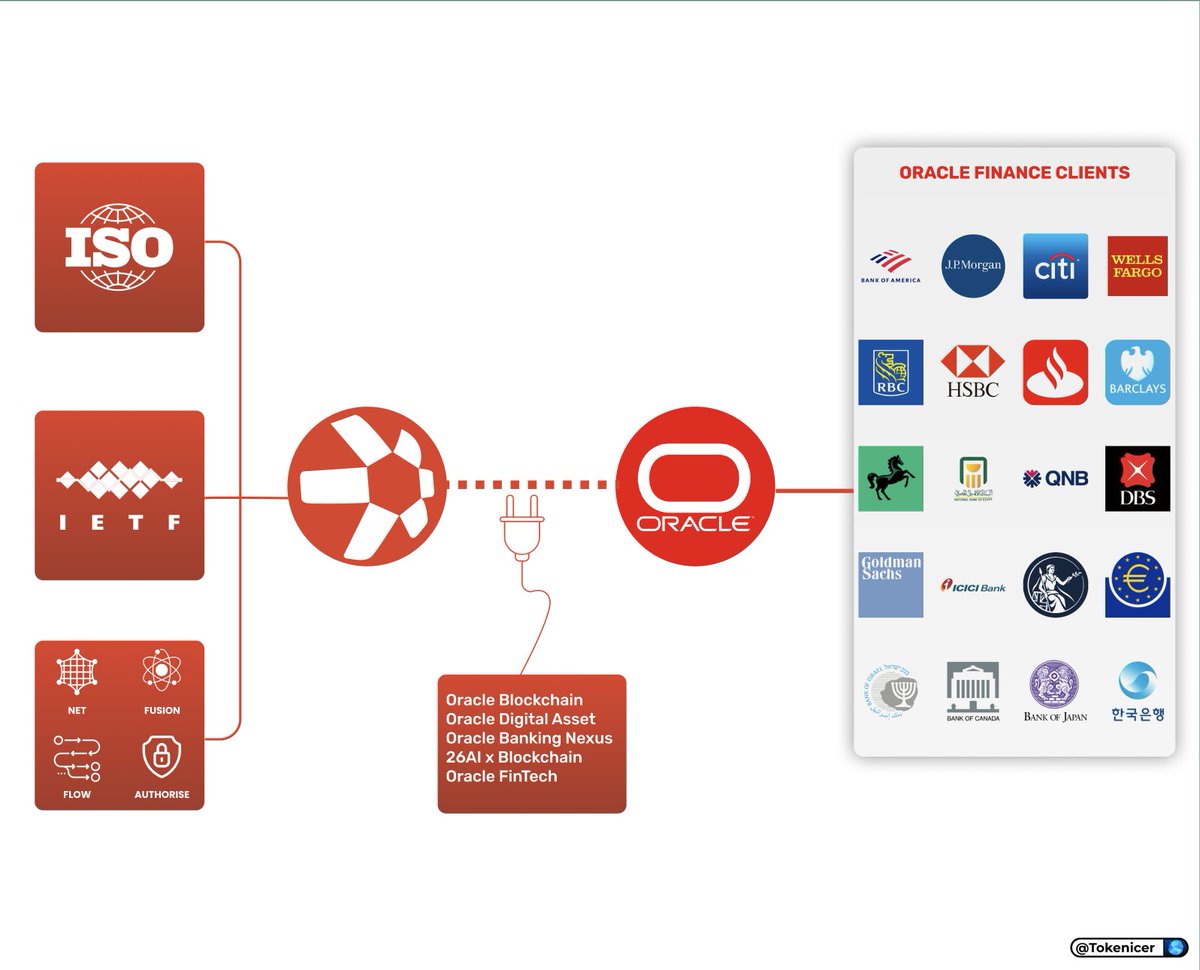
⭕️racle's partnership with $QNT began with a simple integration into Oracle's Startup Program
Today we've seen Quant serve Oracle via:
• Backbone of Oracle Blockchain
• Interoperate 26AI with DLT
• Blockchain Nexus for banks
Oracle's already a leader in FinTech infrastructure for both commercial and central banks.
This is critical as banks begin moving to DLT.
Quant has created the path of least resistance for these banking giants to begin moving onto blockchain without any tech overhaul needed.
It's purely just plugging further into Oracle's overall decorated ecosystem of services.
And of course, with SATP & ISO TC 307 at the epicentre, standards and compliance are baked in since Day 1.
As we've discussed prior, Quant isn't trying to partner with every F500.
It doesn't make sense to try and secure them 1 by 1.
Instead they're the backbone of the one whose already bagged all these F500s & banking giants.🧠