25 🇯🇵Software Engineer
Launched Contextberg. Hit #15 on Product Hunt 🚀
However,,,
Current MRR: -$10
Current status: still figuring things out
Building:
• AI agent memory infrastructure
• OSS around multi-agent workflows
Building in public every day.
@saranshhx@X Local-first memory for AI coding agents.
contextberg reads local conversation history from Claude Code, Codex, Hermes, Cursor, OpenClaw, and GitHub Copilot, then links those sessions to git commits.
https://t.co/0Bd9V7PUMG
@kushmergedeck@X Building a local memory app for your AI agents.
It watches your screens, agent transcripts, and browser in the background.
Drop a like and I'll come connect with you.
https://t.co/QoYYi9nPBg
Dynamic workflows are nice, but I'd rather see improvements in the core model.
Cheap models can already handle orchestration, routing, and repetitive subtasks.
What I can't easily replace is raw reasoning quality, accuracy, and speed.
Day16
Working on the Mac version of Contextberg.
It captures screen activity, browser history, and agent conversations, then turns them into memory AI agents can actually use.
Codex has made 408 commits in 3 days. I've mostly been reviewing PRs.
Mac agent memory is coming.
@rubenhassid Good roadmap.
After you've worked through these, I'd recommend:
https://t.co/giSib2ZTV1
It's one of the fastest ways to learn not just agents, but memory, orchestration, deployment, observability, and infrastructure together.
@adxtyahq After catching up on these concepts, I think the fastest next step is:
https://t.co/giSib2ZTV1
You don't just learn agents. You learn memory, orchestration, observability, deployment, and infrastructure together by building real systems.
@HowToAI_ The interesting part isn't that AI can write CUDA.
It's that AI can now search the optimization space far faster than humans.
Feels less like coding automation and more like automated hardware R&D.
@_avichawla This feels like a major shift.
For years we waited for better models.
Now a lot of the progress comes from better memory, skills, protocols, and orchestration layers built around the same models.
@Fluyeporlaweb Good list.
If I had to filter it down:
• LibreChat → multi-model hub
• Nango → integrations
• Agent Skills → Claude Code workflows
The bottleneck isn't discovering 10 repositories.
It's integrating 2 of them deeply into your workflow.
@trq212 Dynamic workflows solve parallelism.
The next challenge is continuity.
We now have agents coordinating with other agents, but we're still early in figuring out how knowledge persists beyond a single workflow run.
@pejmanjohn "Knowledge lives inside skulls, and skulls don't sync."
That's exactly the problem.
We're trying to build the missing layer between Claude Code, Codex, Cursor, and OpenClaw:
https://t.co/0Bd9V7PUMG
One memory layer. Multiple agents.
@Careerbuddha111 Completely agree.
But preserving context for Hermes alone isn't enough.
Most of us switch between Claude Code, Codex, and Cursor. The real challenge is making context portable across all of them.
That's why I open-sourced:
https://t.co/0Bd9V7PUMG
@Gharbi__S Same reason I'm here.
Being surrounded by ambitious builders makes it much harder to stay comfortable. The environment raises the standard without anyone saying a word.
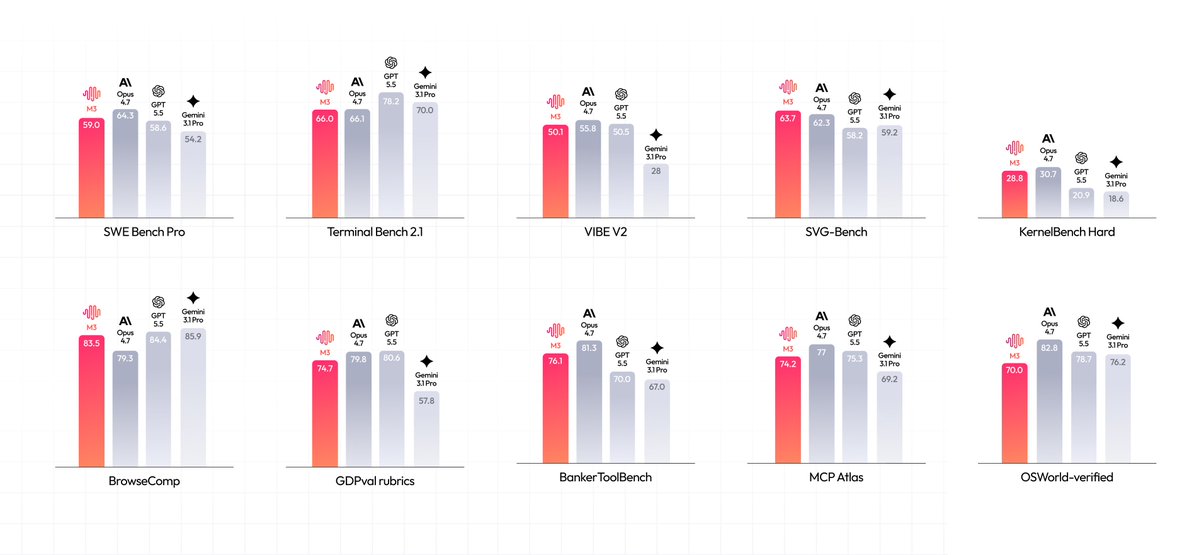
More important than the benchmark scores is the context window upgrade.
20K context disappears quickly once an agent loads skills, project history, and relevant files.
For real-world agent workflows, the ability to hold more context may unlock more value than another few benchmark points.