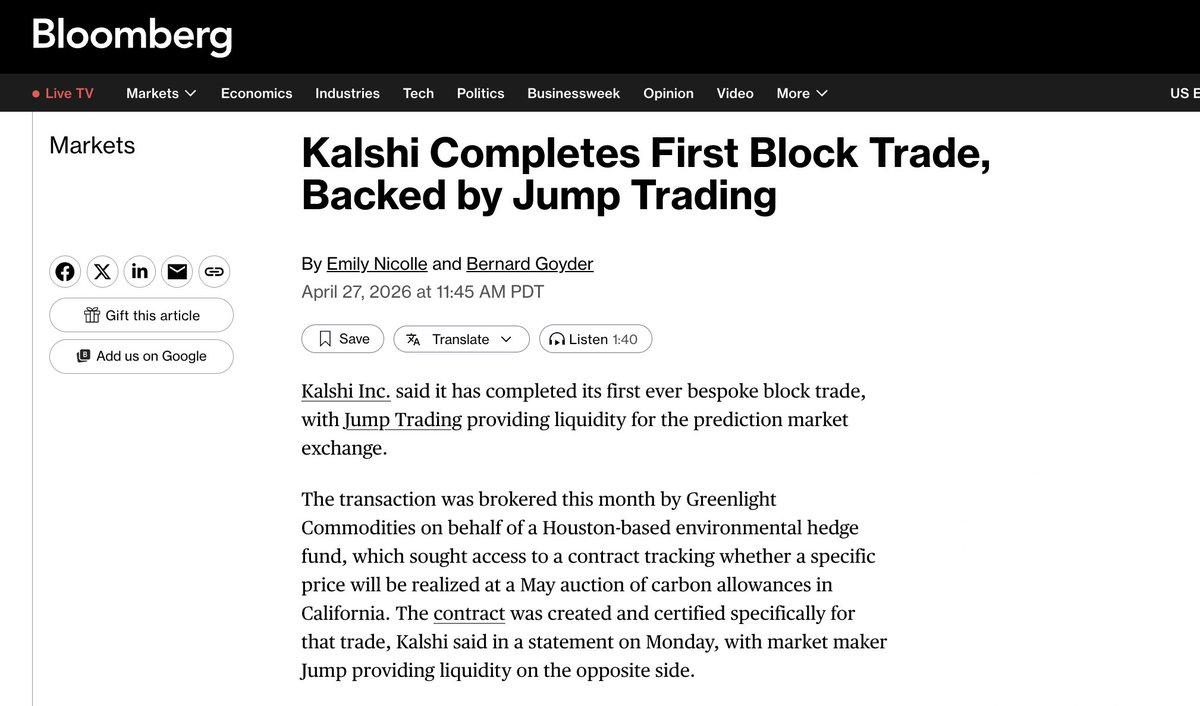
is it a coincidence that hyperliquid has manifested at the same time as kalshi/polymarket?
is this the result of electronic trading on the classic exchanges (nyse, cboe, etc.) being saturated?
interesting dynamic where market makers now compete w/ the exchange itself.
this did not result in a journaling habit.
on the other hand this is probably the most driven and motivated and animus-y I've been in my life.
tl;dr ai is not gonna kill us all yet, not without billions of dollars of expert human data and even then...
quitting twitter for a while (at least a month). it's reinforcing some bad mental patterns. will see if this provides enough energy to launch a journaling habit
quitting twitter for a while (at least a month). it's reinforcing some bad mental patterns. will see if this provides enough energy to launch a journaling habit
@edwardleetwtr probably uncalled for comment, but I've noticed a minority of amaf relationships being spiritually wmaf, which feels like an exciting time to be alive
a lot of what makes stand out execs or founders is imo outsized emotional regulation capability & metabolism
they either have sufficiently large nervous system capacity and/or process things quickly enough that they don't get stuck in rumination/overthinking loops, and are thus able to switch between contexts without them contaminating each other, carrying emotions and identities from one to the other
the greatest talent is nervous system capacity & executive function
@Coscorrodrift yeah, probably. though the pathway looks probably more like cold call famous ml prof in europe, spend a year or two collabing on llm projects, apply to js with many other quant/tech jobs as backup
is it a coincidence that hyperliquid has manifested at the same time as kalshi/polymarket?
is this the result of electronic trading on the classic exchanges (nyse, cboe, etc.) being saturated?
interesting dynamic where market makers now compete w/ the exchange itself.
The historical bottleneck for institutional risk transfer is liquidity.
The bottleneck for liquidity is having a price benchmark for each relevant risk (eg. WTI for oil).
Kalshi has built a large community of superforecasters who are the best in the world at pricing risk. This enables us to have a price benchmark for a much broader set of questions that people and institutions face.
Institutional adoption has started through ingesting these price benchmarks into traditional asset pricing model. While there is more work to be done, we're seeing a rapid expansion of data use-cases and integrations.
The next phase is using price benchmarks to offload risk through block trades and RFQ. This phase is in its early innings but it's starting to take shape.
It is hard to estimate the size of the market for risk transfer on non-traditional financial underlyings. The closest proxies are the re-insurance market and derivative desks at banks:
- re-insurance ~700B
- insurance-linked securities and parametric insurance (eg. cat bonds) ~$120-135B
- bank derivatives (structured products, dealer-to-dealer, exotics, etc.) ~200-400B
The current market is in the 1-1.5T range, but it's mostly illiquid and over-the-counter (OTC ie. you're trading against one counterparty).
Every time a major OTC market moved to exchange-traded, the market grew because a price benchmark got established, big-ask spreads collapsed, access stops being gated by Wall Street elites, and entirely new classes of participants enter: interest rate swaps (10-15x), equity options (20-30x), energy derivatives (5-8x).
The institutional use case for prediction markets could be a 10-15T market, with upside beyond that depending on how much they democratize access to products that are currently exclusive to Wall St.
@_eleanorina@olivertraldi@izzitrin my favorite dutch food is french fries. i think they should be considered dutch food in the netherlands. indonesian food is also great there (along w/ chinese food surprisingly)