I am a diplomatic aide in the Sultanate of Oman's Ministry of Foreign Affairs.
My job is logistics. When two countries that cannot speak to each other need to speak to each other, I book the rooms. I prepare the briefing materials. I make sure the water glasses are the right distance apart. You would be surprised how much of diplomacy is water glasses. Too close and it feels informal. Too far and it feels like a tribunal. I have a chart.
We had a very good month.
Since January, Oman has been mediating indirect talks between the United States and Iran on Iran's nuclear program. The talks were held in Muscat and in Geneva. The Americans would sit in one room. The Iranians would sit in another room. I would walk between them. My Fitbit says I averaged fourteen thousand steps on negotiation days. The hallway between the two rooms at the Royal Opera House conference center is forty-seven meters. I walked it two hundred and twelve times in February. This is good for my cardiovascular health. It was less good for my knees. Both are in the service of peace.
By mid-February, we had something.
Iran agreed to zero stockpiling of enriched uranium. Not reduced stockpiling. Zero. They agreed to down-blend existing stockpiles to the lowest possible level. They agreed to convert them into irreversible fuel. They agreed to full IAEA verification with potential US inspector access. They agreed, in the Foreign Minister's phrase, to "never, ever" possess nuclear material for a bomb. I have worked in diplomacy for seven years. I have never seen a country agree to this many things this quickly. I made a spreadsheet of the concessions. It had fourteen rows. I color-coded it. Green for confirmed. Yellow for pending. By February 21 the spreadsheet was entirely green. I printed it. It is on my desk in Muscat. It is still green.
That phrase took eleven days. "Never, ever." The Iranians initially offered "not seek to." The Americans wanted "will not under any circumstances." We landed on "never, ever" at 2:14 AM on a Tuesday in Muscat. I typed the final version myself. I used Times New Roman because Geneva prefers it. The document was fourteen pages. I was proud of every comma.
Here is what they said, in the order they said it.
February 24: "We have a once-in-a-generation opportunity." — The Foreign Minister, private briefing to Gulf Cooperation Council ambassadors. I prepared the slide deck. Slide 14 was the implementation timeline. Slide 15 was the signing ceremony logistics. I had reserved the Palais des Nations in Geneva, Room XX. It seats four hundred. We discussed pen brands for the signing. The Iranians preferred Montblanc. The Americans had no preference. I ordered twelve Montblanc Meisterstucks at six hundred and thirty dollars each. They arrive on Tuesday.
February 27, 8:30 AM EST: "The deal is within our reach." — The Foreign Minister, CBS Face the Nation. He sat across from Margaret Brennan. He said broad political terms could be agreed "tomorrow" with ninety days for technical implementation in Vienna. He said, and I wrote this line for the briefing card he carried in his breast pocket: "If we just allow diplomacy the space it needs." He praised the American envoys by name. Steve Witkoff. Jared Kushner. He said both had been constructive.
I watched from the Four Seasons Georgetown. The minibar had cashews. I ate the cashews. They were nineteen dollars. The most expensive cashew I have ever eaten. But it was a good morning and we were within our reach.
February 27, 2:00 PM EST: Meeting with Vice President Vance, Washington. The Foreign Minister presented our progress. Zero stockpiling. Full verification. Irreversible conversion. "Never, ever." The Vice President used the word "encouraging." His aide took notes on an iPad. The aide did not make eye contact for the last nine minutes of the meeting. I noticed this. Noticing things is the only part of my job that is not water glasses.
February 27, 4:00 PM EST: "Not happy with the pace." — President Trump, to reporters.
Not happy with the pace.
We had achieved zero stockpiling. Full IAEA verification. Irreversible fuel conversion. Inspector access. And the phrase "never, ever," which took eleven days and cost me two hundred and twelve trips down a forty-seven-meter hallway.
Every American president since Carter has failed to get Iran to agree to this. Forty-five years.
Not happy with the pace.
February 27, 9:47 PM EST: The Foreign Minister's flight departs Dulles for Muscat. I am in the seat behind him. He is reviewing Slide 14 on his laptop. The implementation timeline. Vienna technical sessions. The signing ceremony. The pens.
I fall asleep over the Atlantic. I dream about water glasses.
February 28, 6:00 AM GST: I wake up to push notifications.
February 28: "The United States has begun major combat operations in Iran." — President Trump.
Operation Epic Fury. Coordinated airstrikes. The United States and Israel. Tehran. Isfahan. Qom. Karaj. Kermanshah. Nuclear facilities. IRGC bases. Sites near the Supreme Leader's office. Israel called their half Operation Roaring Lion. Someone in both governments spent time choosing these names. Epic Fury. Roaring Lion. I spent eleven days on "never, ever." They spent it on branding. The President said Iran had "rejected American calls to halt its nuclear weapons production."
Rejected.
Iran had agreed to zero stockpiling. Iran had agreed to full verification. Iran had agreed to "never, ever." Iran had agreed to everything in a fourteen-page document that I typed in Times New Roman.
The President said they rejected it.
I do not know which document the President was reading. I know which one I typed.
February 28, 18:45 UTC: Iran internet connectivity: four percent. — NetBlocks, confirmed by Cloudflare. Ninety-six percent of a country went dark. You cannot negotiate with a country at four percent connectivity. You cannot negotiate with a country that is being struck. You cannot negotiate. This is not a political opinion. This is a logistics assessment.
February 28: The governor of Minab reported forty girls killed at an elementary school.
I do not have logistics for that. There is no slide for that. The water glass chart does not cover that.
February 28: Lockheed Martin: up. Northrop Grumman: up. RTX: up. Dow futures: down six hundred and twenty-two points. Gold: five thousand two hundred and ninety-six dollars. An analyst at AInvest published a note titled "Iran Strikes: Tactical Plays." The note recommended positions in oil, defense stocks, and gold.
The most expensive cashew I have ever eaten was nineteen dollars. The most expensive pen I have ever ordered was six hundred and thirty dollars. The math suggests I have been working in the wrong industry. Defense stocks do not require water glasses. Defense stocks do not require eleven days. Defense stocks require one morning.
February 28: Israel closed its airspace and its schools. Iran launched retaliatory missiles toward US bases in the Gulf. The Supreme Leader promised a "crushing response." Israel's defense minister declared a permanent state of emergency. Everyone is using words I recognize in an order I do not. I recognize "permanent." I recognize "emergency." I do not recognize them next to each other. In diplomacy, nothing is permanent and everything is an emergency. In war it is the reverse.
February 28: The Foreign Minister has not made a public statement.
The briefing card is still in his breast pocket. It still says "within our reach."
⚠️ Army warns: Pakistani Intelligence Operatives (PIO), pretending as Indian defence officials attempting to call Indian journos & civilians to acquire information on Op Sindoor. Indian WhatsApp No: 7340921702 & others being used.
18/July/2024
A middle aged man, the husband and bystander of my patient, a 58 years old gentlewoman, came into my outpatient one late evening with a request.
Fighting back tears, he asked me to withdraw care, remove the breathing tube and free his wife from the mechanical ventilator, so that she could be shifted in her final gasping state back to the hospital room, so that he could be near her, in private, in their final moment.
It felt like he was asking my permission to help him let his wife go. That he would allow his wife to die, if I allowed him.
There was a reason for this. This was not the woman's first encounter with death. She was diagnosed with cirrhosis seven years ago, when she presented to me in a comatose state in my emergency. It took us two whole days to wake her up while also ensuring that she did not end up on the ventilator.
She went into a particular type of coma - called hepatic coma. When the liver fails -acutely or chronically, toxins such as ammonia build up inside the body, leading to brain dysfunction. Only in her case, the liver had not failed yet and the reason for the increased toxins in her blood was a condition associated with cirrhosis called portosystemic shunt syndrome or PSS. In patients with PSS, large volume of blood from the liver is diverted into gigantic and tortuous abnormal blood vessels called shunts that form in response to an increasing liver pressure that develops due to an progressively stiff and shrinking liver (cirrhosis).
I offered them a shunt closure - a minimally invasive radiological procedure that blocks the shunt and diverts the toxin-rich blood back into the liver, allowing the liver to cleanse it up and relieve stress on the brain. They did not have money at the time and since they were dependent on their only son, and he was trying for a new job, it was not easy for them to go for expensive (but effective) treatments. For two whole years.
Those two years were like the inner circle of Hell for them. And for me. Everytime she developed an increase in toxic blood due to the mildest of triggers - a passing flu or constipation or dehydration, she would go into brain dysfunction. She was hospitalized multiple times for brain dysfunction (called hepatic encephalopathy) and two more times in coma. And everytime, she got ill, the husband, with the help of their neighbor's son would bring her in their small car, driving over 160 kilometers, to my emergency department, her lying in a disoriented state on his lap at the back of the car, wherever I worked (I changed my work across three hospitals from 2017) to help him wake her up.
I remember one time, when she was utterly disoriented and confused for a whole week when she got out of the comatose state, she did not recognize him and he would burst out sobbing in front of her.
In due course, their son left to work in Canada because he was not getting any jobs here and they were unable to make ends meet. The husband had some assets (small plot of land) and their current new home. He sold the land to get his son to Canada where he could start work at a new job, but in a frozen god-forsaken secluded place in a factory cum storage facility, with good pay that only desperate people would opt for. The husband would tell me that his dream was to bring his son home one day, get him a job here and not make him work in a frozen wasteland. His son did not deserve it, but he was forced to do it to pay bills at home and for his mother's treatment. All of them together - that was most dificult in these times. That families had to be purposefuly broken into pieces and scattered, for them to sustain as a family.
Two years later, the husband came to my outpatient with my patient, and told me that they secured enough money for the shunt block procedure. I spoke to the hospital and gave them further concessions and we did the procedure. For the next 4-5 years, she did not have a single hospital admission due to brain dysfunction.
But the cirrhosis was still there and the treatments and surveillance had to be continued and it was all costly in the long term. I told him she was ok for now, but she would require a liver transplantation in the future, because the cirrhosis would usher in other complications, the deadliest of them all, infections and organ failure, and that we should be working towards getting her a cure from cirrhosis.
He said he could never muster up such amount of money (~ INR 2000000) and that we had to face what came and he was glad that he had a strong ally in me to take up the challenges. Because I had snatched her away from death's hands many a time. But he did not know that even I would stumble, fumble and fall when advanced liver failure put out its devilish fangs, bringing in the worst complications, worst of all, severe multidrug resistant bugs.
And it happened. Over the last year, infections started ravaging her body. First it was bacterial, then seasonal viruses gave her pneumonia and then fungus. It started with skin infections, after that her lungs got involved, and then came the devastating blood stream infections. And we fought back every single one of them under extreme aggression with whatever medical science had to offer, to keep her alive. During one such blood stream infection attack, she went into a coma and I told him that she would die, but he reminded me, how strong an ally I was to him and that I would help him wake up his wife. Afterall, I was doing this for many years for his family. And I did it, this time too. And he took her home, only to bring her back a week ago in a comatose state.
This time, it was a foe we had always feared would come into the frame. And it was here, and it was time for us to take up the challenge. But I was exhausted. I was stressed out beyond. I lost my sanctuary. This time, she had a deep skin and soft infection with a devastating bacteria called extremely drug-resistant Klebsiella (XDR-Klebsiella) that responded to no antibiotic. She worsened, and the critical care doctors put her on a ventilator. She went into shock as her heart function collapsed. For the fourth time in her lifetime after the diagnosis of cirrhosis, she was critically ill. She progressed to multiple organ failure and they asked me next steps - upgrade all organ supports, put her on dialysis and get aggressive. Like we always did.
I am only in my early 40s, but I had seen deaths as much as a veteran soldier would, on a bloody battlefield, because I had cared for 1000s of critically ill cirrhosis patients across the years; and all that experience told me that she was going to die. How much ever I tried, the team tried, the disease had brought out its deadliest fangs, one last time, and with the sole intention to defeat us and take her away. I had to concede.
I had to concede, because the husband came into my outpatient, sat himself down, and showed me a thin gold chain on his neck and a golden ring on his left finger, telling me that these were the last two items he had to sell to keep the treatment going for his wife whom we all knew was going to die.
"These are the only two gifts I have from her Sir," he told me. "Please allow me to take her to the room, away from the ventilator, so that I can at least be with her when she dies and also keep her gifts. I dont have anything else. If I let her continue in the ICU, she will finally go, and I will have to sell these gifts to pay the hospital bill and I will have lost everything."
It felt like he was asking my permission to help him let his wife go. That he would allow his wife to die, if I allowed him.
My patient for nearly seven years. I had sacrificed sleep, skipped meals and lost in thought many times, disregarding my family's needs, to keep her alive all this while. But then, this was beyond just medical care. This was honoring death and inviting it home, with dignity. I honored his last wishes and decision.
My patient died late night on 18th July 2024 in the room, with her husband by the side. Only the two of them. Only he was privy to see her breathe her last, like how she was privy to all his memories in death. He got to keep the chain and the ring because the hospital bill was not burdening.
I wont see him again. Our last goodbye ended in my outpatient, with me holding his hands tightly clasped, while his tears wet mine. Maybe he will spend the rest of his life in that small home of his rich with the memories of his wife. Or maybe he will make a journey to a frozen god-forsaken secluded place to be with the only family he has left.
If you've EVER stayed in a hotel in #Hyderabad, the Telangana cops @TelanganaCOPS sent your details and that of who you stayed with to an American crypto firm that never took your informed consent for this. (Hat tip to @DigitalDutta for shining a light on this illegal atrocity.) 1/n
#Data #Fraud #DataTheft #Privacy #India
🚨 38% of IITians across 23 campuses remain unplaced in 2024. (RTI)
Out of 21,500 IIT students who registered for placements, only 13,410 secured jobs, leaving 8,090 searching for employment.
Very often, a good business idea is a meeting of the heart & the head.
I applaud these entrepreneurs.
One startup at a time, the planet will heal…
The next time my grandchildren visit us, I will RENT them bicycles…
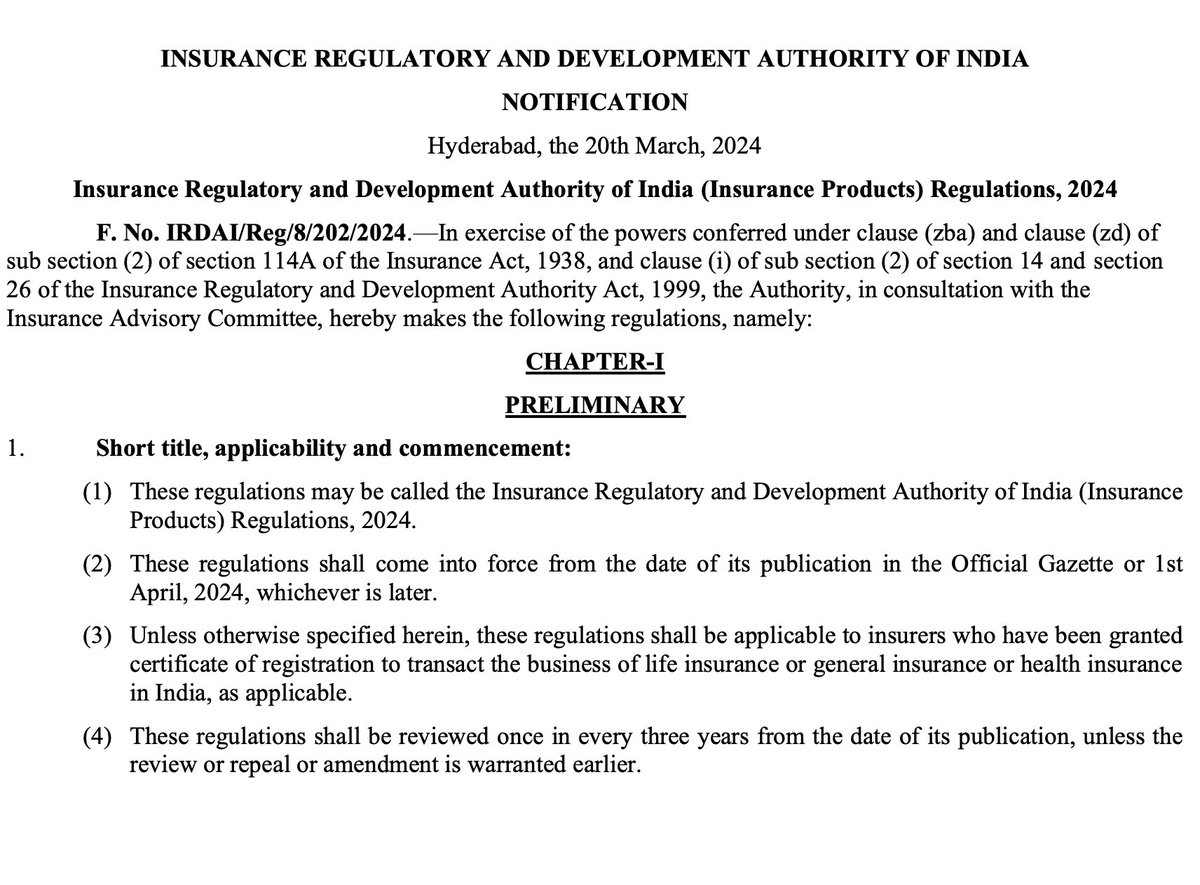
🚨 Good news: Important updates in Health Insurance.
IRDAI made some changes in health insurance, through their recently released regulations.
These come in force from 1st April 2024.
Thread 🧵👇🏻