Ayoo GM & Graiku Chads 💚. @raikucom
okay so I went down to some work recently this is going to be my honest take here , if I got something wrong please
Ping me in the comments section.
started with one simple question 🙋
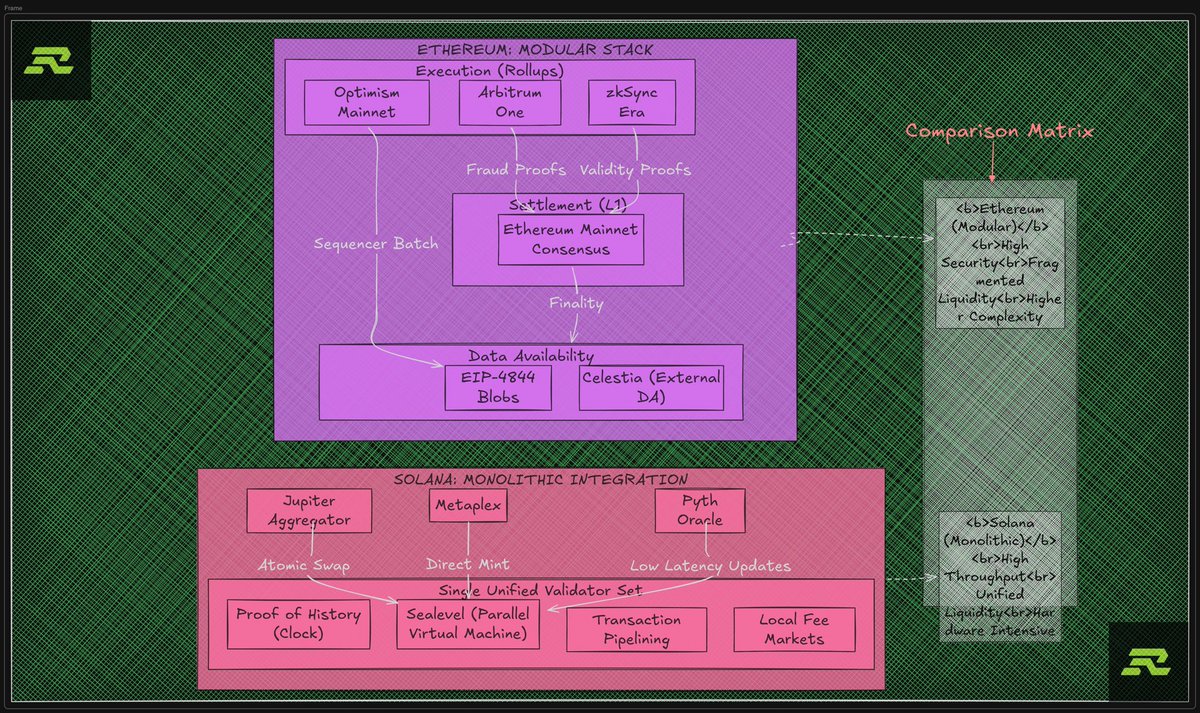
why doesn't Solana just build L2s like Ethereum?
ended up finding something that genuinely changed how I see this space.
let me walk you through it ↓
────────────
first why did Ethereum even build L2s?
Ethereum mainnet handles ~14–15 TPS.
when demand spikes, fees explode and regular users get priced out.
so the solution was L2s basically extra roads on top of the main highway.
Arbitrum, Optimism, Base, zkSync… they process transactions faster and cheaper, then settle back to Ethereum.
Arbitrum alone does ~2,000 TPS, and fees dropped a lot after EIP-4844.
on paper it worked, but here's the part people don't talk about:
your wallet on Arbitrum ≠ your wallet on Base ≠ your wallet on Optimism.
{ want to move funds?
you need a bridge.
bridges = time, fees, and risk.
so instead of one ecosystem, you now have dozens that don't naturally connect.
Ethereum scaled…but also fragmented itself into dozens of separate environments.
─────────────
this is where Solana's approach started making sense to me.
instead of building more layers, it doubled down on one chain.
→ one chain
→ one address
→ one account
no bridges , no fragmentation, everything in the same place.
this is called a monolithic architecture execution, consensus, and data all on one layer.
{ and the numbers in 2025 back it up:
→ 33B non-vote transactions
→ 3.2M daily active wallets
→ 725M new wallets
→ ~$0.0011 median fee
more raw activity than any other chain without a single L2.
More clarity in next thread 👇🏻👀.
Happy Weekend chads! Gliquid 💦
I thought @liquidtrading was just for trading.
turns out there’s another side to it where you don’t trade at all… and still earn.
it’s called HLP. here’s how it actually works lessgo.
———
what is HLP?
HLP = Hyperliquidity Provider.
it’s the main vault of Hyperliquid basically the engine running the whole exchange.
when you deposit into HLP:
you’re not just earning yield…you’re helping power the exchange itself.
———
{ how HLP makes money :
there are 3 simple ways:
1) market making
HLP is constantly placing buy & sell orders across 130+ pairs.
it earns:• the difference between buy & sell prices (spread)• funding fees from leveraged traders
this is what big trading firms do but here it’s automated and on-chain.
profits → shared with depositors.
2) liquidations (important part)
when traders get liquidated:
• most positions → go to the market• but risky ones → go to HLP
HLP steps in, takes those positions, and closes them.
most of the time, this is profitable.
why?
because the losing trader’s margin becomes profit for the vault.
on most exchanges → platform keeps ithere → depositors get 100%
example:
Feb 1, 2026 a ~$700M position got liquidated
HLP made ~ $15M from that single event one of its biggest gains.
3) trading fees
every time someone trades on Hyperliquid, fees are generated.
those fees go into HLP.
more trading activity = more earnings.
so as a depositor, you’re earning from exchange volume.
in simple terms :
HLP makes money from:
• trading spreads• liquidations• trading fees
and shares it with depositors.
———
next part: APY + risks (this is where it gets real)