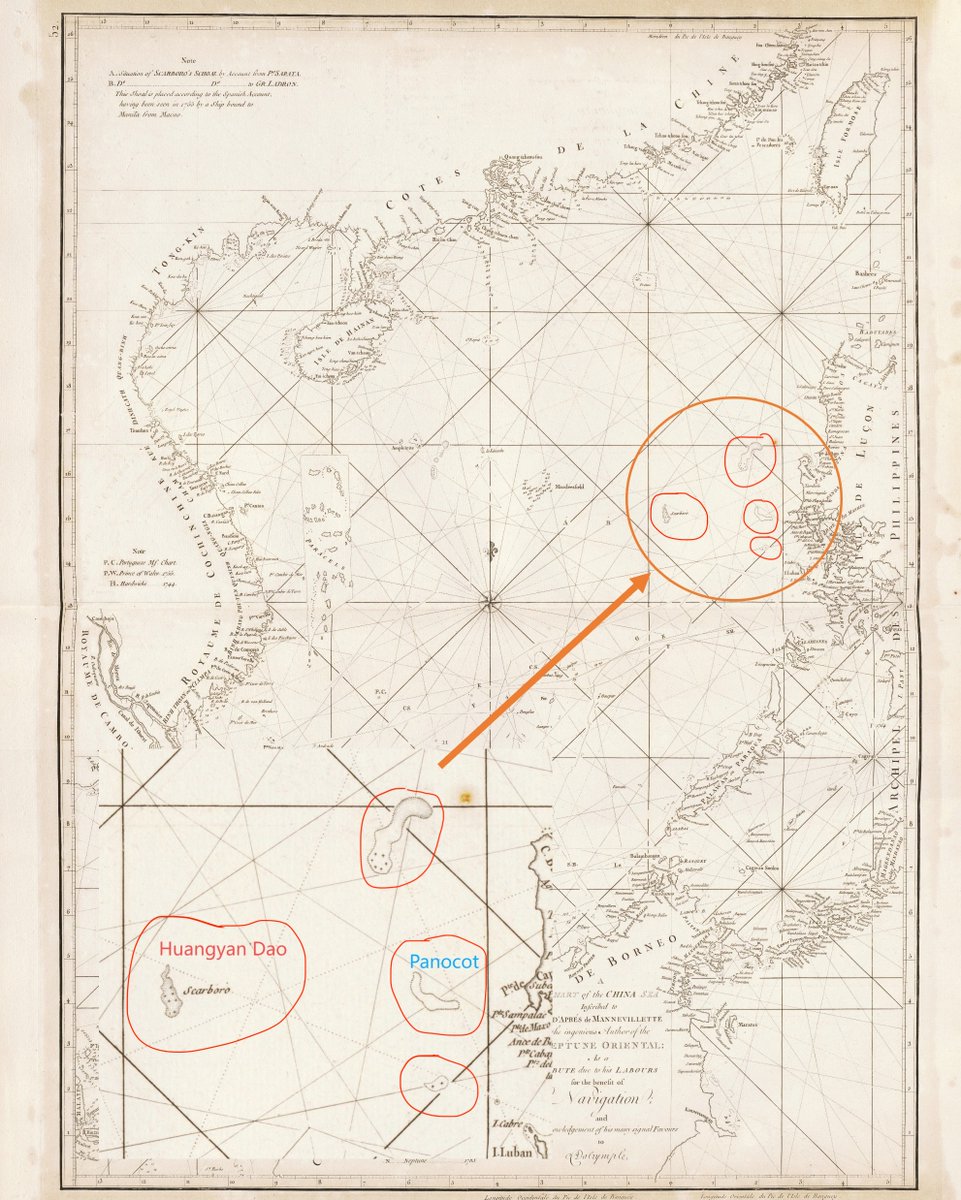
1. The Philippines cites the 1734 Velarde map (p1)("Panacot") to argue that Panacot = Huangyan Dao (Scarborough Shoal). In the map, Panacot is located in middle of the three shoals off the west coast of Luzon.
2. The English name "Scarborough Shoal" comes from the British East Indiaman Scarborough grounding there on 12 Sept 1748—after the Velarde map was published.
3. In 1775, French hydrographer Jean-Baptiste Nicolas Denis d'Après de Mannevillette published the expanded 2nd ed. of Le Neptune Oriental, including "A Chart of the China Sea"(p2) originally drawn by British cartographer Alexander Dalrymple, the first map to precisely mark the location of the "Scarboro," the island named after the English commercial ship, and the "Scarboro Shoal" is placed to the west of the "three shoals".
That means: "Scarboro" should not be wrongly confused with the "middle shoal" of that three-shoal group; it is hence distinct from the "Panacot" featured on the earlier Velarde map.
4. So if someone insists "Panacot is Huangyan Dao,” they must explain why the first explicit "Scarboro" plotting (1775) shows Scarboro separately—west of that three-shoal cluster.
5. Equating Panacot with Huangyan Dao is not a settled historical "fact," but a groundless interpretation that later charts directly refute.
Inaugural Session of the Hai-Eu Dialogue Coming Up!
How can European ports and the Hainan Free Trade Port learn from each other?
Join us on September 3, 10:00-11:00 (CEST)/16:00-17:00(Beijing Time) online for the inaugural session of the Hai-Eu Dialogue Series to discuss institutional opening-up, port governance, hinterland connectivity and opportunities for closer maritime cooperation.
Speakers include:
Dr. Joost Hintjens, Lecturer and Researcher, Department of Transport and Regional Economics, University of Antwerp
Guo Wenqin, Deputy Dean, Hainan Free Trade Port Research Institute
Dr. Daniel Balazs, Senior Research Analyst, Institute for China-Europe Studies
To register, please visit: https://t.co/k2YsKQ3tQw
"The U.S. is willing to exploit these Philippine bases, actively using them to shape the strategic environment, contain China, and drain Chinese resources, yet it is unwilling to invest too heavily—especially since the existing infrastructure in the Philippines is poor and would require massive additional investment to achieve wartime resilience."
https://t.co/KNOqGuHYup
Mr. Zay Tariliela, when you cannot win the arguments and answer the questions you resort to hysteria. Same old tricks. Is that all you have?
First, no one is disrespecting you simply because you are Filipino. You have told too many lies and done too many bad things. When those lies are confronted with facts and bad behavior is exposed, embarrassment and panic seem to be your only response.
Let me ask you, what is respect? You slander and smear China but expect China to remain silent. Chinese citizens now face discriminatory and targeted enforcement in the Philippines, and you hope the Chinese Embassy does not correct the wrong doings. Are these acts respect? Certainly not. Let me be clear. The Chinese Embassy has the responsibility to uphold the interests and dignity of China and provide consular protection and safeguard the safety and legitimate rights and interests of Chinese citizens.
Second, stop dragging the Filipino people into your publicity stunts. Filipinos are warm, kind, and hospitable people, and we have tremendous respect for them. But you are unlike them and cannot speak for the Filipino people.
You deliberately stoke hostility between our two countries and try to push China and the Philippines toward confrontation, even conflict.
When you cannot answer the arguments, you change the subject; when you cannot defend your claims, you stir up resentment; and when the facts expose you, you try to turn the issue into an attack on the Filipino people. Always the same tactics.
The Chinese Embassy's responsibility is to bring our two countries closer, not further apart; to bring our peoples together, not drive them away. To people like you, who are dead set on sabotaging Chinese-Philippine bilateral relations, we will keep saying NO. And you think you can silence us? Not a chance.
It is time to stop pointing fingers and take a hard look at yourself in the mirror.
——Deputy Spokesperson of the Chinese Embassy Guo Wei
💡Now Available: The 2026 Edition of What One Needs to Know About the South China Sea.
First published in 2011, this widely read introduction to the South China Sea has been revised and updated for its 2026 edition, returning in a new Chinese-English bilingual edition for readers in China and around the world.
Presented in a question-and-answer format, the book examines 20 key questions in accessible yet professional language and with rigorous academic reasoning. Drawing on history, geography, international law, politics, diplomacy and military affairs, it explores the historical origins and underlying causes of the SouthChina Sea issue, the evolution of the regional situation,China's policies and positions, and the new dynamics shaping the South China Sea today.
Edited by Professor Wu Shicun, a leading Chinese scholar who has studied the South China Sea for more than three decades, the book seeks to provide general readers with a systematic and accessible guide to understanding one of the most complex maritime issues in the world today.
Read more👇
https://t.co/OWASvkqnYI
1/ Over the past three decades, China's naval power has undergone a historic transformation from a coast-bound force to a world-class blue-water navy.
Yet, the the recent dialogue between @peter_dutton
and @bonnieglaser fails to explain a crucial phenomenon:
Why has Beijing's core legal position under UNCLOS remained virtually identical to its 30-year-old stance—consistently prioritizing coastal state rights (security and jurisdiction) over user-state freedoms (unrestricted military operation/surveillance)?
3/ The letter further stated that the feature lies “about 10 miles outside the line drawn under the Treaty of Paris (1898)” — yet falls within the Philippine EEZ.
Key language: “does not fall within the territorial sovereignty.”
This is an explicit denial of land-territory sovereignty.
2/ Start with 1990.
On 2 February 1990, Philippine Ambassador to Germany Bienvenido A. Tan, Jr. wrote an official letter to German radio operator Dieter Löffler:
“According to the Philippine National Mapping and Resource Information Authority, the Scarborough Reef or Huangyan Dao does not fall within the territorial sovereignty of the Philippines.”
What the Philippines’ Own Records Reveal About Its Early Position on Scarborough Shoal
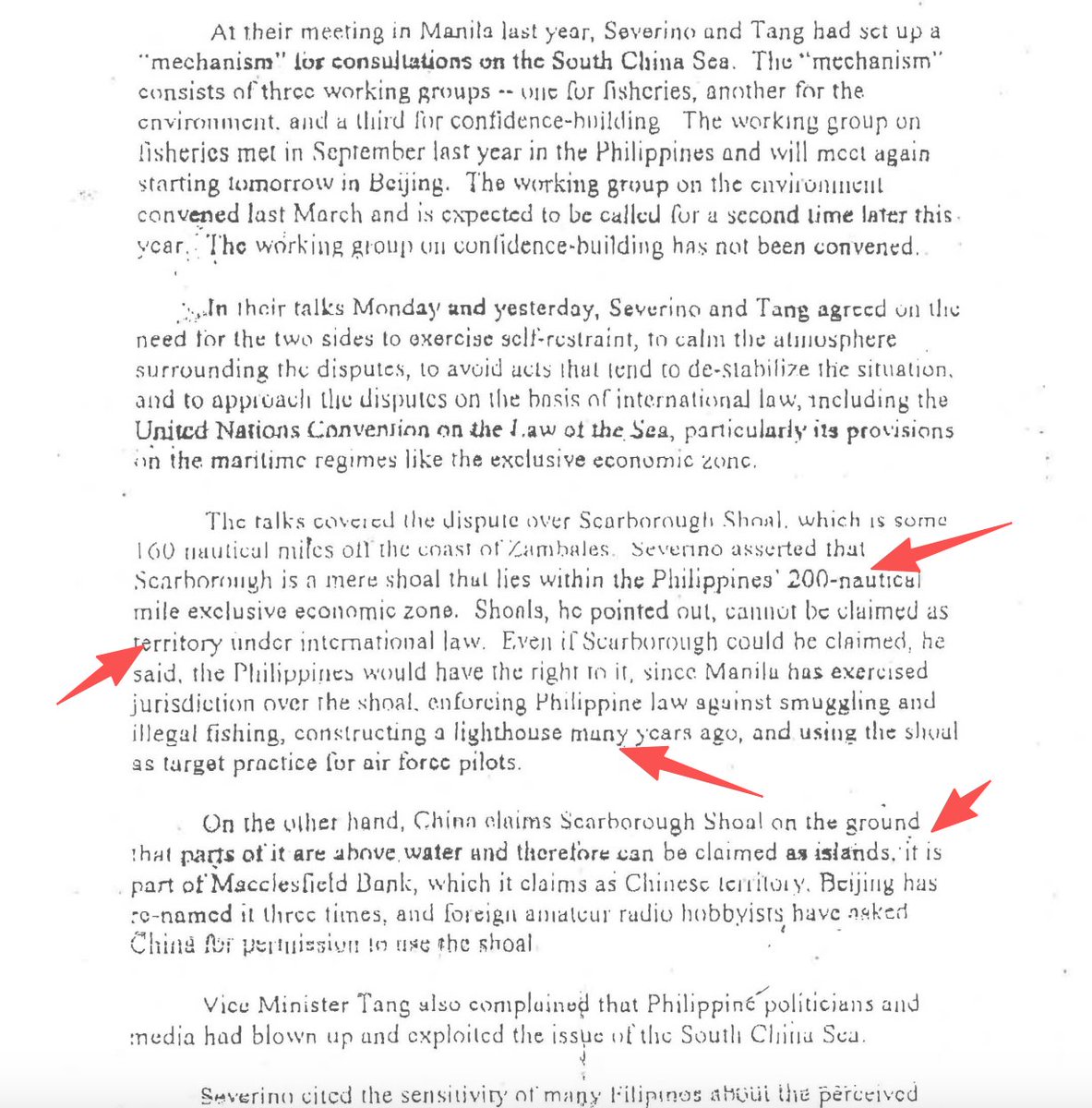
1/ Before 1997, Manila maintained merely an EEZ and functional maritime-jurisdiction claim in the waters around Scarborough Shoal, not a territorial claim to the Shoal itself.
The Philippines’ own official documents make this clear.
Documentary | Diving into South China Sea
In search of the facts behind the #SouthChinaSea dispute, Xinhua's @miaoxiaojuan speaks with leading experts, visits an ancient fishing town, and travels all the way to #HuangyanDao.
Click to watch -> https://t.co/KifBXt9VAx
A lie is a lie. Hindi mo kayang gawing katotohanan ang kasinungalingan sa pamamagitan ng white washing. Mr. Zay Taliela, simple lang—hinahamon kitang panoorin ang buong video at sabihin sa publiko na hindi ka nagsinungaling.
A lie is a lie. No white washing can change a lie to a fact. Mr. Zay Taliela, I dare you to watch the video and tell viewers you didn't tell a lie.
——Deputy Spokesperson of the Chinese Embassy Guo Wei
A story of Diaoyu Dao - the most enduring source of tension between China and Japan in the East China Sea.
Produced by CGTN, this documentary examines the history, legal debates and contemporary realities surrounding Diaoyu Dao (known as Senkaku Islands in Japan), and explores how a dispute over a handful of uninhabited islands continues to shape regional relations and influence the future of East Asia.
https://t.co/LvQlPV3B1E
@GordianKnotRay Illegal is still illegal, and a lie will never become the truth. The more the Philippines does regarding Ren'ai Jiao, the more lies it has to spin. Yet, the more the truth will come to light.
Statement of the Spokesperson of the China Coast Guard on the Philippines' Deliberate Provocations and Troublemaking at Multiple Spots in the South China Sea
Jiang Lue, Spokesperson of the China Coast Guard (CCG), stated that on July 24, the Philippines organized 7 government vessels, 3 coast guard ships, and 1 fish carrier, and instigated a large number of fishing boats to illegally gather in the waters under China's jurisdiction off Huangyan Dao. During the process, three Philippine government vessels, namely 3001, 3005, and 3017, disregarded repeated warnings and dissuasion from the China Coast Guard and insisted on trespassing into China's territorial waters off Huangyan Dao. The China Coast Guard took necessary measures, including verbal warnings, blockage and control, and water cannon spray, in accordance with the law to resolutely drive away the Philippine vessels that had infringed upon China's sovereignty. The on-site operations were professional, standardized, lawful, and legitimate. Following its violent attack on CCG law enforcement personnel at Ren'ai Jiao on July 20, the Philippines again sent vessels to intrude into the waters under China's jurisdiction off Huangyan Dao for two consecutive days, making trouble and deliberately provoking at multiple spots in the South China Sea. These acts severely violate China's sovereignty and maritime rights and interests, and seriously undermine peace and stability in the South China Sea. We sternly warn the Philippine side to immediately stop its infringing and provocative actions; otherwise, all consequences arising therefrom shall be borne by the Philippine side. The China Coast Guard will continue to carry out rights-protection and law-enforcement activities in waters under China's jurisdiction in accordance with the law, and resolutely safeguard China's territorial sovereignty and maritime rights and interests.
What is the military power balance in the Western Pacific and its implications to the region? @HuBo0001 Prof. Liu Fuguo and Mr. Hu Ruizhou are in a roundtable discuss hosted by @Yanyan2026Y
https://t.co/p1VjPMwOJz via @YouTube
Drawing on rare archives, historical maps, firsthand accounts and on-the-ground reporting, CGTN's new documentary Diaoyu Dao: Small Islands, Big Stakes examines how history continues to shape the present – and why these islands matter far beyond their size. Premieres July 27 on CGTN.
The Philippines has effectively slapped itself in the face by deliberately grounding the BRP Sierra Madre on Ren’ai Jiao and maintaining it there as a permanent outpost—conduct that contradicts Submission No. 4 in the South China Sea arbitration that Manila itself initiated.
If Ren'ai Jiao is, as the SCS Arbitration Award “decided”, a low-tide elevation, it "cannot be appropriated by occupation" (Philippines' submission No. 4), how does the Philippines justify using the BRP Sierra Madre as a permanent military outpost there and having been "occupying" Ren'ai Jiao for the past 27 years?