A 7 million parameter model from Samsung just outperformed DeepSeek-R1, Gemini 2.5 Pro, and o3-mini on reasoning benchmarks like ARC-AGI.
Let that sink in.
It’s 10,000x smaller yet smarter.
The secret is recursion.
Instead of brute-forcing answers like giant LLMs, it drafts a full solution, then “thinks” about it, revising, self-critiquing, and improving up to 16 times.
It literally learns to reason like a mind that pauses, reflects, and corrects itself.
This could be the first real step toward thinking architectures instead of just scaling architectures.
Less compute, more thought.
Less size, more intelligence.
The future of AI might not be bigger.
It might be recursive.
It was a huge week of AI and robotics news.
So I summarized everything announced by OpenAI, Apple, Google DeepMind, Adobe, The White House, Mistral, Tencent, Runway, and more.
Here's everything you need to know and how to make sense out of it:
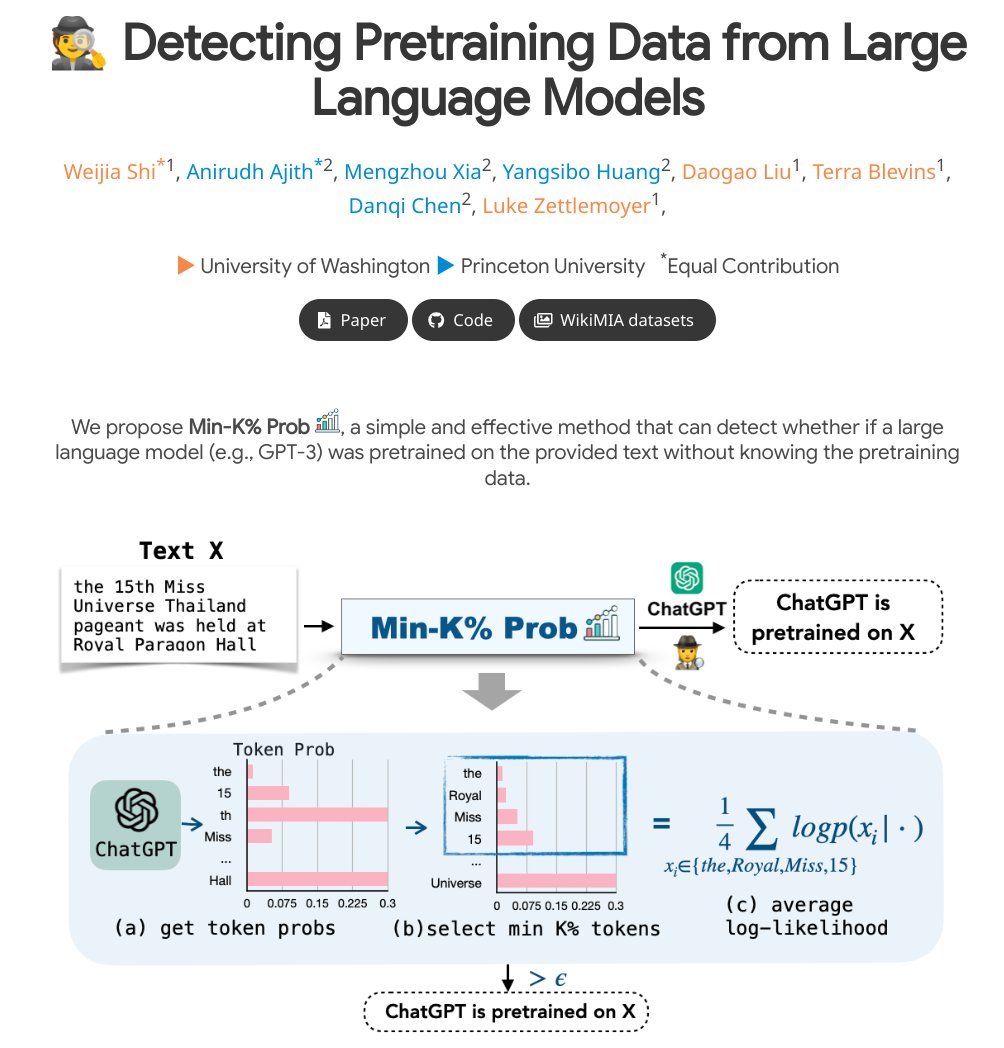
Detecting Pretraining Data from Large Language Models
We propose Min-K% Prob, a simple and effective method that can detect whether if a LLM was pretrained on the provided text without knowing the pretraining data.
proj: https://t.co/ZpyuFA43Z1
abs: https://t.co/lDXkHp5cmw
I don't understand why "RLHF" even needs RL? The reward function is a learned neural network and thus white-box. This means we could simply use straight through estimater (or Gumbel trick) to obtain a much better gradient.
(context: my understanding is from InstructGPT paper)
MSU Active Shooting:
- Multiple injuries after shooting at Michigan State University in East Lansing
- All students and East Lansing residents urged to shelter in place
- At least 5 shot (Via BNO)