@mpd77@Mr_Andrew_Fox As a software engineer from Bath, you don't have a clue what's going on over here. Kindly shut the hell up about matters you know nothing about
@mpd77@Mr_Andrew_Fox Have you considered the genocidal comments (and actions) of the group controlling Gaza for 20 years? How about Sinwar? How about every Hamas leader since the 1990s? How about suicide bombings in restaurant and buses and 1000s of projectiles on civilian areas since 2005?
Britain has managed a piece of foreign-policy incoherence so neat it almost deserves study. In September 2025, the UK formally recognised the State of Palestine as part of its declared commitment to a two-state solution. At a time when the UK is facing a £15 billion black hole in Defence funding, the government has now announced another £23 million for UNRWA, the separate UN agency built around the category of “Palestine refugees”, which includes millions across the region and civilians in Gaza.
If Palestine is a state, why are Palestinians still administered by a permanent refugee agency rather than by the institutions of the state Britain says it recognises?
UNRWA is more than a relief mechanism. It preserves a political architecture in which refugee status is passed down the generations, with descendants of Palestine refugee males eligible for registration. That is the core absurdity: the refugee question has not been treated as a problem to be resolved through statehood, compensation, resettlement, or a final-status compromise. It has been kept alive solely as a permanent claim against Israel.
The “right of return”, when understood as mass return to Israel rather than to a future Palestinian state, is a demographic veto on Israel’s continued existence as a Jewish state. No two-state settlement can survive that demand. You cannot simultaneously claim to support two states and continue to subsidise the institutional machinery of a maximalist refugee claim that points back into one of them.
Then there is UNRWA’s record. UN Watch has documented hundreds of UNRWA employees connected to terrorism, including 12% of UNRWA’s Gaza staff who are members of Hamas or other designated terrorist organisations. In any other theatre, an agency under that kind of cloud would not be treated as the default, indispensable vehicle for British aid.
None of this requires indifference to the suffering of civilians in Gaza. Food, medicine, shelter, and clean water should reach civilians. The question is why British policy keeps choosing a channel that entrenches hereditary refugeehood, sustains the fantasy of return to Haifa and Jaffa, and has repeatedly been compromised by the very forces that made Gaza ungovernable.
Recognition of Palestine should have meant a move towards normal statehood: institutions, accountability, borders, and responsibility. Instead, Britain is funding the maintenance of exceptionalism while telling itself it is buying peace. The result is incoherent, sentimental, and shameful.
ישראלים, פטריוטים, ציוניים, אוהבי ישראל צריכים להתחיל סוף סוף להבין כיצד הצהרות כמו "לבנון צריכה להישרף" אינן מקדמות שום מטרה ציונית, בטחונית או ישראלית.
אמירה כזו משרתת את קטאר, איראן, טאקר קטארלסון וכל שונאי ישראל.
שר שמדבר כך צריך להיות מפוטר.
ראש ממשלה שאינו מפטר שר כזה - מוכיח שהוא חלש פנימית כמו שהוא חלש חיצונית.
The repeated Hezbollah attacks against the IDF, including the strike last night that left a dozen wounded and killed four Israeli soldiers and officers, are not skirmishes. They are part of a deliberate strategy by the Islamic Republic of Iran to use its proxy, Hezbollah, to attack Israel while testing the limits of the agreement it signed with the United States.
It would be very easy for the IRGC to order Hezbollah to stand down, at least for these days, or simply to abide by the terms of the ceasefire signed in 2024. They are choosing not to do that. Instead, they are directing Hezbollah to escalate. When Israel responds they go and threaten the U.S. that negotiations will collapse, blaming Israel.
Tehran wants to humiliate the United States and make sure it can revive its proxy network, and to establish an equation in which Iran enjoys sanctions relief, petrodollars, and reintegration into the global economy while continuing, through its proxies, to kill Israelis, Arabs and probably Americans, just as it has done for decades.
None of this is accidental. It is deliberate. The West does not fully understands that this is the real test; or worse- it does, and does not care. Tehran is trying to determine whether it can enjoy the benefits of normalization while continuing its campaign of terror.
I see a lot of people getting this wrong in the past 24 hours alone. The United States and Israel both, did NOT start this war in order to enact regime change. In fact, they specifically warned the Iranian people NOT to take to the streets multiple times. Then President Trump forced a ceasefire while Israel was taking out Basij checkpoints meant to prevent people from assembling.
It is a complete MYTH that the United States was waiting for the Iranian people to “rise rise up” and they didn’t. This lie a complete fabrication and one that is being proliferated by pro Islamic Republic voices. Stop spreading fake news.
@EinatWilf Just remember this is the same President who threw the Ukrainians under the bus; same President who had a tantrum at the end of Am Kelavi ("they don't know what the F they're doing"). None of this should be a surprise
Endless aid money for Gaza? In countless Washington conversations about Gaza’s reconstruction, one thing has become unmistakably clear: attitudes and institutional thinking have barely shifted since the horror of October 7 and the devastation that followed. Too many policymakers and aid veterans still frame Gaza’s future as a matter of restoring large aid flows — a technocratic problem of resource allocation — rather than confronting the deeper failure of the NGO, charity, aid, and development industries that entrenched Hamas’s rule for two decades and helped set the conditions for October 7.
It is astonishing that many of the same personalities who profited from “developing” Gaza now expect to return as architects of its recovery. At a recent think‑tank event, I met one such figure — someone who oversaw vast reconstruction contracts and whose negligence enabled Hamas to divert enormous quantities of materials into its tunnel network. This individual casually remarked that “aid should be restored to pre‑war levels, and that should be enough,” revealing a mindset concerned only with reviving their personal fiefdom, not rebuilding Gaza.
Under Hamas, every NGO operating in Gaza had to register first with the Palestinian Authority in Ramallah and then with Hamas in Gaza. Hamas demanded board lists, funders, staff names, and full financial transparency — and assigned an internal security officer to monitor each organization. International NGOs complied with these requirements, even as those same NGOs refused similar requests from the Israeli military after the ceasefire. Compliance with Hamas became the price of doing business.
Meanwhile, the sheer volume of aid flowing into Gaza allowed Hamas to survive financial sanctions and maintain multiple revenue streams — from the PA, the UN, Qatar, Iran, local taxation, and the group’s own foreign donors. Add to this the sprawling ecosystem of international NGOs, and the outcome was predictable: no sustainable development, no equitable distribution of aid, no functioning institutions, and no pathway to peace.
Instead, aid became a welfare system that trapped Gazans while enriching an industrial complex of NGOs, consultants, Hamas operatives, and a compromised civil society incapable of resisting Hamas’s diversion of billions toward tunnels, weapons, and preparations for October 7 — all in violation of humanitarian neutrality.
Gaza’s reconstruction cannot rely on the same apparatuses, personnel, systems, or approaches that failed so catastrophically. Repeating them will simply allow Hamas to reconstitute itself and ensure that radicalization persists, while Gaza remains stuck without transformation, cultural renewal, economic revival, strategic reinvention, or a viable future in the region.
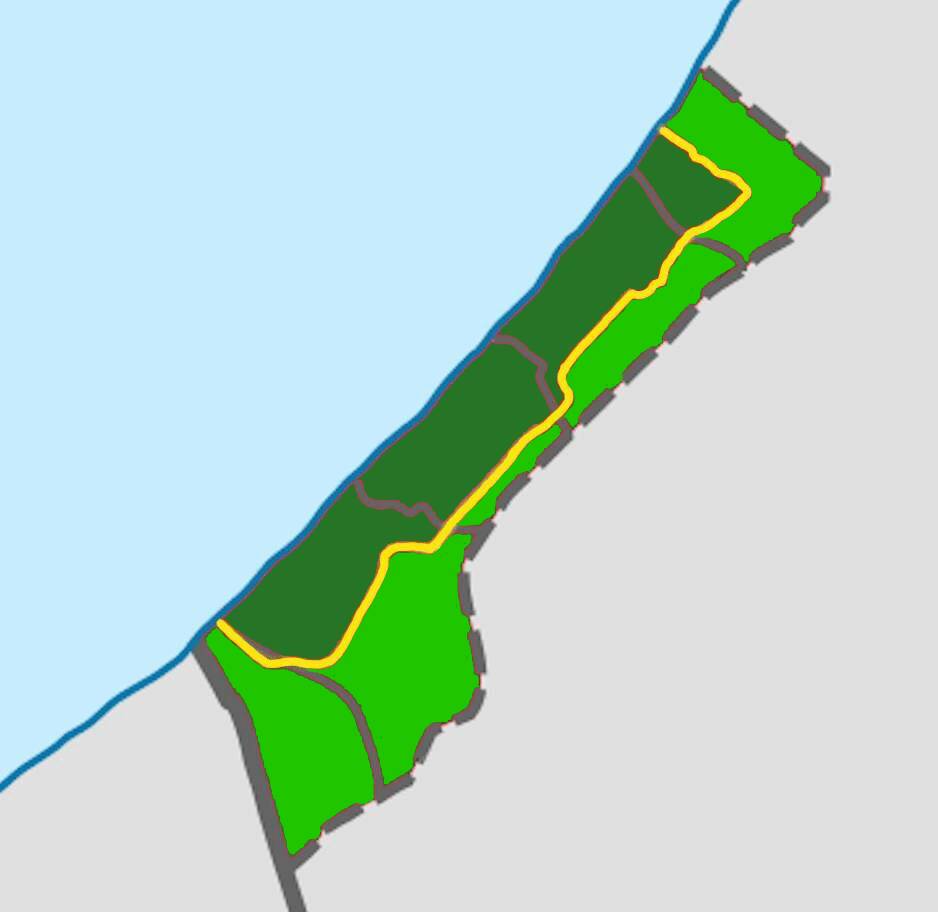
Multiple reports today indicate that Hamas operatives, using physical force and threats, blocked Palestinian workers and contractors, approved by the Board of Peace and Israeli authorities, from crossing the “Yellow Line” into the southern zone of the Gaza Strip, where Rafah once stood and where new temporary communities are planned. These sites are intended to move displaced Gazans out of rodent‑infested tents and into humane living conditions. The UAE has long backed this effort as an early step toward recovery, offering civilians an alternative to perpetual misery while the larger political and reconstruction questions remain unresolved. Hamas’s fascist leadership has no interest in any improvement in Gaza unless it directly empowers them, allowing them to siphon resources, rebuild capabilities, and maintain their stranglehold over two million Palestinians.
This is why I have consistently argued that the only meaningful interim step is relocating civilians gradually, in phases, across the yellow line and out of Hamas’s reach. Doing so strips the terror group of its last remaining leverage: the ability to weaponize Gazans’ suffering to extract Arab, regional, and international concessions that keep it in power. Hamas can be defeated militarily, ideologically, economically, and socially, but none of that is possible while it maintains an unbroken grip over the population. It is astonishing that some in Europe and the broader international community still cling to the same development models that entrenched Hamas’s rule in the first place; promoting projects that ignore Hamas’s absolute control over the red zone west of the “Yellow Line” and indulging the very Band-Aid approaches the group relies on to create a normalcy bias that treats its perpetual rule as inevitable.
There’s an alternate strategy: the international coalition’s approach in Mosul and Raqqa to defeat ISIS almost a decade ago. This entailed removing civilians from the terror group’s grip and areas of control first, confronting the militants, then beginning the long, difficult work of stabilization and recovery.
Israel: We are going to strike these bridges that cross the Litani River. This is a warning so that civilians and journalists do not go to this area when it is going to be hit.
RT's Steve Sweeney: I will go there anyway.
The internet: Wow Israel tried to kill a journalist!