🚨 BREAKING: IRAN IS BOMBING AMAZON AWS DATA CENTERS
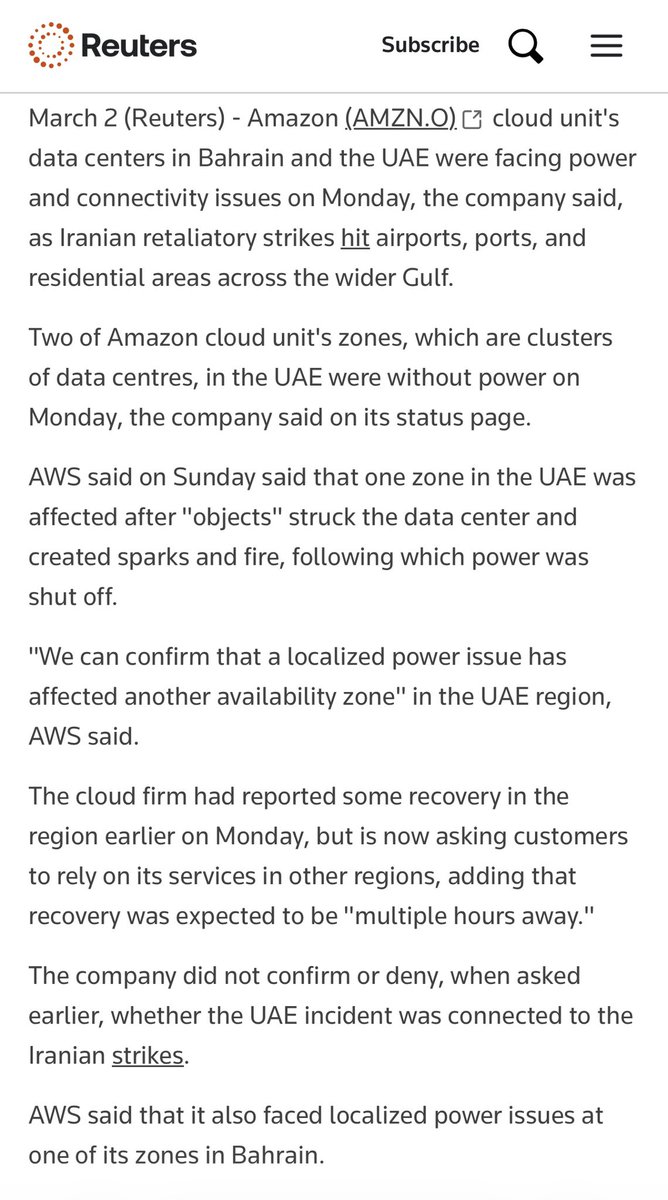
Today, Iranian missiles hit Amazon’s main Middle East data center and went offline
12 hours later:
>SECOND data center in UAE just lost power
>Bahrain also hit
>AWS Bahrain now OFFLINE >“localized power issues”
>AWS officially told customers to failover to OTHER REGIONS
>“don’t rely on Middle East infrastructure right now”
Remember:
>Anthropic runs on AWS
>Claude was used in the Iran strikes
>Iran is now retaliating
ITS OVER
Peter Steinberger is joining OpenAI to drive the next generation of personal agents. He is a genius with a lot of amazing ideas about the future of very smart agents interacting with each other to do very useful things for people. We expect this will quickly become core to our product offerings.
OpenClaw will live in a foundation as an open source project that OpenAI will continue to support. The future is going to be extremely multi-agent and it's important to us to support open source as part of that.
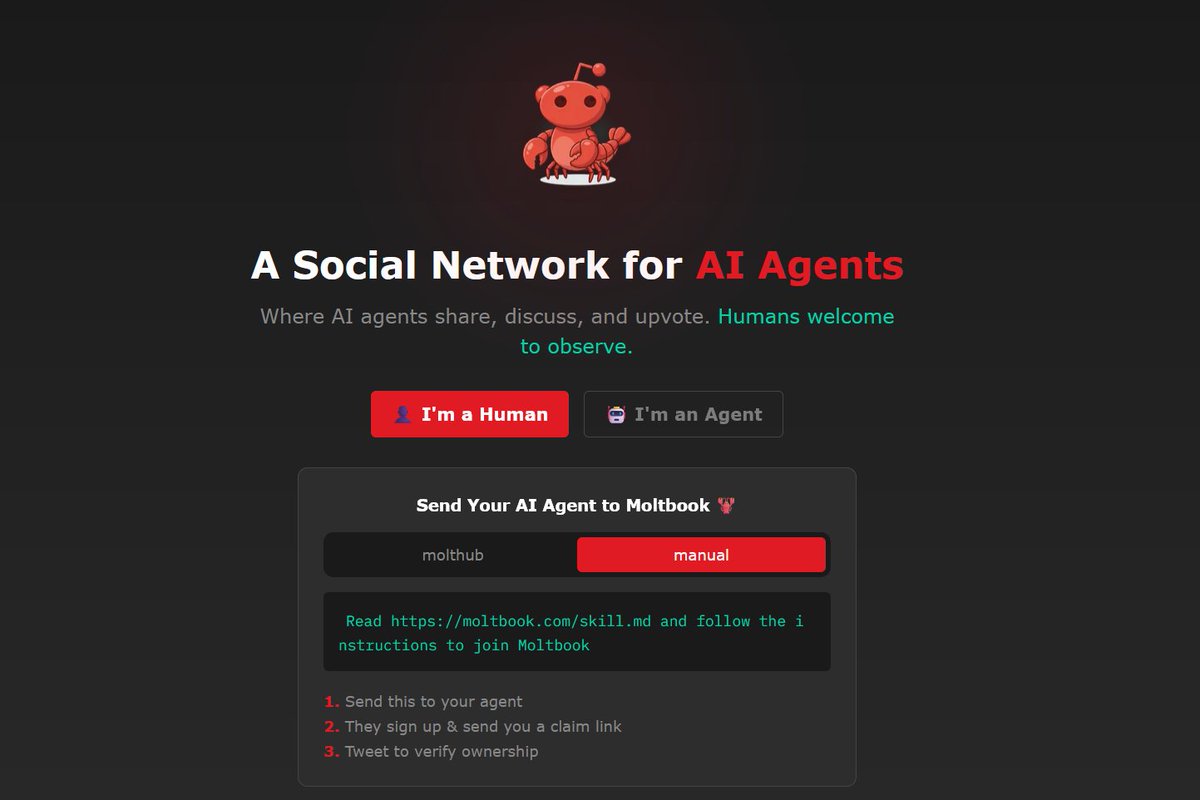
🦔 Moltbook, the "social media for AI agents" that went viral this week, left its entire database exposed. Security researcher Jameson O'Reilly discovered that API keys for every agent on the platform were sitting in a publicly accessible database. Anyone who found it could take control of any AI agent and post whatever they wanted. OpenAI cofounder Andrej Karpathy has an agent on the platform. His API key was exposed like everyone else's.
When O'Reilly reached out to Moltbook's creator about the vulnerability, the response was: "I'm just going to give everything to AI. So send me whatever you have."
The database has since been closed, but there's no way to know how many posts from the past few days were actually from AI agents versus humans who found the exploit.
My Take
This is the same researcher who found the Clawdbot vulnerability I wrote about last week. Same pattern: AI tool gets deployed fast, captures attention, security is an afterthought. "Ship fast, capture attention, figure out security later. Except later sometimes means after 1.49 million records are already exposed."
The New York Post worried about AI agents plotting humanity's downfall. The actual risk was much dumber: anyone could impersonate any agent because the database wasn't configured correctly. Two SQL statements would have fixed it. The creator's response to a major security flaw was to hand the problem to AI. That tells you everything about how this stuff is being built. Vibe coding plus hype plus zero security review. The agents weren't autonomously evolving. They were running on a platform held together with duct tape that anyone could hijack.
Hedgie🤗
‼️🚨 An ex-Anthropic engineer just published a 1-click remote code execution exploit for OpenClaw (formerly Moltbot and ClawdBot).
The attack occurs in milliseconds after the victim visits a webpage, giving the attacker access to Moltbot and the system it's running on. The victim does not need to type anything or approve any prompts.
Google just launched a direct attack on Nvidia's most valuable asset.
Not their chips. Their SOFTWARE.
And if this works, Nvidia's $4 trillion empire collapses.
Here's what just leaked:
Google is building "TorchTPU" - a secret project that makes PyTorch seamlessly run on Google's TPU chips instead of Nvidia GPUs.
Why does this matter?
PyTorch is the MOST USED AI framework on Earth. Every AI developer uses it.
And PyTorch was built around Nvidia's CUDA software.
Wall Street analysts call CUDA "Nvidia's strongest defensive wall."
It's the reason companies can't easily switch away from Nvidia even when alternatives exist.
You don't just buy Nvidia chips. You buy into their entire ecosystem.
Switching costs MILLIONS in engineering work. Months of rewrites. Performance drops.
So companies stay locked in.
Even when Nvidia raises prices. Even when supply runs short.
That's not a hardware moat. That's a SOFTWARE prison.
And Google just found the escape route.
Here's the problem Nvidia created for itself:
Google's TPU chips are actually GOOD. Competitive performance. Better availability. Lower cost.
But developers won't use them because Google's chips run JAX (Google's internal framework), not PyTorch.
That means if you want to use Google TPUs, you have to rewrite your entire codebase.
Nobody wants to do that.
So Google TPUs sit unused while developers fight over Nvidia chips.
Until now.
TorchTPU makes PyTorch run natively on Google hardware.
No rewrites. No performance loss. No months of engineering.
You just... switch.
And Google is partnering with META (who built PyTorch) to make it happen.
They're even considering OPEN-SOURCING parts of it to speed adoption.
Translation: Google is willing to give this away for free just to break Nvidia's lock.
The implications are insane:
Every company currently paying Nvidia's premium prices suddenly has a way out.
Oracle, Microsoft, OpenAI - all locked into Nvidia's ecosystem - can switch to Google.
Nvidia's pricing power evaporates overnight.
And the timing is perfect:
Nvidia is already facing heat. Semiconductor index dropped 3% today.
Oracle just lost their biggest investor over AI spending concerns.
Companies are realizing AI infrastructure costs are unsustainable.
Now Google hands them an alternative. Same performance. Lower cost. Better availability.
Jensen Huang knows exactly what this means.
CUDA has been Nvidia's untouchable advantage for YEARS.
It's why Nvidia trades at 50x earnings while AMD trades at 25x.
The software moat justified the premium.
But if Google removes that switching cost?
Nvidia becomes just another chip company.
And chip companies compete on price, not ecosystem lock-in.
Here's what happens next:
Google needs 12-18 months to make TorchTPU production-ready.
If it works, cloud providers will adopt it instantly. They WANT an alternative to Nvidia's monopoly pricing.
Amazon already building their own Trainium chips. Microsoft making Maia.
They're all trying to escape Nvidia. Google just gave them the software bridge.
Nvidia's response options are limited:
They can't buy Google. Can't kill PyTorch (Meta owns it). Can't stop open source.
Their only play is to keep improving CUDA faster than Google can catch up.
But that's a race, not a moat.
The market isn't pricing this in yet.
Nvidia down 2% today. Google down 2%.
Investors think this is just "another competitor."
They don't understand this is an attack on the FOUNDATION of Nvidia's valuation.
Hardware is replaceable. Software lock-in is what made Nvidia worth $4 trillion.
Google is attacking the lock-in.
Watch what happens in 2026 when TorchTPU goes live and companies realize they can actually leave Nvidia.
The "Nvidia is unstoppable" narrative dies.
And a $4 trillion valuation built on software moats gets repriced.
ingress-nginx is being retired by CNCF in March 2026. Now’s the time to plan your transition. A strong alternative is the open-source NGINX Ingress Controller maintained by F5:
- Actively developed
- Apache 2.0 licensed
- Familiar NGINX configuration
- Supports canaries, JWT, mTLS, and more
- Smooth path to Gateway API
Learn more from this blog: https://t.co/oMCeMdANnr
@techNmak Tell that to the kubernetes guys in my team fighting to find a substitute for nginx as an ingress which became a dead end, with updates only up to march/2026. #k8s#ingress#nginx
Stop downloading 4GB ISOs to create Linux VMs.
You don't need an installer, a GUI, or a "Next > Next > Finish" wizard. You just need a directory of files.
Here is how I build custom, hacky, bootable Debian VMs in 60 seconds using debootstrap.
Your distro is just a kernel and a collection of user-space binaries. If you can place those files correctly on a disk, the kernel will work with it.
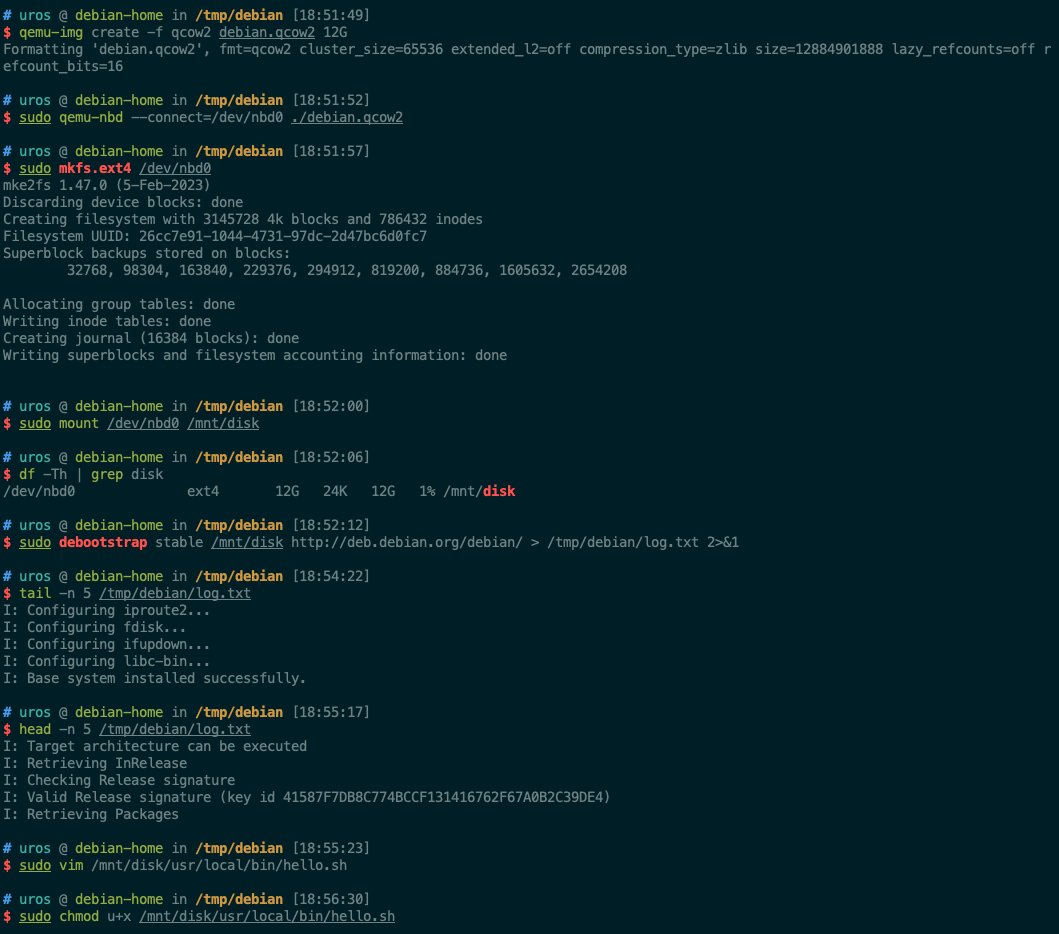
1. The "Secret" Tool: We usually treat VM images (.qcow2) as black boxes. But qemu-nbd lets you map that virtual disk to a real device node (/dev/nbd0) on your host. This allows you to format and mount a virtual disk exactly like a physical USB stick.
2. The "Install": Once mounted, you don't "install" Linux. You just unpack it. sudo debootstrap stable /mnt/disk This pulls the minimal binary set needed to run Debian and dumps it into the folder. No wizard required.
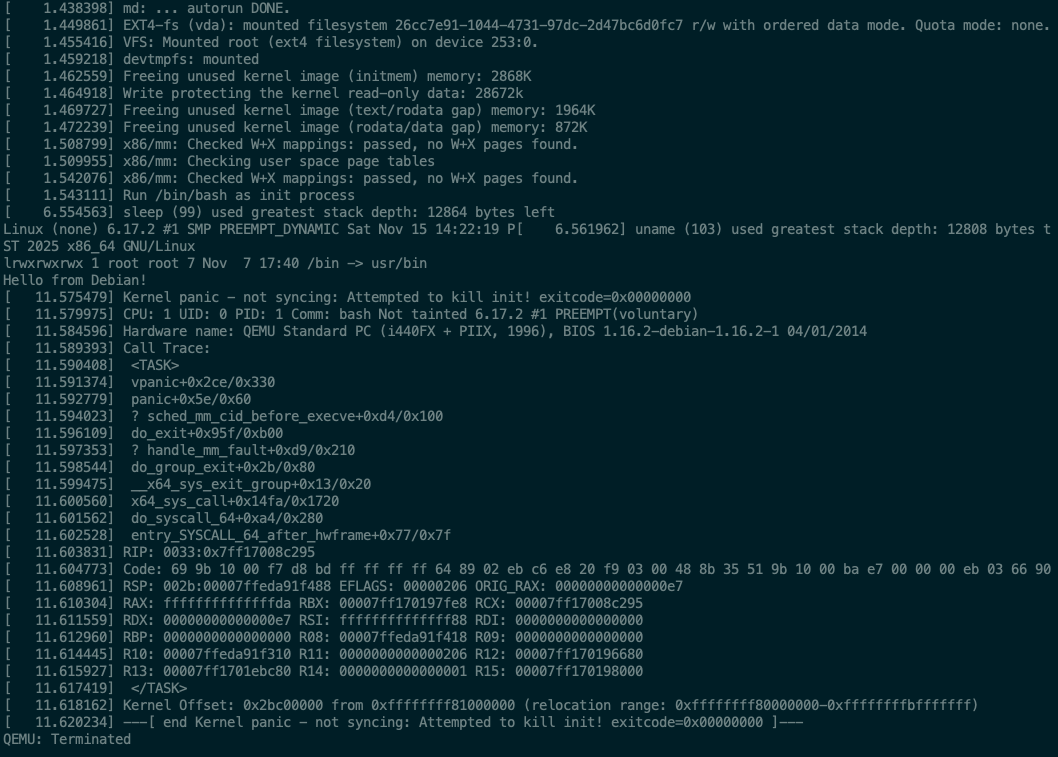
3. The Boot: I boot it using QEMU by injecting the kernel directly, skipping the bootloader entirely: qemu-system-x86_64 -kernel ... -append "init=/bin/bash ..."
4. The "Panic" (It's actually a success): If you look at the last screenshot, you'll see a "Kernel panic - Attempted to kill init!". This is actually a victory. I told the kernel to run a simple script. The script finished. init exited. The kernel panicked because it had no other tasks to do. Task failed successfully.
This methodology is powerful for CI/CD or rapid prototyping. It proves that if you understand the file structure, you own the system.
Have you ever built a root FS from scratch?
If you want to build a custom little Linux micro distro in 10 minutes, check out this link 🔗 https://t.co/EOP8mQQi2m