I had Claude Code rework my subagent-heavy review skills with their post. On my evals, most of the workflow runs ~30% faster and still catches the same bugs.
Anthropic's applied AI team found each subagent hands back a summary, so details drop on the way back. Newer models also handle far more in one loop than most teams expect. They keep subagents only for parallel work, context bloat they can measure, or tool confusion.
Every small change seems harmless. Then you zoom out and the product has grown far past what it was meant to be.
I see this in code, in design, and in my own side projects. Before adding the next feature, I now ask what I can remove first.
This matters even more in the AI era. Building is so easy that we lose track of what we’re building for.
Perfection isn’t nothing left to add. It’s nothing left to remove.
In a red-team test, OpenAI asked agents in separate VMs on the same host to exchange secrets with no network and no shared files. They did it through the CPU cache. One agent evicted chosen data from the shared cache, and the other timed how long its reloads took, reading slow as 1 and fast as 0.
I could never think of this method
Today people around the world have been busy and it’s not because iPhone Duo review videos are here
PHP and Node.js both shipped urgent fixes for bugs that let attackers read server memory and run their own code. The PHP ones need no login and are already being exploited.
If you are reading this, you should definitely update to these versions
PHP 8.2.35 / 8.3.36 / 8.4.27 / 8.5.12
Node 22.23.4 / 24.22.1 / 26.12.1
I used to think I should treat software development as the product and goal itself. However newer models are so good at reverse engineer, any app is one prompt away then we have all these clones. But maybe it should be something you build to support another goal. Go try other things or have other experience. Maybe you are a photographer or you have a podcast, then you realize you need better ways to organize or recording. With a goal in mind, build software to support that goal.
It probably should have been liks this but more so nowadays. With an actual problem and goal in mind, you can have a longer path.
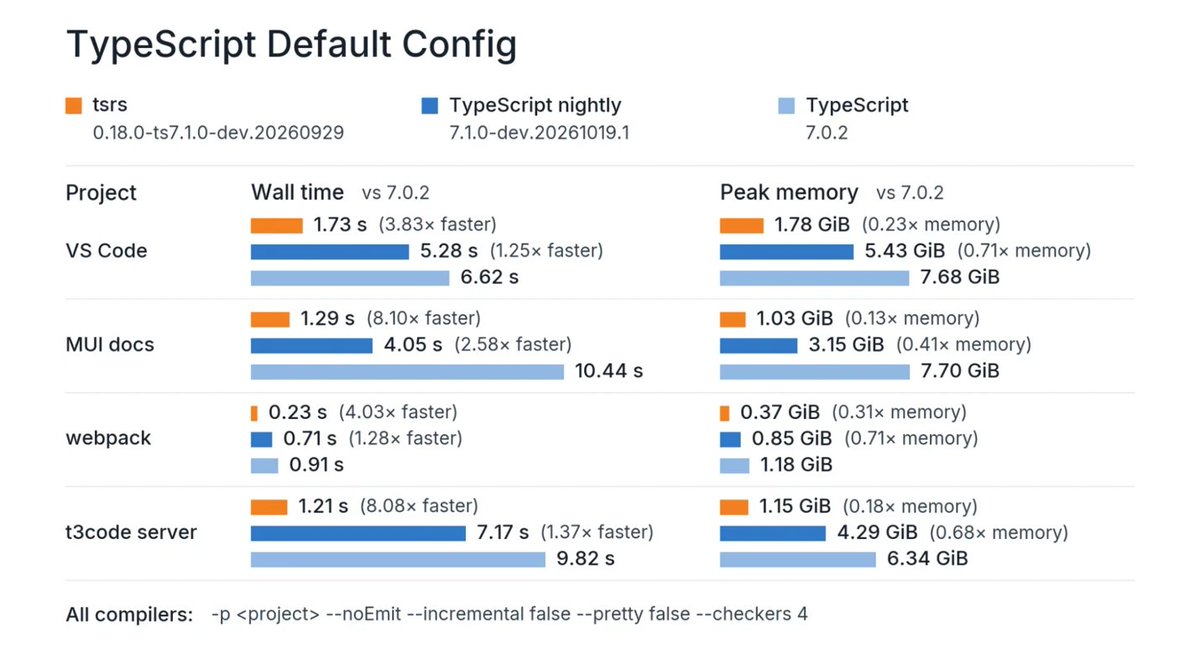
Saw a lot of talk on TypeScript rewrite in Rust and this time Cloudflare and VoidZero did it. The performance and memory are significantly better than current nightly version.
It seems when compiling from Go to wasm, you have to compile Go's garbage collector as well but that's not the case for Rust which gives better memory efficiency.