6 stages of a millionaire trader (which one are you?)
Stage 1 – The Gambler
Right now you’re trading outcomes, not structure. Your decisions are emotional, inconsistent, and heavily influenced by P&L. There’s no stable process yet just reactions.
To move to Stage 2 (The Student): commit to one market, one setup, and journal every trade. Your goal is to replace chaos with structure.
Stage 2 – The Student
You’re learning aggressively, but execution is inconsistent. You believe more knowledge will fix the problem it won’t. The issue isn’t information anymore, it’s application.
To move to Stage 3 (The Emotional Trader): stop adding strategies and master one setup. Track execution quality, not profits.
Stage 3 – The Emotional Trader
You know what you should do, but you don’t always do it. Discipline breaks show up under pressure overtrading, cutting winners early, revenge trades. Awareness is high; control is unstable.
To move to Stage 4 (The System Trader): reduce size, enforce hard stop rules, and measure rule adherence percentage. Emotional stability comes before performance.
Stage 4 – The System Trader
You have defined entries, exits, and risk. Losses are planned and structured. Now the challenge is patience and selective execution not taking trades that almost qualify.
To move to Stage 5 (The Consistent Executor): trade less, wait for full confirmation, and eliminate impulse entries. Precision separates you now.
Stage 5 – The Consistent Executor
You trust your system and understand variance. Emotional swings are smaller and you no longer need constant action. The threat now is boredom and over‑optimization.
To move to Stage 6 (The Professional): think in weeks and months, not trades. Focus on capital preservation and long‑term consistency.
Stage 6 – The Professional
You operate on probabilities, not emotion. Risk management is automatic. Trading is process‑driven and stable. Your job now: protect discipline, avoid complacency, and continue refining execution without increasing emotional exposure.
Nobody tells you this about trading
...but I will.
You can spend years learning how to trade and still never become a consistently profitable trader.
I know because I've been there.
13 years of trading. Multiple blown accounts. Thousands and thousands of trades.
And one of the hardest things I've had to accept is that knowing what to do and actually doing it are two completely different skills.
Think about it.
You know you shouldn't chase. You chase anyway.
You know you should cut your losses. You hold and hope.
You know you should stop after three bad trades. You take a fourth.
You know you should wait for your setup. You convince yourself otherwise.
And when the day is over, you look back at your trades and wonder why you did the very things you promised yourself you wouldn't.
Sound familiar?
Here's something I've learned:
Most traders have an execution problem.
And more knowledge won't necessarily fix it.
You can do all the extra work.
Watch videos. Read books. Take notes. Study charts. Evaluate your trades. Adjust your strategy.
You can do everything you're supposed to do.
But none of those things guarantee you'll follow your own rules when it matters.
That's something you have to learn to do yourself.
Here are a few things I've learned along the way:
Sitting out is perfectly fine.
Honor your stop loss.
Never average down unless it was part of your plan before entering.
You don't need to make money every day.
You do need to protect your capital every day.
The market moves every day. Not every move is meant for you.
And here's perhaps the most important one.
Don't lie to yourself.
You have rules, right?
Then follow them.
Every time you break a rule and justify it, you make it a little easier to break it again.
Do it enough times and it becomes a habit.
And habits are hard to break.
So start rewarding yourself for the things that actually matter.
For making a plan.
For following your rules.
For honoring your stop.
For sitting out when nothing looks right.
For walking away when you've had enough.
Even on days when you lose money.
Because those are the behaviors that build discipline. And discipline is what gives you a chance to survive long enough to become consistently profitable.
I've spent over a decade learning how to trade.
And perhaps the biggest lesson has been this.
You don't become a disciplined trader by making money. You give yourself a better chance of making money consistently by becoming a disciplined trader.
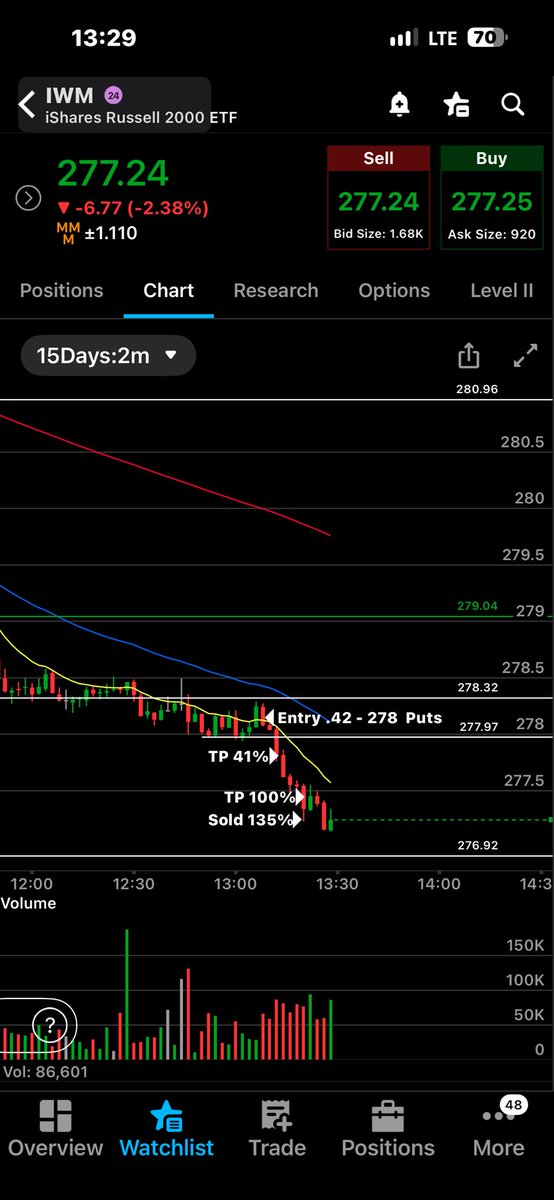
$IWM puts bellow pml but watch 283 area for a possible bounce bounce if it breaks below has plenty room down to yesterday low if bounce of pml plenty room for calls up to yesterday high
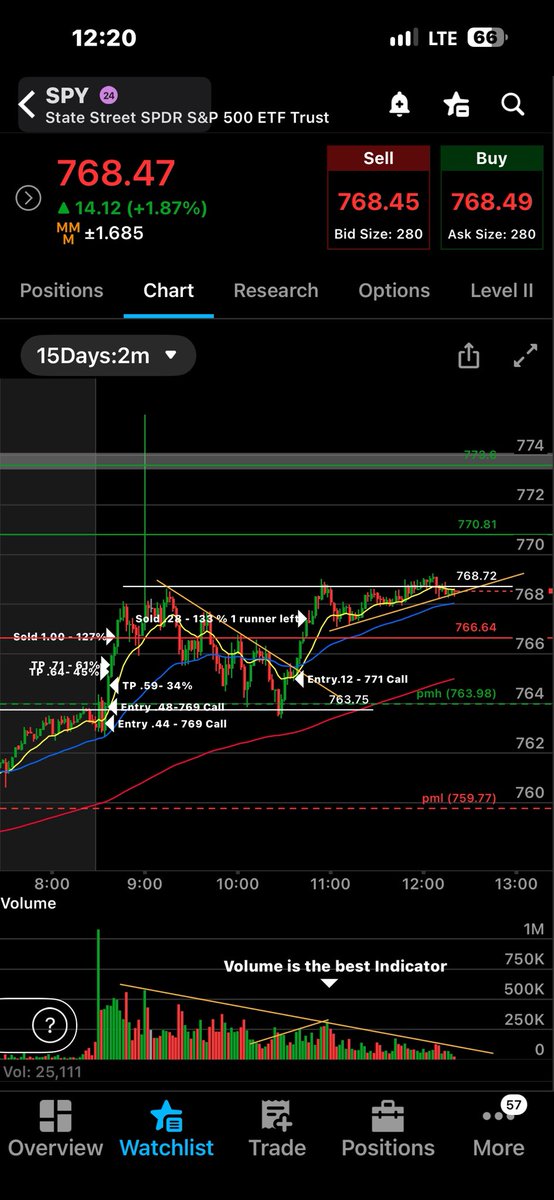
$SPY is in yesterday’s range , Calls if breaks above $769.09, Puts if breaks below PML down to yesterday low and watch for a possible bounce or or wait till it gets down to that support and take calls if it bounce.
@Subs4Shiny@Sagittus11 Some times I select the strike and the number of contracts and save them , so when the price gets to where I want to buy I go to save orders and press send or I just go to option section and buy there
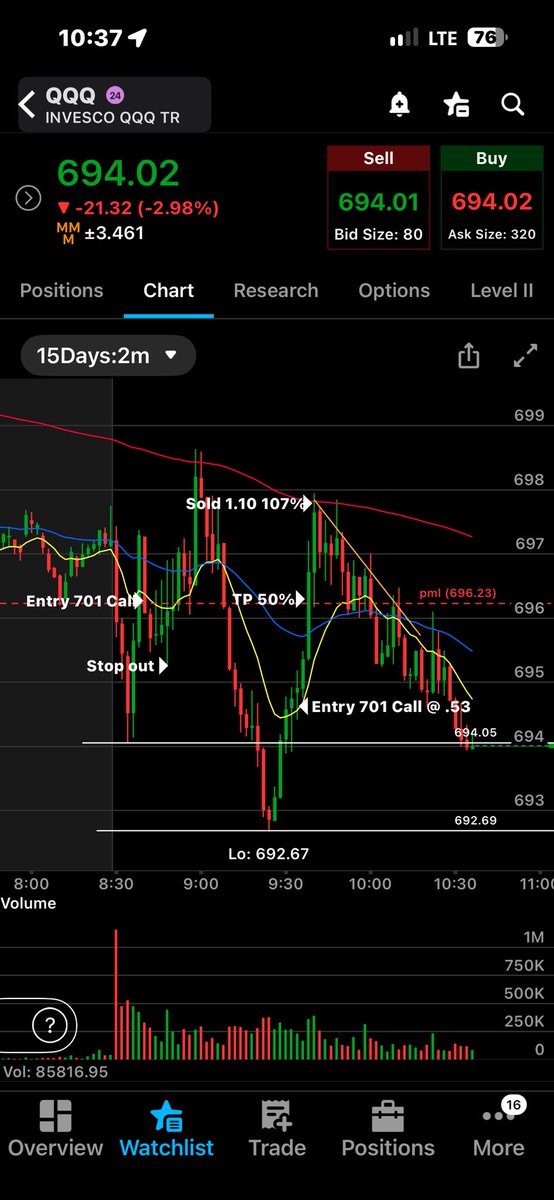
@Chezzarre@Team2Trading It hit the Premarket High area twice and rejected, the candles were big and volume rising, it move above 13 ema and was forming a small flag so I took the risk. My stop was bellow 13 and 200 ema
@Avanon6at1@Team2Trading I don’t know how to use bracket orders, I do it manually , I don’t think I can use bracket orders on the mobile app only with the computer.