OpenRouter just shipped a completely new routing engine.
The core problem was incentives. OpenRouter sits in a unique position: the way we route traffic ends up shaping how inference providers compete. The old algorithm weighted sticker price too heavily. That created a race to the bottom. Providers serving low-quality or unreliable tokens at rock-bottom prices captured share, while the ones actually delivering better experiences got punished.
So the team rebuilt routing from the ground up. Instead of optimizing for the cheapest tokens, it now scores providers on the real cost of a good answer. That includes latency, throughput, caching behavior, error rates, retries, and output quality.
Everyone has a clear path to earn more share by improving the actual user experience.
Early head-to-head results vs. the old router:
~20% faster time to first token
~20% higher throughput
~40% fewer fallbacks
~60% fewer rate-limit errors
For users, this just means better inference by default: stronger caching, competitive prices, and higher reliability without having to manually tune providers.
For providers, the game changes. There’s no single metric left to game. To win more traffic, you have to serve higher-quality tokens across the dimensions that actually matter.
This is the right long-term shape for the marketplace. When the router rewards real quality instead of pure price, the whole inference ecosystem gets pushed toward faster, cheaper, and more reliable tokens.
Thank you @alexatallah@cclark and @louis_g_v for letting Founders’ Co-op and the https://t.co/Twr562xt46 community follow along with your journey since the seed.
Ya’ll are absolute beasts and deserve all of your success. Unfortunately, I will now be forever disappointed in any other investment’s IRR 😂🥇❤️🙏
PS: @seawatts drinks are on you next time
OpenRouter is joining Stripe: https://t.co/JY7bledeQD.
As anyone who uses it knows, @OpenRouter is a truly delightful developer tool. It is by far the best way to use new models and manage multiple inference providers.
OpenRouter is also playing an increasingly important role: in the future, every business will have to manage both revenue flows and token flows. OpenRouter is the world's leading token marketplace, helping businesses effectively allocate the new currency of intelligence capital. We think that there's a lot to build together.
OpenRouter is joining Stripe.
We started OpenRouter with a simple mission: intelligence should be multi-model. Today, we are the largest AI marketplace & gateway, processing 10T+ tokens daily on 400+ models.
Joining @Stripe gives us the opportunity to accelerate that mission.
We're giving you a $10 coupon to build on Ori Harness this weekend
What will you build?
Run your favorite agent - Claude Code, Codex, DeepSeek, and more - with 500+ models, 70+ providers, all in one account, on OpenRouter
Redeeming is easy:
Introducing the OpenRouter MCP, live model intelligence right inside your agent
Your agent builds and ships, but when it comes to choosing the right model for the right job, it guesses from 6 month old training data
Watch it pick, price, and test the right model:
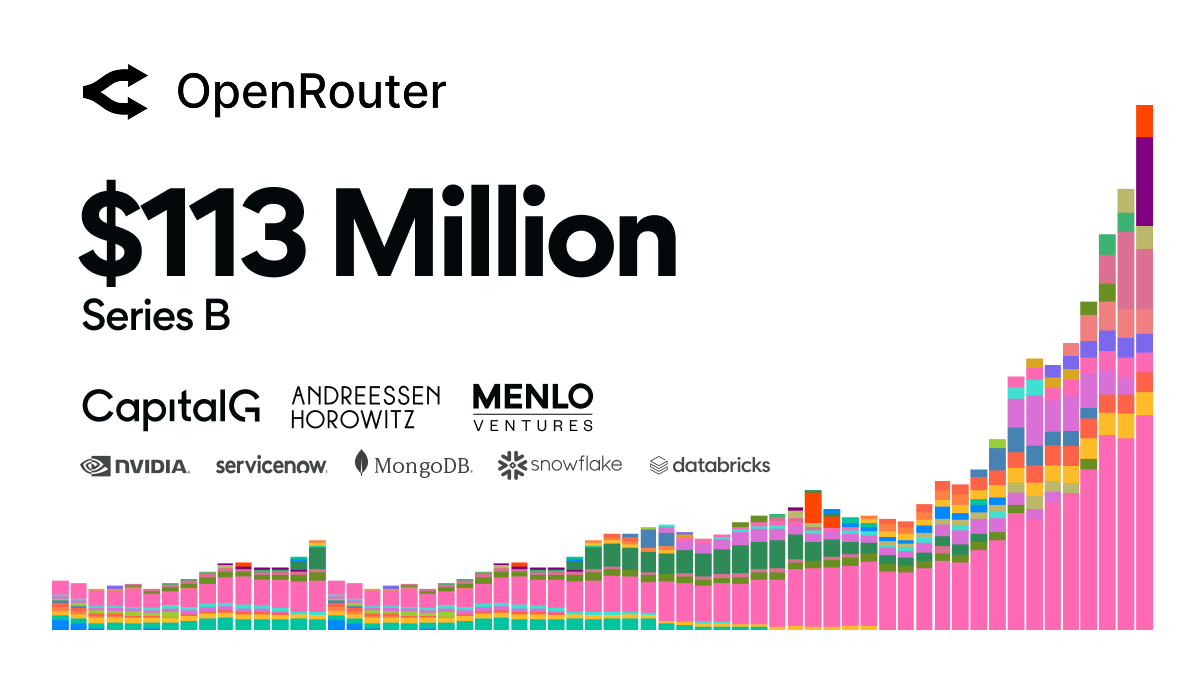
Today we’re announcing our $113M Series B led by @CapitalGVC.
Over the last 6 months, weekly volume on OpenRouter grew from 5T to 25T tokens as AI rapidly shifts from experimentation into production.
We’re excited for what comes next.
@stripe Projects + @OpenRouter now GA! You can just tell your agent to create an ai app and it will auto create a OpenRouter account and api key for free! https://t.co/qYMtmjO2zb
A feature everyone missed.
One-click observability for @n8n_io, Moltbolt, custom apps, or even Claude Code (yes, it can work with @openrouter).
What catched my attention: sending your traces not just to common providers but also to your webhooks -> custom data viewer.
NEW: Smarter error messages for JSON healing ❤️🩹
When models return arrays (68% of failures) or strings instead of objects, you'll now get guidance:
- Arrays: Use json_schema {"type": "array"} or wrap in an object
- Strings: Explicitly request JSON in your prompt
@pondorasti @shreygupta Yeah you should check out Unhook. The VS Code extension is my favorite. And having a checked in local config for each repo is super helpful for having multiple projects. It’s like Infisical in that way. Also has a CLI headless and interactive as well.