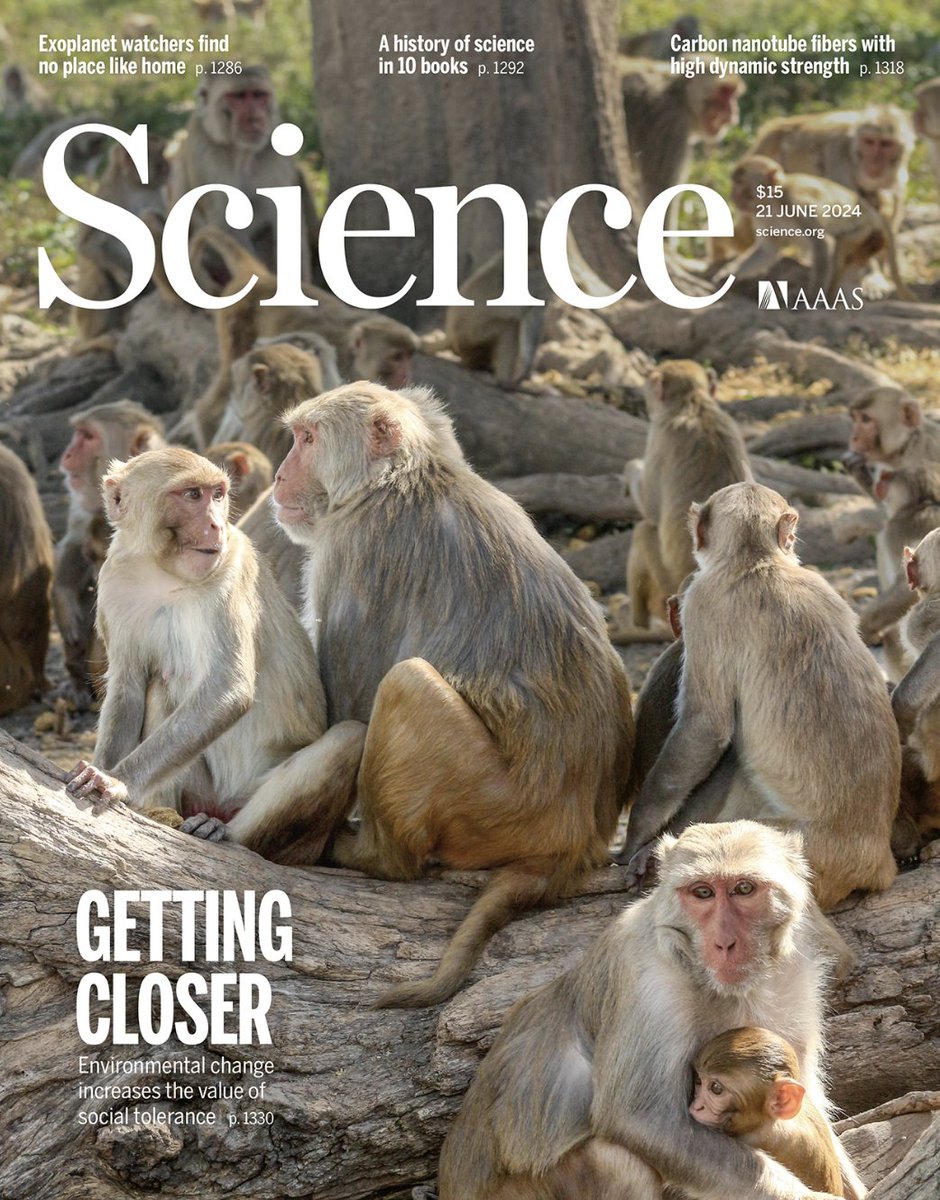
*Very* excited to see the last study of my PhD making the cover of @ScienceMagazine on the macaques of @CayoSantiagoPR.
We show that ecological disturbances can alter selective pressures on social ties leading to persistent societal changes.
https://t.co/Zt4EJY5XWw 🧵👇
So immensely proud to see my PhD work out today in @Nature!
Combining neuroscience and ethology to an unprecedented degree in primates, we uncover neural signatures of social support and grooming reciprocity—building blocks of relationships.
https://t.co/hAGkBSMDiU 🧵👇
*THRILLED* to share our latest work with @seb_trem & co in @MichaelLouisPl1 ’s lab!
Primates maintain long-term bonds through grooming and social support. How?
Here, we reveal neural signatures of natural social behavior in freely-moving macaques.
https://t.co/qjCSuRPPP3 🧵👇
@NicoleCRust@jcbyts@CamilleTestard I would argue that knowing whether an area is visual or auditory is a “what”, not a “how” question.
Eg. We didn’t learn through Hubel&Wiesel’s ephys that V1 is visual. We learned it through prior lesion studies. They showed “how” through ephys based on prior “what” knowledge.
@CamilleTestard Thanks everyone for the heated debate! Just to add some oil on the fire 🔥 ...
To quote Darwin🦜:
"Nothing in neurophysiology makes sense, except in the light of causation!"
🙃
happy to chat in person at SFN!
**NEW PREPRINT ALERT** co-authored w/ @seb_trem (yes, 2nd in a week!!)
We show that inferring a brain area’s function from neural recordings alone can be misleading, with severe consequences to the field of neuroscience.
https://t.co/1O5CxviIUK
🧵👇 (1/10)
*Thrilled* to share our latest work with @seb_trem!
Pioneering work in rodents from @anne_churchland's group showed that spontaneous movements dominate neural dynamics across the whole brain. Is this also the case in macaque monkeys ?
https://t.co/4jZFOJGWIk
🧵👇