$BTC – What's Next?
The Big Sunday Report: All We Need to Know
🚩 TA / LCA / Psychological Breakdown:
Everyone and I mean literally everyone I personally know has told me over the last three or four weeks, and especially over the last two weeks, that they want to buy in September or October. That alone is already very dangerous. When you ask them why, they all give the same answer: “Because of the four-year cycle.” And I honestly ask myself how long some of these people have even been in the market. The four-year cycle also worked almost perfectly at the top, but nobody talked about it then. That is the difference. At $120,000, nobody wanted to talk about the four-year cycle. In fact, people hated it. They said, “It does not exist. It does not exist,” because they were greedy and wanted prices to keep going higher.
Now the same people are greedy again, just in the opposite direction. They believe the market is going to serve them the exact bottom on a silver platter. “Here is the bottom. It will come around September or October. The exact price will be this or that.” That is genuinely what people believe. The problem is not the four-year cycle itself. The problem is the number of people who believe in the exact same outcome. The more people believe it, the less realistic it becomes. I honestly believe we will not see this traditional four-year-cycle bottom
The next question is: what do we actually see instead?
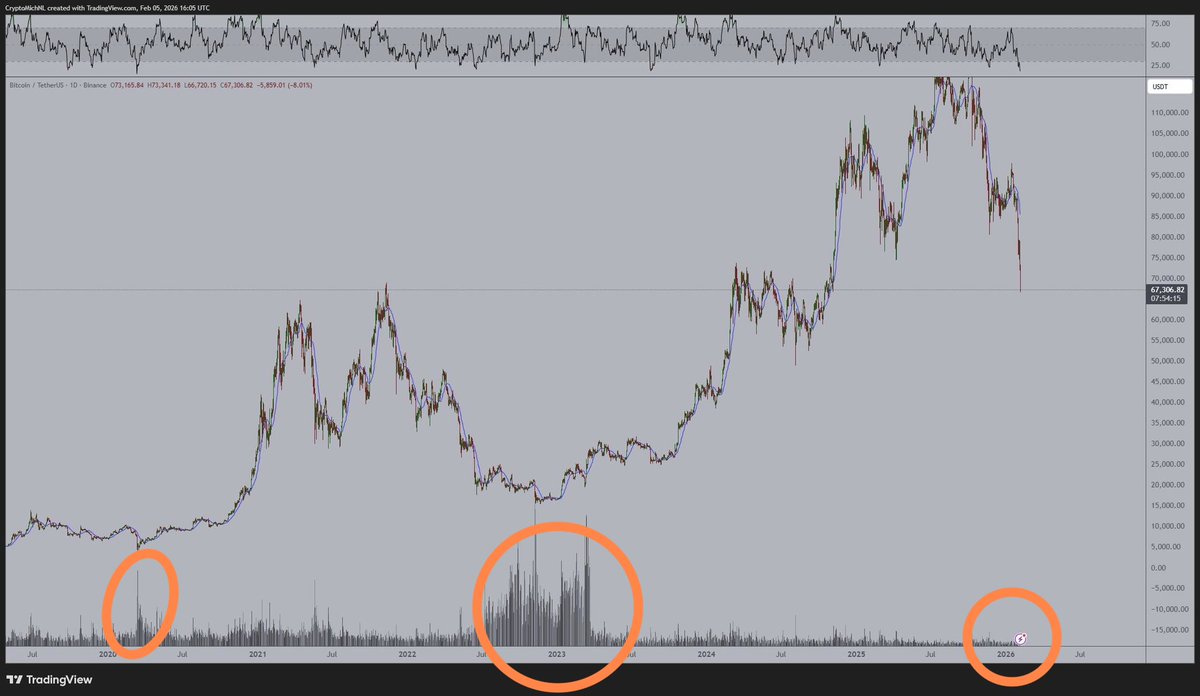
At the moment, I do not even see Bitcoin going below $50,000. There is an extreme amount of liquidity around $54,000, and that cannot be ignored. You have to keep that level in mind. From the current price down to $54,000 is around 15%. From a risk-reward perspective, even if we assume the worst-case scenario is a move into the $54,000 region, buying now and facing 15% downside is not much. It is nothing compared with the people who always and stupidly bought at $70,000, $80,000 or $90,000, and those who never understood the right moment to enter the market, and anyway, those people will always buy, and we cant count them among those who bought the bottom.
That is why it makes sense to begin accumulating now, step by step. Not all in. That is very important. I do not suddenly FOMO in and deploy everything. No. This will still take some time. I also believe the real move higher is not starting immediately. But there is one more thing people should not forget. They say the four-year cycle should end around October. Fine. Then let me ask you a counterquestion:
BlackRock, the New York Stock Exchange, the S&P, Nasdaq and the other major institutions are all involved in the DTCC, the new financial market infrastructure, and they want to move forward with the tokenization of stocks. BlackRock wants to launch the new platform in October. What does that mean?
It means investors WILL trade stocks 24 hours a day. That is enormous, and the market still has not fully understood it. Tokenization has mostly been treated like a beta phase until now. Platforms such as Hyperliquid and similar markets were effectively test environments. They wanted to see how much demand there was, how users would react and whether the infrastructure worked. The users had to be tested. The technology had to be tested. The market had to be tested. And it worked extremely well. Now it has been announced that this is expected to move forward in October. At the same time, there are rumors that the Clarity Act could pass in August. That would be enormous news.
If it passes, there is regulatory clarity. Institutions can enter the crypto market much more easily. I do not necessarily believe they will suddenly start buying the entire crypto market at scale, but I do believe they will move aggressively into tokenization, which could follow one or two months later. So lets return to my question:
Who benefits from tokenization?
First of all, the entire crypto market benefits. Even if institutions do not directly buy every cryptocurrency in large size, the narrative becomes bullish for crypto and Blockchain. The market starts to see blockchain as legitimate, institutional and part of the future financial system.
Then you will see prices move strongly in my opinion. I expect we will see BlackRock announcing partnerships, BlackRock doing something with Bitcoin, Trump making new statements, and suddenly the entire narrative becomes extremely bullish because everything fits together. Do you really believe BlackRock will aggressively push tokenization forward in October while, at the exact same time, the crypto market crashes, fear dominates and nobody wants anything to do with crypto? Do you think that ? I do not.
I believe we will see FOMO in October. I believe we will see large candles and strong momentum in the market. It may not necessarily be the same type of retail FOMO we have seen before, but there will be growing confidence and acceptance, while major bullish news enters the market at the same time. And this will be the time where the retails are sitting and doing what ? Exactly, these people will wait for their four years cycle! Let them wait for their cycle, because the market will front run that! In my opinion, that will create an extremely powerful bullish narrative.
That is why the fact that everyone now believes in the four-year-cycle bottom is a warning sign to me. It tells me the crowd may once again be completely wrong. I especially believe that many people sitting with buy orders below $50,000 will never get filled. That is why I am starting to accumulate now. I hope we still take the liquidity around $54,000, because that would give an even better entry. I have my orders ready, and I will continue buying gradually every day.
The Exact Strategy: How I Am Buying, How Much I Am Deploying, and the BTC–ETH Ratio
Watching this chart closely. In my opinion, once Bitcoin reclaims and flips the green line on the weekly timeframe, the end of the bear market will be confirmed. This would not be a standalone signal. It would align with several other indicators I am monitoring, some of which I have already disclosed inside Premium, together with multiple technical, psychological and fundamental factors I am currently considering. Bitcoin has already reclaimed the weekly MA200. The next major step is to reclaim this green line and hold above it on the weekly close. Once that happens, my next major target becomes $80,000. For now, however, Bitcoin has faced a rejection at this level, while a large amount of liquidity remains around $54,000. That is why my strategy is structured around two completely separate buckets of capital. It is important to understand that I am not mixing these funds.
The first bucket consists entirely of realized profits from the Bitcoin short opened around $120,000 and the more than 100 altcoin shorts I held for approximately nine months. I deployed that entire bucket yesterday and bought Bitcoin at around $64,000. In other words, I converted the profits made during the bear market directly into a long-term Bitcoin position fully.
The second bucket is completely separate. This is capital that was never used in the short positions and remained on the sidelines. I am now deploying this cash gradually. My plan is to invest this second bucket on every day Bitcoin trades between $54,000 and $64,000. Five percent multiplied by 20 purchases equals 100%, meaning the entire amount would be deployed if Bitcoin remains inside this accumulation zone for approximately 20 buying days.
If Bitcoin trades at $64,000, I buy. If it trades at $60,000, I buy. If it falls to $58,000, I buy. If it reaches $54,000, I continue buying at a better price. However, if Bitcoin moves above $64,000, I stop adding the daily 5%. I will not chase the market outside the accumulation zone. After approximately one month, the objective is to hold one large Bitcoin position purchased at around $64,000 using the realized short profits, together with a second position accumulated gradually through disciplined daily purchases. Depending on how deeply Bitcoin trades inside the range, I expect my combined average entry to settle somewhere around the $60,000 region.
From a risk-to-reward perspective, I personally consider my average Bitcoin entry around $60,000 to be phenomenal for the long term. That level is below the previous 2021 all-time-high region, and thats an exceptional position. At the same time, I am following a fixed BTC-to-ETH allocation. For every four dollars I invest in Bitcoin, I invest one dollar in Ethereum. That means for every $100,000 deployed into BTC, I allocate $25,000 to ETH.
Bitcoin remains the dominant position, while Ethereum receives an allocation equal to 25% of every Bitcoin purchase. Ethereum is a separate topic that deserves its own full report, because I am extremely bullish on ETH for the next major market expansion. So the strategy is clear: one bucket of realized short profits has already been fully deployed into Bitcoin at approximately $64,000. The second bucket is being deployed gradually through daily 5% purchases whenever Bitcoin trades between $54,000 and $64,000. For every four dollars invested in BTC, one dollar is invested in ETH.
That is the strategy, my accumulation just started
Join Premium and you will not miss out on what exactly I am buying, what I plan to build, where I place potential long orders and other of my trading targets: https://t.co/oP8wCPuO9J
THIS IS NO FINANCIAL ADVICE BUT EDUCATIONAL CONTENT ONLY
Le coût de fabrication de Bitcoin est de 78 000 dollars. On le brade à 63 000.
Les mineurs les plus fragiles crèvent. Ils éteignent les machines, ils vendent leurs derniers bitcoins pour survivre. 32 000 lâchés en un trimestre. Un record, pire qu'en 2022.
C'est laid, c'est violent et c'est exactement ce que je veux voir. Parce que ce n'est pas un marché qui meurt. C'est un marché qui essore ses mains faibles.
Et maintenant, parlons de ceux qui te promettent 40 000.
Sous le coût de production, chaque mineur qui s'éteint retire du Bitcoin du marché. L'offre se tarit pile au moment où tout le monde panique. C'est mécanique. C'est ça qui forme un plancher.
2015, 2019, 2022…À chaque fois que le prix est passé sous le coût de production, c'était le fond. Pas le début de la chute.
Moi je l'ai vu deux fois de mes yeux. Et deux fois, j'ai vu des gens que je connaissais vendre en bas, dégoûtés, en jurant qu'on ne les y reprendrait plus. Ils sont rerentrés bien plus haut, dans le vert, en regrettant.
Pendant que certains attendent un 40 000 qui ne viendra pas, je ramasse du #Bitcoin moins cher que ce qu'il coûte à fabriquer.
Regarde bien le graphique. La ligne du dessous, c'est le coût de production. Le prix l'a touchée quatre fois en dix ans, et quatre fois c'était le moment d'acheter, pas de fuir.
Aujourd'hui on y est pour la cinquième fois. Dis-moi que cette fois c'est différent. J'attends.
🔥BRUTAL🔥
🚀El texto completo del nuevo PROYECTO DE LEY sobre la Reserva Estretégica de #Bitcoin ya es público.
💥Este proyecto de ley haría efectivo la PROHIBICIÓN de VENTA de $BTC por 20 años y planea evaluar formas de ACUMULAR BTC.
Ayer recibí los dos informes de la UDEF sobre Zapatero, como me imagino le ha pasado a media España.
He hecho como Rufián el otro día y apenas he dormido leyendo todo por aclararme.
Como los medios sacan noticia por noticia para ganar clicks… he decidido ordenar las ideas y hacer un hilo completo sobre el caso.
El informe 1907 (186 páginas) reconstruye la estructura: quién es quién en la red, qué sociedades controlan, por dónde se mueve el dinero, dónde acaba y qué papel juega cada implicado. Es la radiografía societaria y financiera.
El informe 1908 (158 páginas) reconstruye la cronología: ordena por fecha los mensajes de WhatsApp, correos electrónicos, llamadas y reuniones recuperados del móvil de Rodolfo Reyes y de los demás dispositivos intervenidos. Es el guion temporal del caso.
Uno te explica el cómo y el cuánto, el otro te explica el cuándo y el con quién.
Por eso, a lo largo del hilo, las capturas alternan entre los dos: cuando se cita un mensaje concreto (una frase, una hora, un día), la fuente es casi siempre el 1908; cuando se cita una conclusión policial, una titularidad societaria o un flujo de dinero, la fuente es el 1907.
Abrochaos los cinturones… que empezamos.🧵
⚠️ATENCIÓN⚠️
ESTA SERÍA UNA CLARA PRUEBA DEL CAMBIO EN EL ORDEN MUNDIAL
👀Bloomberg acaba de titular lo que ningún estadounidense quiere ver
💥El sistema que sostuvo el poder americano durante 50 años se está cayendo en TIEMPO REAL. Y casi nadie lo está mirando ¿$BTC lo amenaza?
¿Sabés qué pasa cuando se rompe el sistema monetario que financia la deuda de la potencia más grande del mundo⁉️ Ahora lo vas a saber.
🎯PRIMERO LO BÁSICO: ¿QUÉ ES EL PETRODÓLAR?
👉En 1974 Henry Kissinger viajó a Arabia Saudita y le ofreció al rey Faisal un trato secreto:
"Vendé tu petróleo SOLO en dólares, y reinvertí esos dólares en bonos del Tesoro de EE.UU. A cambio, te garantizo seguridad militar."
🔹Arabia Saudita aceptó. Después se sumaron los otros países del Golfo. Y así nació el PETRODÓLAR.
🔹La existencia del acuerdo secreto recién fue confirmada públicamente en 2016, cuando Bloomberg lo destapó vía un pedido de Freedom of Information Act.
¿Por qué fue una jugada MAESTRA? Porque creaba demanda PERMANENTE de dólares en TODO el planeta.
🔹Como el petróleo es la base de toda la economía global, todos los países necesitaban dólares para comprar energía.
¿Y cómo conseguían dólares? Vendiendo cosas a EE.UU o comprando dólares directamente
¿Y qué hacían los exportadores de petróleo con sus dólares? Compraban bonos americanos.
🔹EE.UU. podía imprimir sin límite porque siempre había compradores forzados. Podía endeudarse barato. Podía financiar su ejército global.
🔹Esta es la BASE del poder americano de los últimos 50 años.
🧨PUNTO CLAVE: EN 2024, EL ACUERDO ORIGINAL VENCIÓ Y NO SE RENOVÓ.
🔹El acuerdo original entre EE.UU. y Arabia Saudita era por 50 años. Vencía en junio de 2024. Y NO se renovó formalmente.
🔹Arabia Saudita ya está aceptando yuanes en aproximadamente el 12% de sus transacciones petroleras, según datos recientes.
👉Pero la maquinaria seguía girando por inercia ya que +80% del petróleo se comercializa en dólares
🧨LO QUE BLOOMBERG ACABA DE PUBLICAR Y POR QUÉ ES UN TERREMOTO:
👉El 6 de abril de 2026, Bloomberg publicó un artículo titulado: "La Guerra de Irán Rompió el Petrodolar"
🔹Lo escribió Aaron Brown, ex jefe de research de mercados financieros de AQR Capital Management (uno de los hedge funds más grandes del mundo).
Sus palabras textuales:
🗣"El loop virtuoso que ha visto a EE.UU. garantizar estabilidad en Medio Oriente a cambio de que los estados del Golfo reciclaran sus dólares en bonos del Tesoro americano se ha ROTO."
🗣"Y lo que rompió el petrodólar no fue una decisión política. Fue MILITAR. Específicamente, el hecho de que EE.UU., con todo su poder, NO PUDO mantener el Estrecho de Ormuz abierto."
🗣"Irán cerró el estrecho. EE.UU. no pudo abrirlo. Y ese fracaso destruyó el corazón del trato: 'vos invertí en nuestros bonos, nosotros te garantizamos seguridad.'"
👉Si EE.UU. no puede garantizar seguridad, ¿por qué los países del Golfo seguirían reciclando sus dólares en bonos americanos?
🎯Y ENTONCES IRÁN HIZO ESTO:
👉Empezó a permitir el paso de algunos barcos por Ormuz, pero con UNA condición: que pagaran los peajes en YUANES chinos o cripto, no en dólares.
👉No es trivial. Es la primera vez en la historia moderna que un cuello de botella petrolero se cobra en una moneda que NO es el dólar.
🎯Y ACÁ VIENE LA JUGADA QUE NADIE VIO VENIR:
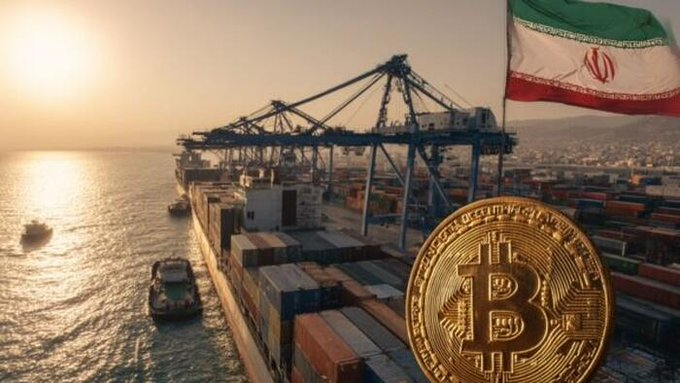
👉Según Financial Times Irán quiere que los barcos paguen un peaje para cruzar el Estrecho de Ormuz. Pero el detalle es brutal: El pago tiene que hacerse en BITCOIN.
🔹Irán no eligió Bitcoin al azar. Eligió la ÚNICA moneda que no pertenece a ningún país, que no se puede congelar por sanciones, y que se puede transferir en minutos a cualquier parte del mundo.
🔹Esto generaría una DEMANDA DIRECTA de BTC por parte de las empresas petroleras
🔹Legitima a $BTC e incentiva a otros países a hacer lo mismo
🔹Desafía al estatus del dólar
🎯¿Y POR QUÉ ESTO TE TIENE QUE IMPORTAR?
📍Porque el cambio de régimen monetario es uno de los eventos más importantes que puede atravesar una generación.
📍La última transición (libra esterlina → dólar) fue acompañada por dos guerras mundiales y la Gran Depresión.
📍El que entiende el cambio se posiciona. El que no lo entiende lo sufre.
¿Creés que este peaje en Bitcoin es el principio de un cambio estructural o es solo una medida de guerra que desaparece cuando Ormuz se reabra⁉️
🚨 Kevin Warsh tendrá su 1era audiencia de confirmación la PRÓXIMA SEMANA!😯
🇺🇸Una #FED pro Bitcoin ya no es una fantasía
El banco central más PODEROSO del mundo podría estar a punto de tener un presidente pro BTC
¿Qué pasa con el precio cuando la FED deja de luchar con BTC?🤔
🚨 31 años de bolsa americana resumidos en una sola imagen.
El patrón es brutal. Y casi nadie lo conoce.
📊 Lo que dice la matriz:
🔴 Años de entrada con caídas al año siguiente: 2000, 2001, 2002, 2008, 2022
Elon Musk acaba de identificar qué trabajos caerán primero, y eso destruye todas las suposiciones sobre quién está a salvo.
Musk: “La IA va a hacerse cargo de esos trabajos como un rayo. Cualquier cosa que sea digital, es decir, alguien en un ordenador haciendo algo.”
No los trabajadores de fábrica. Los trabajadores de oficina. Las personas que pasaron décadas asumiendo que la educación y un trabajo de escritorio significaban seguridad son, en realidad, las primeras.
Musk: “Cualquier cosa que implique mover átomos físicamente… esos trabajos existirán durante mucho más tiempo.”
¿El resultado es un archivo? Vulnerable.
¿El resultado es físico? Protegido. Ese es todo el marco.
Musk: “La IA sigue siendo, en realidad, digital.”
La IA no necesita un cuerpo. No necesita una oficina. Solo necesita acceso al mismo software que tú usas. Ejecuta más rápido. Nunca se cansa. No cuesta nada escalarla.
Pero no puede soldar. No puede cablear un edificio. No puede arreglar tuberías ni trabajar la tierra.
Musk: “Literalmente soldadura, trabajo eléctrico, fontanería. Esos trabajos existirán durante mucho más tiempo.”
Los oficios no son los trabajos vulnerables. Son los duraderos. La presencia física, la adaptación al mundo real y la destreza manual ofrecen una protección que ningún título digital puede dar.
Analista, contable, asistente jurídico, programador, cualquiera que produzca archivos y documentos, se automatiza primero porque el trabajo digital es exactamente lo que la IA hace de forma nativa.
Quien mueve átomos tiene una defensa natural. La física, los entornos impredecibles y la resistencia de los materiales crean una fricción que la IA no puede escalar.
Quien mueve bits no tiene nada. Sin fricción. Sin barrera física. Solo software que la IA ya maneja mejor que la mayoría de los humanos.
La suposición de que el trabajo de oficina y los títulos universitarios representan seguridad acaba de invertirse por completo. El graduado universitario que produce documentos enfrenta un desplazamiento más rápido que el electricista que realiza instalaciones.
La sociedad pasó generaciones diciendo a la gente que los oficios estaban por debajo de ellos. Empujó a todos hacia oficinas y pantallas. Resulta que quienes no escucharon construyeron las carreras más resistentes a la automatización.
El resultado más irónico de la revolución de la IA: el trabajo que la sociedad trató como inferior resultó ser el que no podía reemplazar. Y el trabajo que más valoró resultó ser el más fácil de eliminar.
Estados Unidos está a punto de activar la mayor impresión de dinero de la historia.
¿CÓMO AFECTA A TUS INVERSIONES?
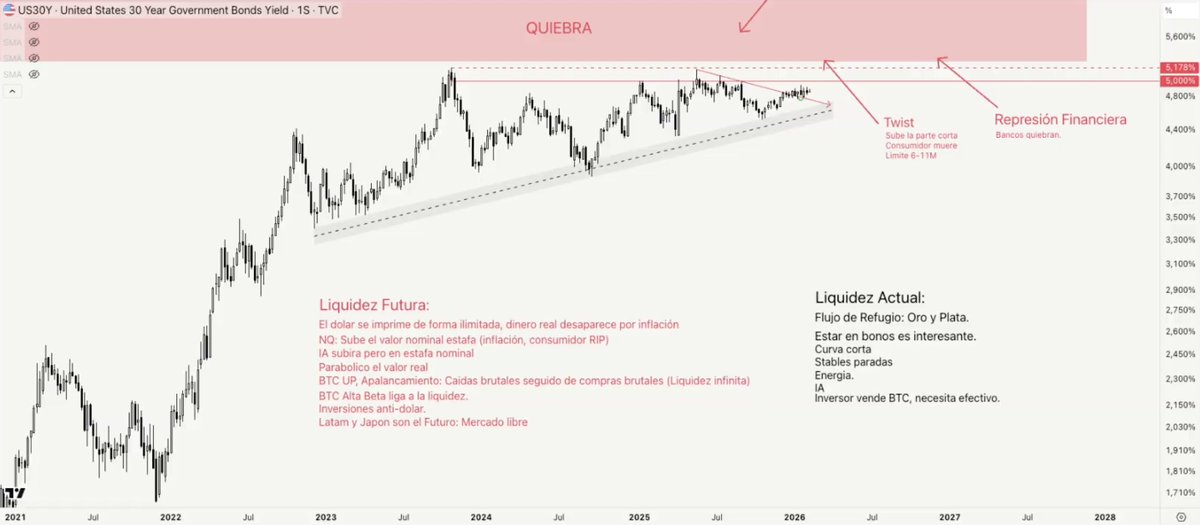
El bono a 30 años de Estados Unidos está empujando el 5%. Esa es la línea roja. Si la supera, el sistema quiebra. Estados Unidos tiene tanta deuda que no puede pagarla a esos tipos de interés.
Por eso cada vez que el rendimiento se acerca al 5%, la Fed o Trump intervienen. Hacen lo que sea para bajarlo. Pero el problema es que no pueden hacerlo para siempre.
Estados Unidos solo tiene una salida viable: el Control de Curva (YCC). La Fed comprará bonos cada vez que el rendimiento suba. De forma infinita. Imprimiendo dólares sin parar.
Es el bucle de la muerte: Imprimes → Compras bonos → Dólar cae → Rendimiento vuelve a subir → Imprimes más. Sin fin.
Trump necesita un dólar débil para que funcionen sus aranceles. Por eso dice que la caída del dólar es positiva. Está completamente alineado con este escenario.
¿Qué pasa con las inversiones?
Cuando activen el Control de Curva, el dólar se imprimirá ilimitadamente. Podríamos ver mucha inflación.
El Nasdaq subirá en valor nominal. Pero solo porque el dólar vale menos. Cuando lo compares con activos reales, verás que no bate a la inflación.
Lo que creo que se irá parabólico: Oro, plata, energía y Bitcoin. Activos reales que no se pueden imprimir.
Bitcoin dejará de ser un cajero automático. Recibirá flujos masivos de capital que huye de la inflación.
Los que tengan stablecoins paradas se verán forzados a rotar porque la inflación también destruye su valor.
Creo que Bitcoin será uno de los activos que más suba. Pero con volatilidad extrema. Subidas brutales seguidas de caídas brutales.
🚨 RUSIA ACUSA A ESTADOS UNIDOS DE USAR CRIPTOMONEDAS PARA ELIMINAR SU DEUDA DE $35 TRILLONES.
Un asesor de Putin dice que el gobierno americano meterá la deuda en stablecoins, la devaluará y reiniciará el sistema.