Beta testing iOS 18 on iPhone. Trained eye tracking and just controlled my phone using just my eyes. Blown away. This is an accessibility game-changer and gives new meaning to focus.
@hborys I love this description:
“If Canada were a high school, Winnipeg would be the overlooked, artsy, chill kid who would have been the most fun person by far to be friends with – if only you were smart enough to figure that out before graduation.”
Monotype slashes royalties to foundries from 50% down to 25% with its font subscription service, raises prices for customers by up to 10 times, & in the meantime its value is potentially up from $825M to $4 billion.
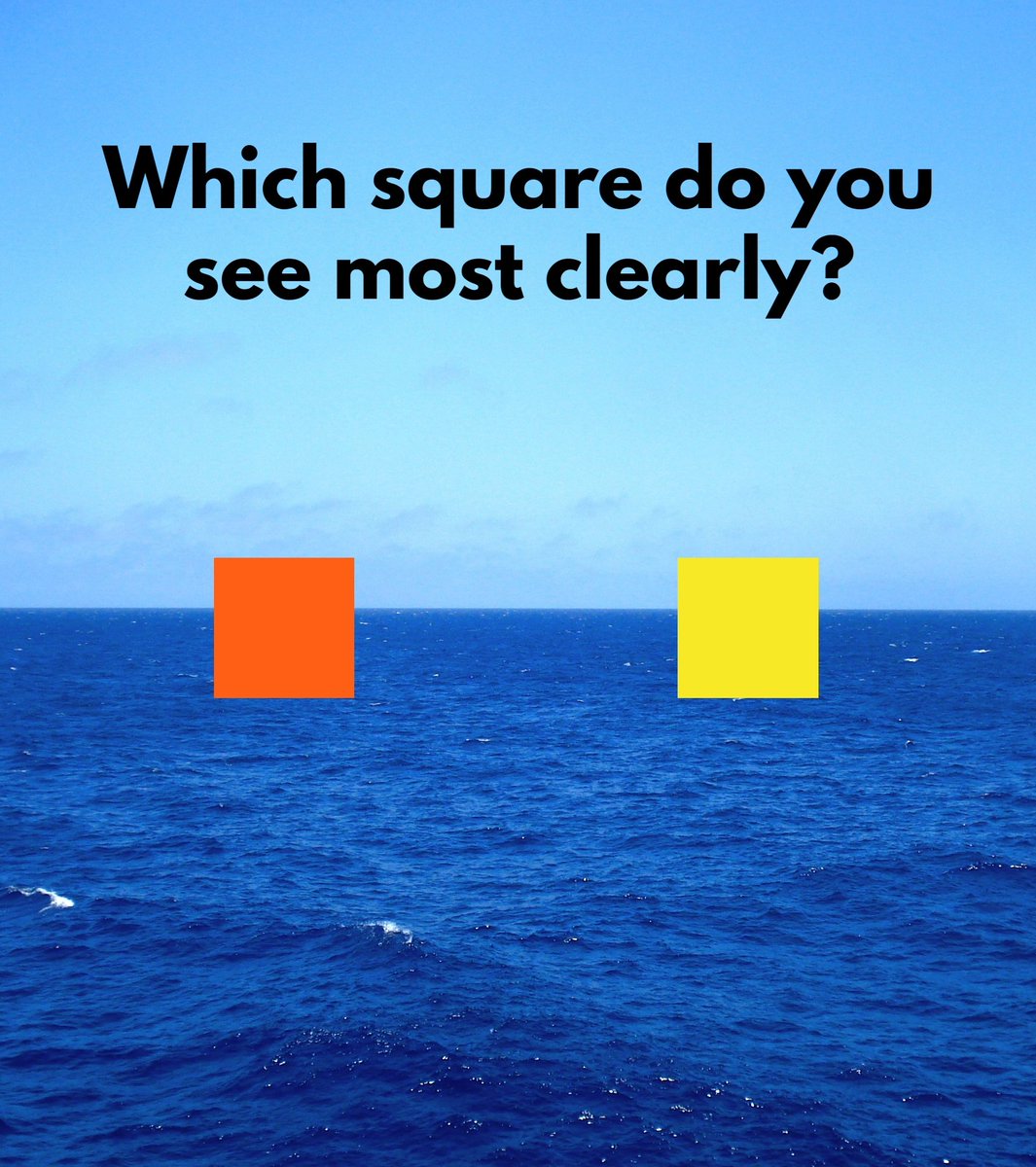
Which square do you see most clearly: orange or yellow?
Normally yellow is the most visible colour: it grabs our attention and we can see it from far away.
Hence warning signs, high-vis jackets, road markings, police tape, school buses, and taxis are almost always yellow.
But yellow isn't always the most visible colour. See, orange is *more visible* in one specific context: when it is contrasted with blue.
That's because orange and blue are complementary colours. This means that, when mixed, they cancel each other out. But, when placed alongside one another, they create a powerful, luminous, highly visible contrast.
And this fact is important because... lots of the world is blue: the sky and the ocean.
Hence lifeboats and lifebuoys and liferafts all around the world are orange — rather than yellow, the usual colour of safety equipment. If you pay attention, you'll notice that most objects relating to safety and caution around the ocean are, indeed, orange.
It's why the Golden Gate Bridge was painted orange — a particular shade which has come to be known as "International Orange" — so that it would stand out more clearly against the water and in heavy fog.
And it's also why astronauts wear orange suits during lift-off and ascent, and when they return to Earth; this makes them much easier to spot if they land in the ocean.
The "black box" recording device in aeroplanes is not actually black; they are legally required to be painted bright orange because that makes them much easier to find when planes go down over water.
The fact that orange and blue are complementary colours was also exploited by the Impressionist and Post-Impressionist artists of the late 19th century.
Think of Vincent van Gogh's Starry Night or Café Terrace at Night, in which he contrasted oranges and blues to create his famously vivid swirls of colour and light.
Claude Monet, too, in his paintings of Haystacks and of Venice, frequently used the complementary contrast between orange and blue because of the clarity and luminosity they produced.
Many things in the world are a coincidence, but the fact that lifeboats, space suits, the paintings of Vincent van Gogh, and the Golden Gate Bridge are all orange is not one of them.
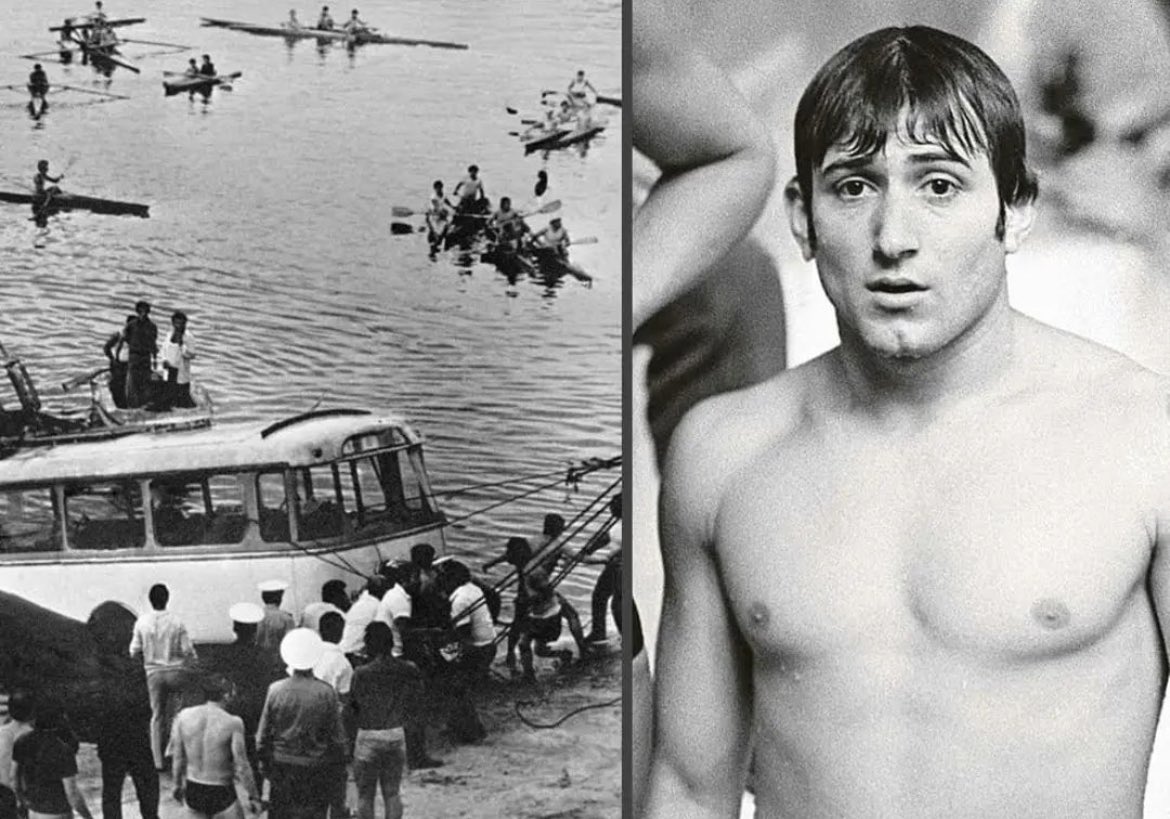
Shavarsh Karapetyan, a retired Armenian swimmer, had an incredible experience in 1976. After finishing a 26 km (16 mile) run, he heard a loud noise and found out that a trolleybus had crashed into a reservoir. The trolleybus had sunk 10 meters (33 ft) deep, about 25 meters (82 ft) from the shore.
Despite the difficult conditions of dirty water and poor visibility, Karapetyan bravely dived in and used his legs to break open the back window of the trolleybus. With great determination, he saved 46 out of the 92 passengers, rescuing 20 lives.
But the cold water and broken glass caused many cuts on Karapetyan's body, and he had to stay in the hospital for 45 days. He faced more problems like pneumonia and sepsis. Although he eventually recovered, the damage to his lungs meant he couldn't continue his successful swimming career.
"I knew I could only save a limited number of lives. I was scared of making mistakes. It was so dark down there that I could hardly see anything. Once, I accidentally grabbed a seat instead of a person during a dive. I could have saved a life instead. That memory still haunts me in my nightmares," he said.
In 1985, Karapetyan came across a burning building where several people were trapped. Without hesitation, he bravely entered the building and started rescuing the people inside.
Unfortunately, he suffered severe burns during the rescue and had to go to the hospital again. In his later years, Karapetyan moved to Moscow and started a shoe company called "Second Breath." Surprisingly, he is still alive today and actively manages his business.
Quite the start of the week around here. Our Executive Creative Director @PhilGarnham confirmed that while it's similar, this X is not a glyph from the “Special Alphabet 4” font. More information here: https://t.co/ZSwxoYp0ev