No, I do not believe that we should “surrender human free will” to AI systems, and it’s absurd to suggest that I do. I have written hundreds of pages of essays and a constant theme in them is the need for AI to be governed by legitimate democratic processes. For millennia (going all the way back to Greek and Roman philosophers), advocates of autocracy have claimed that it leads to better, faster, or more decisive decision-making than the messy process of democracy. Even if this were true (which I doubt!), we should never sacrifice legitimacy or self-determination at the altar of efficiency or security. This argument against autocracy applies word for word against governance by AI, and I feel equally strongly that turning over governance to AI is a bad idea.
No one who had carefully read my writing or my interviews could reasonably conclude that I believe anything different. For example in an interview on CBS a couple months ago, I specifically called for AI to be governed democratically. I call for the same in Policy on the AI Exponential, Machines of Loving Grace, and The Adolescence of Technology, and We Must Pace the Frontier. Machines of Loving Grace contains an extended section on using AI to revitalize democracy, and discusses the use of AI as an aid to citizens in their decision-making, "aggregat[ing] opinions and driv[ing] consensus among citizens, resolving conflict, finding common ground, and seeking compromise.” The clear and obvious implication is that humans should remain the ones making political and governance decisions. The Adolescence of Technology has an entire section on fighting against AI-driven tyranny, and I even discuss the danger of AI labs usurping power and come out strongly against it — by implication, this definitely includes an AI lab usurping power and giving it to AI itself!
If I thought any of this was a good idea, I would be advocating for it in public, just as I have not been afraid to advocate for many, many unpopular views over the last few years. But I am not advocating for it, because I think turning over governance to AI is a terrible idea.
Separately, I think there is frequent conflation (including in this article) between the idea of “surrendering human free will” to AI in some grand sense of global governance, and the more prosaic idea that as AI systems advance, they become capable of doing specific tasks in a more automated way. This is not AI “running the world,” but AI driving a car, designing a cancer drug, or writing software end-to-end. Here, my view is mixed. AI doing more complete or larger tasks is economically valuable and can drive important advances in software, medicine, transportation, energy, etc. It is clearly desirable in many cases and will save a lot of lives. But it has downsides as well, and in some areas it may not be worth it.
For example, using AI too autonomously to build the next generation of AI systems (known as recursive self-improvement, or RSI) may cause AI to improve faster than we can control or adjust to it, so we may want limits on this process. As we said publicly in early November, we don’t expect it to be safe for Claude to build successive frontier models fully autonomously, without meaningful human supervision or understanding. Second, in some contexts, using AI in too end-to-end a manner may be a cause of serious job disruption, and it may make sense to slow or even stop some AI deployments to give people more time to adapt. Third, while the use of AI for alignment research is an incredibly valuable tool, it must be done with caution, because we may not be able to trust the work of the AI system. Finally, in many cases, humans would simply prefer to do some activities themselves, so they can stay deeply engaged in what matters to them, even if AI can do those activities better. There are countless other examples and hard cases. I don’t think there are any easy answers here, nor is there (nor should there be) any single decision-maker: some of these decisions will be made by society, some by government, some by AI companies, and some in a decentralized manner by individuals expressing their own preferences as consumers, which may differ from the preferences of others.
I don't think that other AI leaders or AI companies have significantly different views from me on whether specific tasks should be automated. Certainly the products that they offer don’t differ materially in their orientation towards automation of tasks; every company seems to be releasing models more and more capable of task automation (as that’s been the general consequence of scaling up AI training), and every company claims to understand there are risks and downsides of such automation and to offer safeguards. If anything, Anthropic has been the most vocal and the most proactive about acknowledging these downsides and trying to address them. For instance, it’s fairly absurd to cite my statement that fully autonomous weapons might “one day be needed for the defense of democracy” as differing from that of other AI companies, when I was willing to risk Anthropic’s future as a company to refuse to allow our existing AI models to be used for autonomous weapons even in the face of legal sanctions, and no other AI company did the same.
To summarize, as applied to grand questions of how we govern increasingly capable AI, I have been vocal and consistent that AI needs to be governed by a legitimate, democratic process and that “surrendering human free will” to AI systems is a terrible idea. As applied to automation of specific tasks by or for people, my views are more mixed, but I don’t think they differ from those of other AI companies — most other companies seem to be offering similar products and confronting similar tradeoffs without having perfect answers to them. What is happening is that there’s a sort of vibes-based commercial and political positioning that some AI CEOs are engaging in, where they repeat slogans like “human control and agency,” or “AI should be just a tool,” without actually doing anything different in their products or taking seriously the difficult questions that lie behind these slogans.
미친 롤러코스터 변동성.. 반도체 3배 인버스(SOXS)가 장중 +24.8%까지 치솟았다가 단 2시간 반 만에 +3%대로 수직 추락했음.
이상한 건 이 반등 도중에 오히려 엔비디아 SEC 조사 착수와 S&P 신용등급 강등 경고까지 터졌다는 점임. 대형 호재가 나온 것도 아닌데 나스닥이 저점에서 975포인트나 튀어 올랐음.
반도체가 바닥을 찍기 딱 8분 전, 월가에 떨어진 한 통의 소식과 오늘 밤 벌어진 추세 전환의 원인을 뜯어봄.
1️⃣ 바닥 찍기 딱 8분 전 울린 신호탄: 마이클 버리, 나스닥 풋 전량 청산
오늘 밤 반전의 결정적 심리 스위치는 미국시간 오전 11시 36분이었음.
《빅쇼트》의 마이클 버리가 본인 서브스택을 통해 남아 있던 나스닥100(NDX) 풋옵션 절반을 전량 매도하고 사실상 매수(롱) 포지션으로 돌아섰다고 공개한 것임.
이유는 단순했음. 나스닥100이 고점 대비 -20% 약세장 경계선(25,000)에 닿고 공포지수(VIX)가 35 가까이 치솟자, 풋옵션 가격이 너무 비싸져 더 이상 하락에 베팅할 손익비가 안 나온다는 판단이었음.
이 속보가 뜬 지 정확히 8분 만인 11시 44~45분, SOXS가 장중 고점(+24.8%)을 찍고 필라델피아 반도체(-8.0%)가 바닥을 다진 뒤 수직 반전이 시작됐고, 12시 18분 블룸버그 보도가 2차 불을 붙였음.
2️⃣ 11시 30분 마진콜 청산 종료 → 25분 만에 주식·금·비트코인 동시 반등
오늘 오전 폭락은 단순한 주식 매도가 아니었음. 미국 10월 근원 PCE(3.3%)와 3분기 GDP(4.3%) 과열로 12월 금리 인상 확률이 98%까지 치솟자, 현금을 구하려는 마진콜 강제 청산이 쏟아지며 S&P 500(6,970), 금(3,500달러 붕괴·-3.8%), 비트코인(57,229달러·-4.2%)까지 안전자산·위험자산 가릴 것 없이 한꺼번에 던져졌음.
그런데 11시 30분 유럽 증시 마감과 추수감사절 조기 7년물 국채 입찰이 끝나자(입찰 수요 자체는 약세였음) 오전 강제 매도가 딱 멈췄음. 달러가 꺾이면서 11시 53분부터 단 25분 만에 나스닥·반도체·금·비트코인이 동시에 수직 반등함(현재 금 +0.3%, 비트코인 6만 달러 탈환).
3️⃣ 관세 세부안 ‘반도체 면제’ 확인 + 앤트로픽·델·다우의 심리 회복
개장 직후엔 “14개국 301조 관세” 헤드라인만 보고 반도체를 일괄 투매했지만, 세부 조항에서 대만·한국 등 비중국 13개국의 핵심 반도체 일부가 관세 면제 대상에 포함돼 있고 당장 시행이 아닌 내년 1월 이후 공청회 절차라는 점이 확인되며 숏 세력의 명분이 약해졌음.
여기에 공모가(83달러)가 깨지며 장중 73.85달러까지 밀렸던 앤트로픽(ANT)이 12시 33분 공모가를 되찾고 +4.7%(85.75달러)까지 치솟았음. 어제 AI 서버 수주잔고 178조 원 실적을 냈던 델(DELL)도 -10.3%에서 보합권으로 돌아섰고, HP(+13.6%)·존디어(+4.7%)·러셀2000(+0.9%)까지 올라 다우가 저점 대비 +1,480포인트 양전하며 시장 전체를 받쳐줌.
4️⃣ 제일 무서운 대목: 오후에 엔비디아 대형 악재 2방이 터졌는데도 올랐음
오늘 반등이 ‘호재성 추세 전환’이 아니라는 가장 확실한 증거가 오후 장중에 나왔음.
• 13시 14분(WSJ 단독): 미국 증권거래위원회(SEC), 젠슨 황 사퇴·복귀 사태 관련 엔비디아 조사 착수
• 13시 59분(S&P 글로벌): 엔비디아 신용등급(‘AA’) 부정적 관찰대상 등재(90일 내 강등 경고)
• 12시 35분(로이터): 후티 반군 사우디 정유시설 드론 공격 주장 → 국제유가 오히려 +2% 상승
이 때문에 브로드컴(-1.3%)·AMD(-1.8%)가 낙폭 대부분을 지우는 동안 엔비디아만 -4.8%로 뒤처졌는데도, 지수 전체는 멈추지 않고 밀어 올렸음.
이유는 VIX 붕괴와 기계적 숏 스퀴즈임. 오늘 SOXL 거래량은 평소 20일 평균의 181%, SOXS는 123%로 거래 자체는 폭발했지만, 내일 추수감사절 휴장을 앞두고 기관 호가창이 듬성듬성 비어 있었음.
VIX가 34.95에서 27.5까지 급락하자 아침에 풋옵션 헤지용으로 주식을 팔아뒀던 옵션 딜러들이 기계적으로 주식을 되사들였고, 반도체 지수 -3배 레버리지인 SOXS는 하루 만에 +24.8%에서 +3.8%로 수익률이 증발해 버린 거.
$CRWV - COREWEAVE BANKS PREPARE $4.5 BILLION LOAN SALE AS DEFAULT FEARS SURGE
Morgan Stanley and MUFG are preparing to sell $4.5 billion in CoreWeave-linked debt as soon as next week, Bloomberg reports.
The loan, backed by GPUs supporting a Meta data center project, is expected to carry investment-grade ratings and yield 7%–7.5%.
But CoreWeave's broader credit picture is deteriorating sharply.
🔸 2031 bond yield: Approximately 18%
🔸 Five-year implied default probability: Above 70%, based on credit-default swaps
🔸 Loan sale: $4.5 billion
The striking contrast: Meta-backed financing may attract investment-grade investors even as CoreWeave's own debt trades at distressed levels.
미국 반도체가 이틀 연속 크게 밀리고 있음.
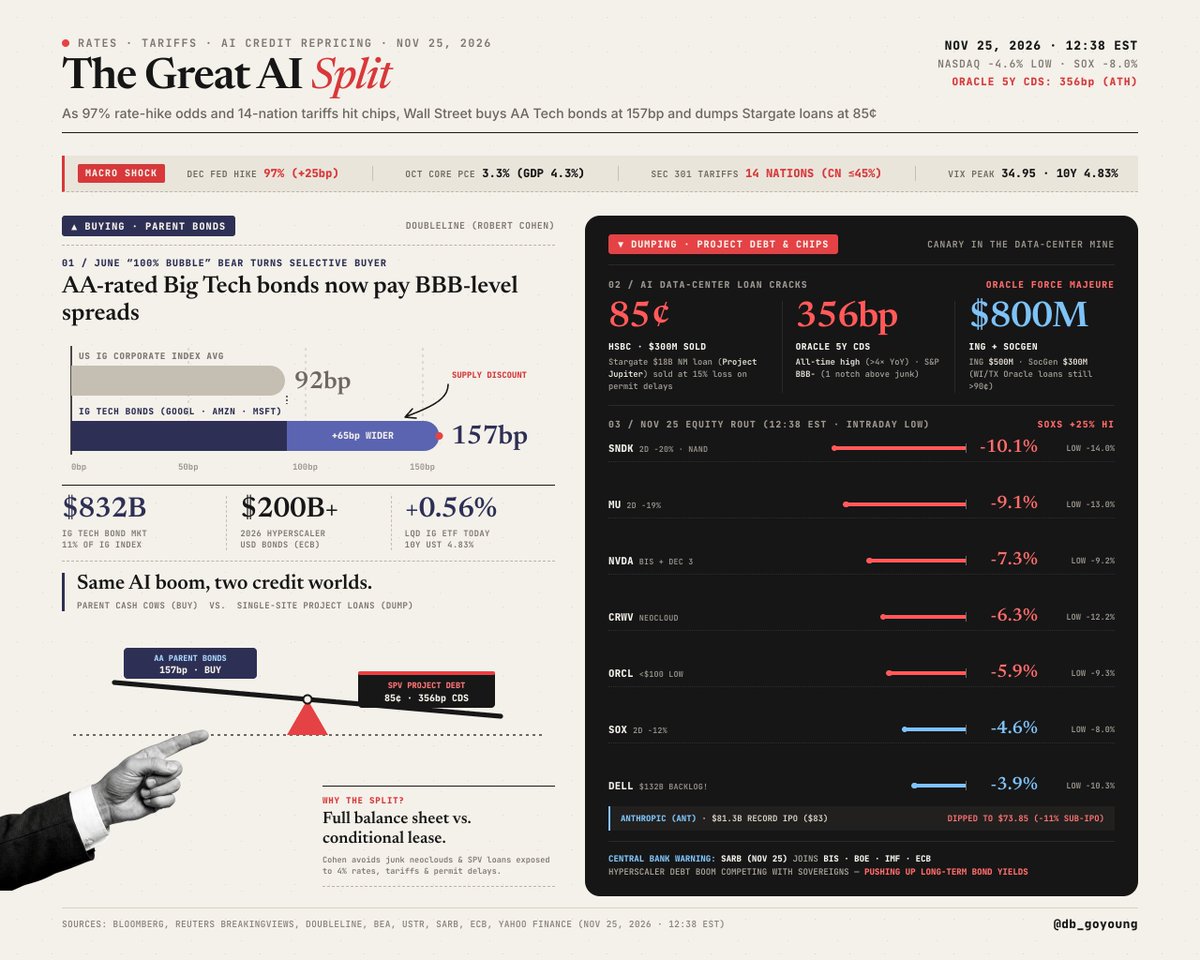
장중 필라델피아 반도체지수 -8%, 샌디스크 -11%, 마이크론 -10%, 엔비디아 -7~9%. 오늘 아침 미국 물가(근원 PCE 3.3%)가 튀며 12월 금리 인상 확률이 97%까지 치솟은 데다, 14개국 관세와 은행들의 AI 데이터센터 대출 85센트 손절 소식까지 한꺼번에 겹쳤음.
지금 월가에서 무슨 일이 동시에 벌어지고 있는지, 왜 이런 폭락장에서도 우량 빅테크 회사채만 오히려 오르고 있는지 핵심만 정리함.
1️⃣ 은행권의 첫 손절: ‘스타게이트’ 대출 85센트 매각과 오라클 CDS 356bp
오늘 로이터 브레이킹뷰스가 “은행들이 AI 데이터센터 부채 광산의 카나리아”라고 짚은 사건의 진원지는 뉴멕시코 2.45GW 데이터센터 ‘프로젝트 주피터’임.
오픈AI·오라클·소프트뱅크 ‘스타게이트’의 핵심 기지로, 블루아울 계열사가 개발하고 글로벌 은행 약 20곳이 180억 달러(약 24.2조 원) 건설 대출을 대줬음.
문제는 천연가스 파이프라인과 전력·대기질 인허가가 막히면서 시작됐음. 핵심 임차인인 오라클이 지난 9월 개발사에 ‘불가항력(Force Majeure)’ 통보를 보내며 “2028년 가동이 밀리면 임대료 지급을 최대 3년까지 미룰 수 있다”고 선을 그은 것임.
임대료가 들어와야 대출 원리금을 갚는 구조가 흔들리자, 11월 들어 HSBC가 3억 달러 물량을 액면가 85센트(15% 손실 감수)에 처분했고 ING(5억 달러)와 소시에테제네랄(3억 달러)도 데이터센터 대출 매각에 나섰음.
물론 공사가 정상 진행 중인 위스콘신·텍사스 대출은 아직 90센트 이상에서 거래되고 있음. 그래도 오늘 오라클의 부도 보험료 격인 5년물 CDS가 사상 최고치인 356bp(1년 전의 4배 이상, S&P 등급은 정크본드 바로 위인 BBB-)까지 치솟으며 AI 인프라 대출 전반으로 경계감이 번졌음.
2️⃣ 그런데 6월 대표 비관론자는 왜 오늘 AI 회사채를 줍고 있을까?
재미있는 건 채권 시장 안에서도 돈의 방향이 완전히 갈렸다는 점임.
지난 6월 “AI 신용 버블 확률은 100%”라고 경고했던 더블라인(DoubleLine)의 로버트 코헨이 오늘 블룸버그 인터뷰에서 AI 회사채 매수로 돌아섰다고 밝혔음. 실제로 오늘 AI 주식은 폭락하는데 미국 우량 회사채 ETF(LQD)는 오히려 +0.5% 상승 중임.
이유는 가격과 신용 계급 차이 때문임. 올해 빅테크들이 AI 설비투자 자금을 대느라 달러 회사채를 2,000억 달러 넘게(ECB 추정) 쏟아내면서, 우량 기술채가 국채보다 더 얹어주는 추가 이자(스프레드)가 157bp(1.57%p)까지 벌어졌음. 미국 전체 우량 회사채 평균(92bp)보다 0.65%p나 더 얹어주는 수준임.
코헨이 줍는 건 알파벳·아마존·MS처럼 본업 현금이 넘치는 AA급 ‘본사 우량 채권’임. 현금 부자 본사 채권이 물량 부담 탓에 신용등급 두 단계 아래인 BBB급 금리로 싸게 팔리니 사들이는 것이고, 은행들이 던지는 프로젝트 대출이나 하위 등급 네오클라우드 빚은 여전히 거들떠보지도 않는다고 선을 그었음.
3️⃣ 오늘 밤 주식을 찍어 누른 거시·메모리·개별주 3연타
신용 시장의 균열 위에 오늘 아침 거시경제와 반도체 악재가 한꺼번에 얹혔음.
• 금리 인상 & 관세 공포: 오늘 발표된 미국 10월 근원 PCE 물가가 3.3%(예상 3.2% 상회), 3분기 GDP 수정치가 4.3%, 주간 실업수당 청구가 18.9만 건으로 모두 과열 신호를 내며 12월 연준의 25bp 추가 인상(4.00~4.25%) 확률이 97%까지 치솟았음. 여기에 대만·한국·일본·중국 등 14개국 대상 무역법 301조 관세(중국 최대 45%, 내년 1월 이후 순차 발효)가 2027년 물가·원가 압박 우려까지 키웠고, 남아공 중앙은행(SARB)까지 가세한 ‘빅테크 차입→국채 금리 자극’ 경고(BIS·영란은행·IMF·ECB에 이은 합류)가 겹쳤음.
• 메모리 집중 폭격: 트렌드포스가 중국 클라우드 업체의 SSD 발주 축소를 이유로 2027년 1분기 낸드 계약가 하락 전환을 경고하면서, 낸드 비중이 절대적인 샌디스크(SNDK -11%, 이틀 -21%)와 마이크론(MU -10%, 이틀 -20%)이 이틀 연속 두 자릿수 급락을 맞았음.
• 엔비디아·앤트로픽 부담: 엔비디아(-7~9%)는 월요일 젠슨 황 복귀 랠리(+31.5%)의 차익 매물에 더해, 연루 업체 메가스피드의 미국 수출통제 블랙리스트 등재와 12월 1일·3일 미 의회 소환 부담이 겹쳤음. 역대 최대 813억 달러 IPO로 상장한 앤트로픽(ANT)도 공모가(83달러) 아래로 밀려 장중 73.85달러까지 내려갔음.
어제 장 마감 후 델(Dell)이 AI 서버 수주잔고 1,323억 달러(약 178조 원)라는 괴물 실적을 내고도 주가가 밀린 건, 지금 시장의 질문이 “주문이 있느냐”에서 “금리와 관세, 빚을 뚫고 그 돈이 진짜 회수되느냐”로 넘어갔다는 신호임.
수십 년간 트레이딩하던 베테랑들도 하루아침에 방향이 꼬여 털리는 장세라 이런 구간에선 억지로 수익을 내겠다고 칼날을 잡기보다, 당분간 예금이나 현금으로 내 돈을 지키는 것 자체가 오히려 제일 확실한 전략일 수도 있음.