pretty interesting that the category is converging on the same visual grammar almost comically fast too.
you’ve got a blob, a face, some “eyes”, you gotta give it some soft geometry, add in some emotions via animations, & of course a very friendly affect.
The world around you is designed in CAD. How well can AI build it?
Introducing CADArena, benchmarking AI CAD generation across the tools engineers use
Agents can now build accurate geometry, but struggle to create feature trees engineers can maintain and edit
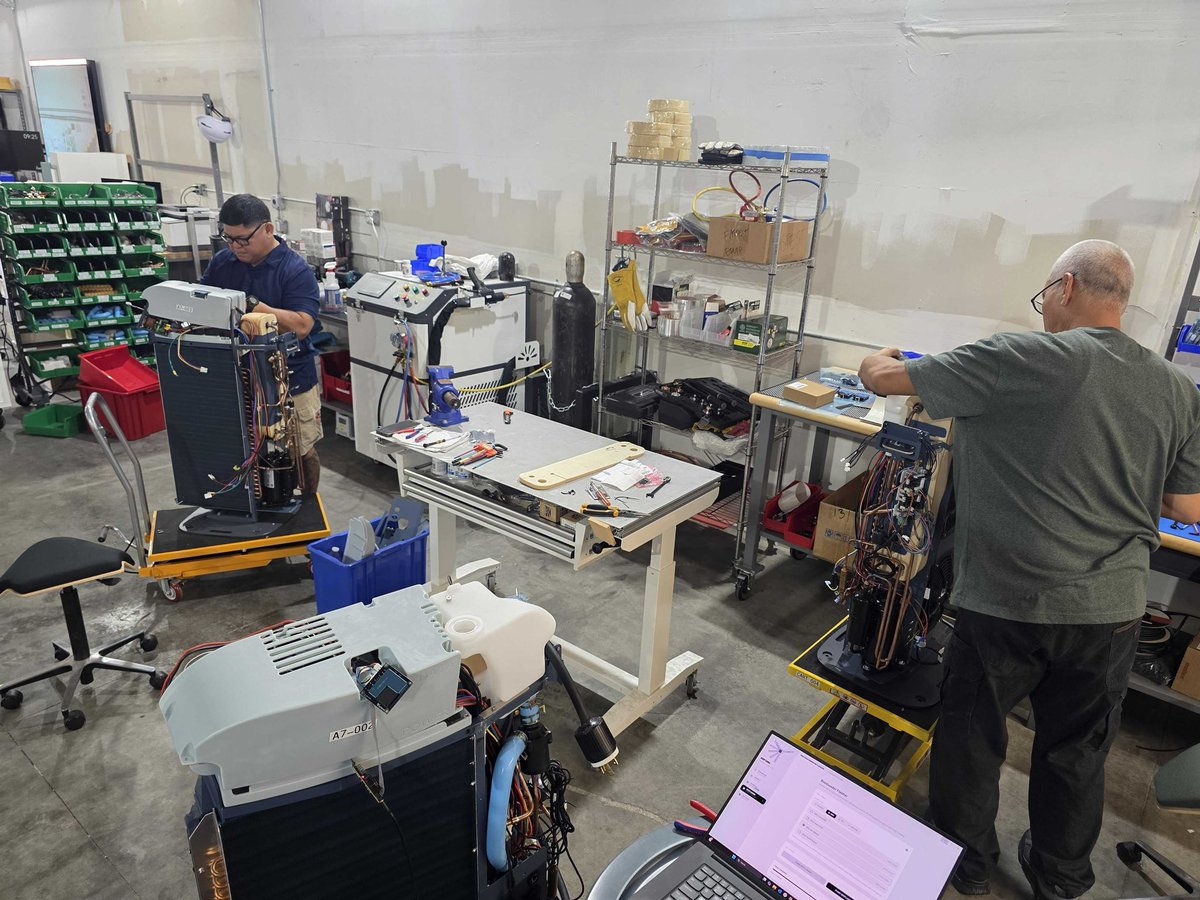
Slowly unveiling the curtains on what we’ve been building at Airform - we have an incredible team building the next generation of heating and cooling infrastructure from Hawaii and California ❤️
Thanks for the feature @WSJ! The team is working very hard to make more Airforms right now here in Kailua, Hawaii. You can check out more here at https://t.co/e1MDnsKF0E. They are now delivering in Hawaii and California.
@barbinbrad They should work for a few weeks on the factory floor. Automakers and other shops are always hiring. You’ll find 10x more interesting problems
Hot take: there is actually not really a shortage of talented mfg engineers who live and breathe these problems right here in the US. In fact it’s these same engineers that trained Shenzhen in the first place.
I think the real problem is that these types of talents are naturally system and standards oriented, which makes them hard to cross over into being a founder or work in startups. When I quit Toyota and said I’m gonna run a startup, most people in my org thought I was crazy.
Funny because manufacturing is by far one of the toughest engineering disciplines I’ve been a part of, sometimes spending over 24 hours on a production line trying to fix an issue. Still to this day I’ve had more mental panics there than I have being a tech founder which is crazy.
These engineers definitely exist in the US, have the grit and ability tolerate pain to solve a problem, but somehow not many of them will work in uncertain environments like startups. I’m hopeful that the reindustrialization movement will push more of them though!
A super smart scientist asked me last week: what's so hard about reshoring general advanced manufacturing (short of TSMC frontier precision chemistry)? Isn't the issue just labor cost? Nope.
A toy example to illustrate: We're trying to build a lot of drone motors in America right now, and falling short. It's not a labor cost issue.
The work instruction says: this magnet, this adhesive, cure at this temperature, wipe the rotor first. Any competent team can build the station and follow it.
But in week 3, motors start failing vibration testing. Some of them, mostly night shift. Also, weirdly, whenever the careful new hire is on station.
The adhesive cures differently with humidity, and the dehumidifier cycles differently at night. The new hire wipes the rotor generously, and that leaves a solvent film the adhesive doesn't like very much. Someone who has run a motor line before can figure this out in 10m. Everyone else -- struggle city.
The "fix" is two lines in the work instructions: run the dehumidifier continuously, one solvent wipe per rotor. But those lines aren't in the work instruction, and they're not in anyone's! At best the fix becomes a corrective-action report in one line's files, linked to nothing and never read.
A motor line rapidly may go from 5 to 40 stations, each with a dozen of these painful stories on the weekly as it grows. "What Shenzhen knows" is not written down in a book whose covers can be sliced off and ingested into a model, it's a few million humidity stories stored in people, and a pace of knowledge-rich adjustment that keeps cost down and yield high. The only way to get it back is work with people who have brought up lines, to reshore and grow the ecosystem of people who have this knowledge, and to capture that knowledge as we build.
Lots of people have clever ideas about the data capture/API piece, but we think the business of manufacturing may need equal portions pain tolerance, customer commitment, and cleverness on talent.
America needs to solve the other half of reshoring.