@UpdatesChennai Official data from Commerce Ministry. Anyone who says current chennai airport is under-utilised does not know anything about aircargo.
Source: https://t.co/I2m14GyXv1
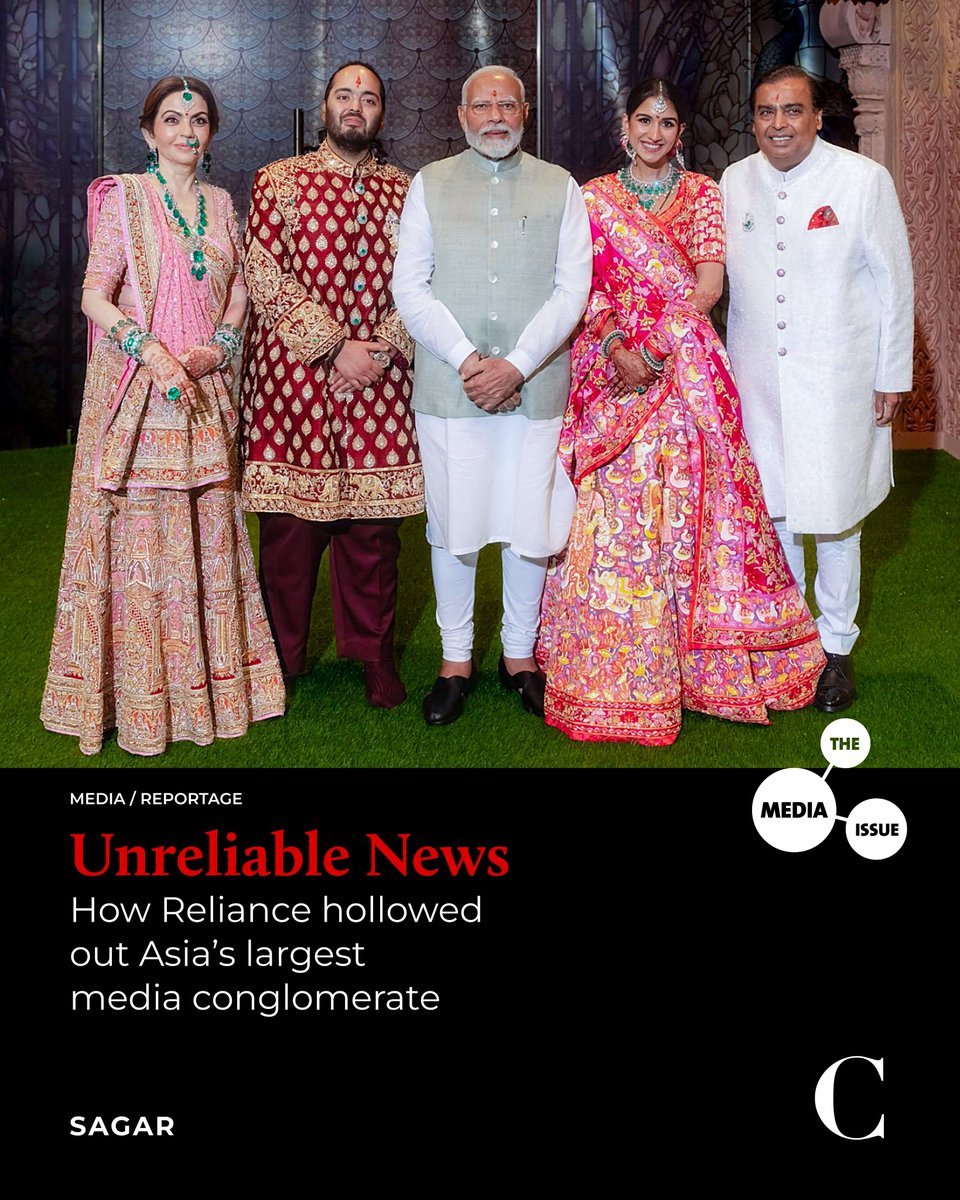
Archives | For most journalists who worked at Network18, it was a simple value proposition. Many told Sagar (@Sagar_reporter), a staff writer at The Caravan, that Reliance took care of its employees quite well in terms of salaries, medical insurance and provident funds, as long as they did what they were told.
If not, the company would come after you. Two former employees said they struggled with finding jobs after leaving Network18 because the management warned potential employers against hiring them. A former associate editor said they were asked to remove “Former Network18” from their social media account because they had tweeted something that the management believed was “anti-Hindu.” Almost half a dozen staffers said their social media accounts were closely monitored by the management. “Because the ruling government is very particular about it,” the former primetime anchor told Sagar. “They live by twitter, die by twitter. Who tweets what? Which journalist tweeted what? Which journalist tweets what way? Identical tweets will be sent to PMO reporters.” Those who reported directly on and to the Prime Minister. Individuals also lost their jobs at the network for posts even vaguely critical of Modi or the Rashtriya Swayamsevak Sangh that trained him.
Unreliable News: How Reliance hollowed out Asia’s largest media conglomerate. Read the full report:
https://t.co/55ZvaJFApp
#Reliance #Network18 #Ambani #NarendraModi
NDTV editor who is famous for eating elephant’s Khichdi went to Nepal to cover the devastating flood and ended ip reporting how survivor pilgrims saw the image of god on mountains.
The absolute state of Indian media, can’t even do calamity reporting without clownery.
All foreign correspondents in Nepal right now: The disaster has wiped away villages, killed so and so number of people. It was caused by a glacier collapse etc etc
A certain section of Indian channels in Nepal right now: Survivor says he saw Lord Shiva swirling in the waters
This Subhash Chandra insolvency case does not look like a normal commercial haircut to me. The deeper you read the NCLT record, the more uncomfortable the questions become.
Let’s understand the Maths.
The easiest defence being circulated in the Subhash Chandra insolvency case is that he was “only a guarantor.” That description is legally misleading.
Under Section 128 of the Indian Contract Act, the liability of a surety is ordinarily coextensive with that of the principal debtor unless the contract provides otherwise. In simple words, a personal guarantee is not a ceremonial signature. If the borrower defaults, the creditor can proceed against the guarantor for the guaranteed liability. That is precisely why claims of around ₹22,006 crore were admitted against Subhash Chandra in his personal insolvency proceeding.
And there is another important point. He was not a man worth ₹31 crore when these guarantees were being given. The NCLT record itself refers to net worth certificates showing approximately ₹45,888 crore in 2017 and ₹40,562 crore in 2018. So the story is not that a person worth ₹31 crore somehow guaranteed ₹22,000 crore. The real story is that a promoter who had represented personal wealth of more than ₹40,000 crore gave massive guarantees, and years later, when those guarantees became enforceable, his disclosed net worth had fallen to around ₹31.79 crore.
That immediately creates the first serious question.
Where did the wealth go?
If assets worth tens of thousands of crores disappeared from the personal balance sheet, then before granting an almost complete discharge of personal liability, the natural thing should have been to trace those assets properly. Which assets were sold, to whom, for what price, where did the consideration go, whether any assets moved to relatives, group entities, LLPs, trusts or connected companies, whether those transactions were at market value and what ultimately happened to the money.
This was not merely an outside suspicion. The Technical Member herself considered the fall in net worth serious enough to call for an independent forensic audit and asset tracing exercise.
Then comes the part which, to me, makes the case even more extraordinary.
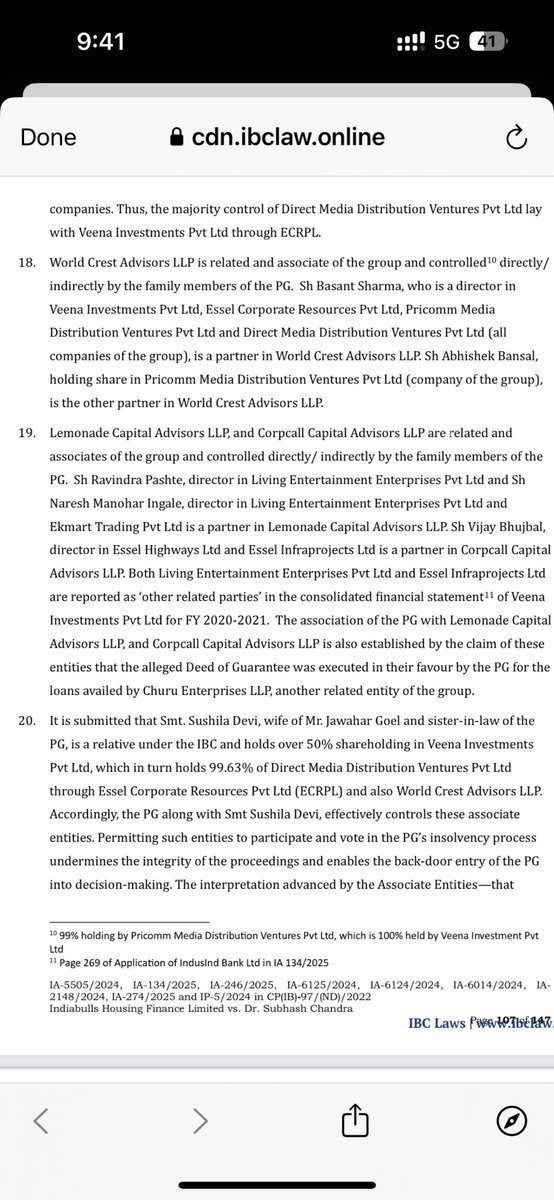
Five disputed creditors, World Crest, Lemonade, Corpcall, Veena Investments and Direct Media, together controlled around 61.78 percent of the total voting power. Their links with the Chandra and Essel ecosystem through family relationships, directorships, shareholding and corporate connections were argued before the NCLT. The Technical Member found these connections serious enough to question their voting rights. The Third Member took a narrower statutory view and said the legal test to disqualify them as associates had not been fully satisfied.
But the mathematics does not disappear.
Around 77.48 percent of the total voting share supported the plan. Remove these five disputed creditors and the support falls to around 15.70 percent, while around 18.42 percent had voted against it.
So these five were not minor creditors sitting on the side.
Their votes were decisive.
Now understand why this matters economically.
Suppose a promoter has ₹10,000 crore of personal liability. A company within the same economic ecosystem holds a ₹6,000 crore claim and an outside bank holds a ₹4,000 crore claim. The connected company accepts almost nothing on its ₹6,000 crore claim and uses its voting strength to approve the plan.
On paper it looks like that company suffered a massive loss.
But if both sides are really part of the same economic pocket, then the internal claim is only being sacrificed on paper, while the same vote helps reduce or extinguish the outside bank’s ability to recover ₹4,000 crore personally from the promoter.
That is why the real question is not who took the biggest haircut on paper.
The real question is whose money was actually lost.
If these five creditors were genuinely independent and commercially separate, then their decision is one thing. But if their economic interests were aligned with Chandra or the Essel ecosystem, then their huge nominal claims could have supplied exactly the voting power needed to cut down the personal recovery rights of outside banks.
That possibility is exactly why beneficial ownership and real economic control should have been forensically examined before approving such a massive discharge.
And there is one more fact which makes it impossible to casually say that the entire process was flawless. Claims of more than ₹185 crore on behalf of 1,260 people were admitted without proper supporting documents and later had to be excluded by the Third Member.
So no, the real issue is not simply that ₹22,006 crore became ₹6.25 crore.
The deeper issue is this.
A person once represented as worth more than ₹40,000 crore came into personal insolvency with a disclosed net worth of around ₹31.79 crore. Five disputed creditors with documented links to the wider Chandra and Essel ecosystem held 61.78 percent of the voting power. Their votes were mathematically decisive. No complete independent forensic asset tracing was done before the plan was approved.
That is why “he was only a guarantor” is not an answer.
The two questions that must be answered are very simple.
Where did the wealth go?
And who really controlled the 61.78 percent voting block?
Until these two questions are answered through a proper forensic investigation, this will not look like an ordinary commercial haircut. It will remain a serious test of whether our insolvency system can actually deal with powerful promoters, connected entities and enormous financial claims without allowing form to defeat substance.
@FinMinIndia@RBI @IBBIIndia @narendramodi@RahulGandhi@khurpenchh@NaukarshahiGems
#SubhashChandra #NCLT #NCLAT #IBC #Banking #ForensicAudit #CorporateGovernance #FinancialSystem #Accountability #BankingFraud
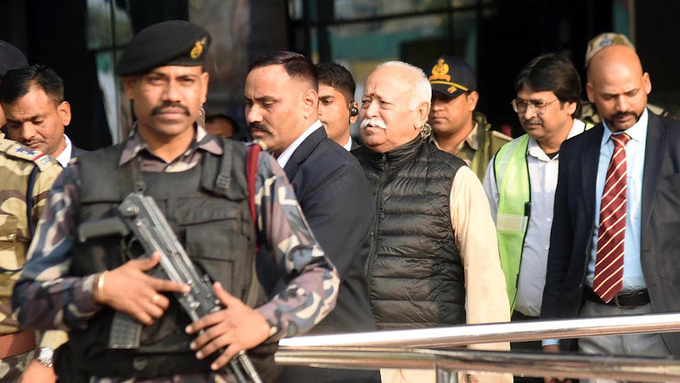
Archives | The CISF has reportedly been providing Z-plus security—the heaviest the government can offer—to Mohan Bhagwat and the RSS headquarters in Nagpur since 2015.
Since June 2021, Lalan Kishore Singh, a 64-year-old who has been a part of trade unions for most of his life, began a quest to find out how much money the government has been spending to provide security to the Sangh. “When RSS is not a registered organisation, then by what rules has the government been spending on it?” Singh told me. “And if the RSS is paying for the protection, how much has been spent?”
Mapping the hidden structure of an unaccountable organisation. Read @singhamritaa's report: https://t.co/Krat9S2tvV #MohanBhagwat
@UpdatesChennai so its between which of the two is going to take less resources. Datacenters may generate many secondary jobs for HVAC, Electricals, etc.. related systems but it is primarily glorified warehouse. Semicon fab needs specialised workforce that even India does not have in enough no.
‘ஊழல் செய்தவரை நீக்கிவிட்டோம்; அவரின் மனைவிக்குப் பொறுப்பு வழங்கியதில் என்ன தவறு?’ - அமைச்சர் அருண்ராஜ் (ஜூ.வி பேட்டி)
👉 https://t.co/7WCFwAqjE7
#JuniorVikatan#Magazine