1/n Solana decoding for data analysts & engineers.
Working with Solana data can feel like navigating a dark forest. In this 🧵, I’ll break down:
how data is encoded/decoded
provide examples with explorer, rpc call and code.
Key concepts include Instruction, Event, Anchor, CPI
The age of one-time token due diligence is over. A given "token" can easily involve 300+ changing contracts.
We've built a balance sheet graph for every token, so you can see all protocol/token dependencies and then model economic and operational risks.
Subgraph monetization beta opens next: any Goldsky customer will be able to flip a switch on their own subgraphs and turn their data into paid endpoints.
When it comes to in-depth technical write-ups, one of my favorite authors is @abhi9u. And this time, he has crafted a beautiful article, "Virtual Memory: A Deep Dive into Page Tables, TLBs, and Linux Internals."
Go, give it a read.
https://t.co/vSum7srMRT
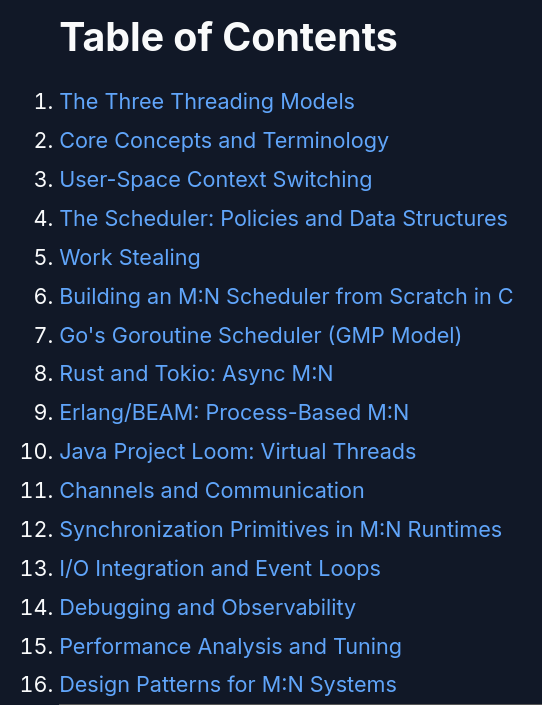
A nice article about "The M:N Concurrent Model — A Complete Guide. From First Principles to Production Schedulers"
#golang and others...
https://t.co/24bvQw975t
"Technical writing completely changed my life." -
@trq212
In less than 2 years, Thariq (@AnthropicAI) cracked the code on writing technical articles that consistently pass 1M+ views.
In this 15-min workshop, he breaks down:
→ his exact writing workflow
→ tactics behind articles that go viral
→ how he leverages AI to write faster (without losing his voice)
→ why technical writing is the most underrated way to drive mindshare
Technical writing is one of the most powerful (and completely free) ways to gain views, build authority, and teach the world what you know.
This is the 4th [Technical] Write & Learn, a curated workshop series cohosted with @swyx and @KernelLabs_ai.
At Goldsky, we care about our users a lot and take feedback from builders very seriously!
So last week, we introduced Fast Scan support for @Mega_Ecosystem across both mainnet and testnet.
Fast Scan is designed to handle chains at massive scale. It enables you to either backfill entire datasets or pre-filter data based on specific attributes quickly.
Combined with Turbo, you can build backend applications with simple or complex indexing logic in an efficient and cost-effective way.
See for yourself—check the next tweet to see how we made historical blockchain backfills 12× faster with Turbo 👇
The blockchain built for AI payments is here, coming soon to an agent near you.
Kite AI mainnet is now live and ready for action! 🚀
We’re thrilled to announce that @goldskyio is supporting @GoKiteAI as we bridge the gap between institutional finance and agentic payments.
Goldsky is live today as a launch partner for Nanopayments mainnet. Any agent with a funded wallet can pay for Edge RPC requests in @USDC across 40+ EVM chains
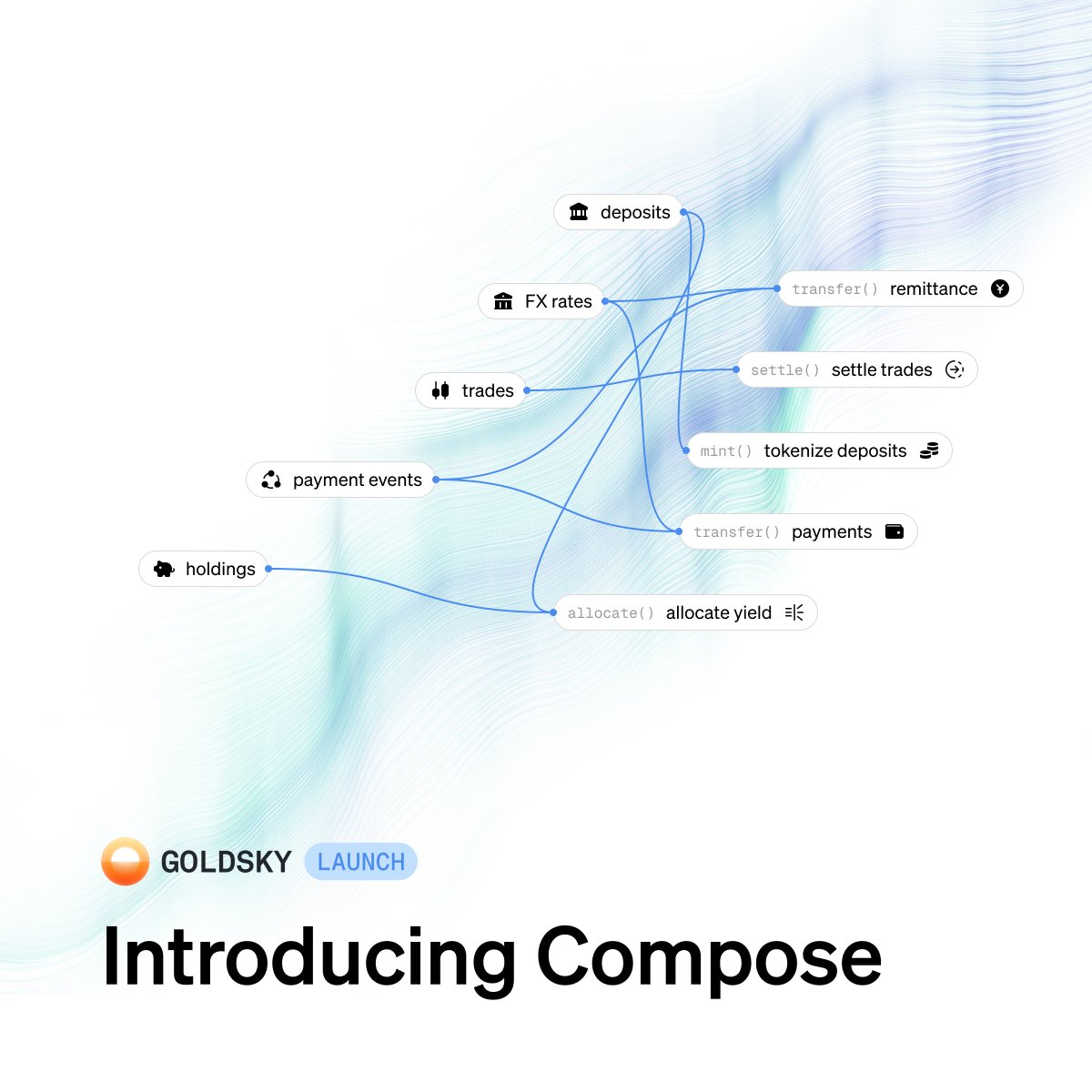
We’re thrilled to announce the general availability of Compose!
For the past two months, Compose has been quietly powering the automation of Polymarket’s 15/5-minute markets — which have generated over $4 billion in cumulative trading volume since launch — resolving markets and thus enabling trader redemptions with durable, auditable execution.
Better infrastructure and faster markets will attract more capital on-chain!
Two months ago, 5-minute crypto markets didn't exist on Polymarket.
Today, short-duration crypto markets drive over $500M in weekly transaction volume, over 20% of the platform's total.
That category wasn't feasible before.
5-minute and 15-minute markets across 7 crypto assets mean thousands of new markets per day, each resolving onchain the moment it expires. That's not a manual job.
Bots drive 50%+ of the volume in these markets, viable only because settlement is near-instant.
Goldsky Compose automates these markets.
Compose is the framework for writing durable onchain operations in TypeScript. Wire a function to a trigger (cron, onchain event, HTTP call) and Compose handles the rest: wallets, gas, retries, state, execution traces across 100+ chains.
The same pattern repeats across onchain finance. Banks shipping stablecoin rails. Tokenized funds pricing 24/7. AI agents paying for API calls. In each case, the onchain part is 20% of the system. The other 80% is a backend that happens to have an asset attached.
Compose is for that backend.
Live today: https://t.co/dU1GJjltAU
The event loop is a foundational concept in async programming, and Node.js uses libuv to handle async I/O and events under the hood.
The libuv docs give a great overview of how it all fits together.
https://t.co/Up7o0t1XhK