some eth maxis may raise their eyebrows at me building the @tacitfi zk bridge to bitcoin. Well what could be more bullish for decentralized smart contracts than making them interoperable with a trillion dollar asset. The institutions are not coming to save you. Bitcoin is belief.
this prescriptive transition function will become apparent in due time, that creative objects are containers for future care and concern, even whimsical memes can be packaged as the root for societies and economies of the greatest conceivable scale.
worth considering that characters are pulled from mortal circumstances to higher-fidelity media, e.g. Gilgamesh. a physical toy bank can be branded with Mickey Mouse, so can a digital service transact with likeness. vitality may be spent in simulation, but what follows?
the most performative aspect is suggesting operation chokepoint for very fancy calculators. it's plain hypocrisy and the reversion to selective authority against the affairs of others is a basic lapse of principle.
1/ New bounty: Vibecode a Tacit Explorer 🤫🔍
One page that shows the whole of @tacitfi: Bitcoin activity, the confidential pools, and the ZK bridge between them.
Seeded with $10. It's an open pool, so sponsors can add to it 👇
https://t.co/JquzWmM4x6
happy halloween and bitcoin whitepaper day, 🎃
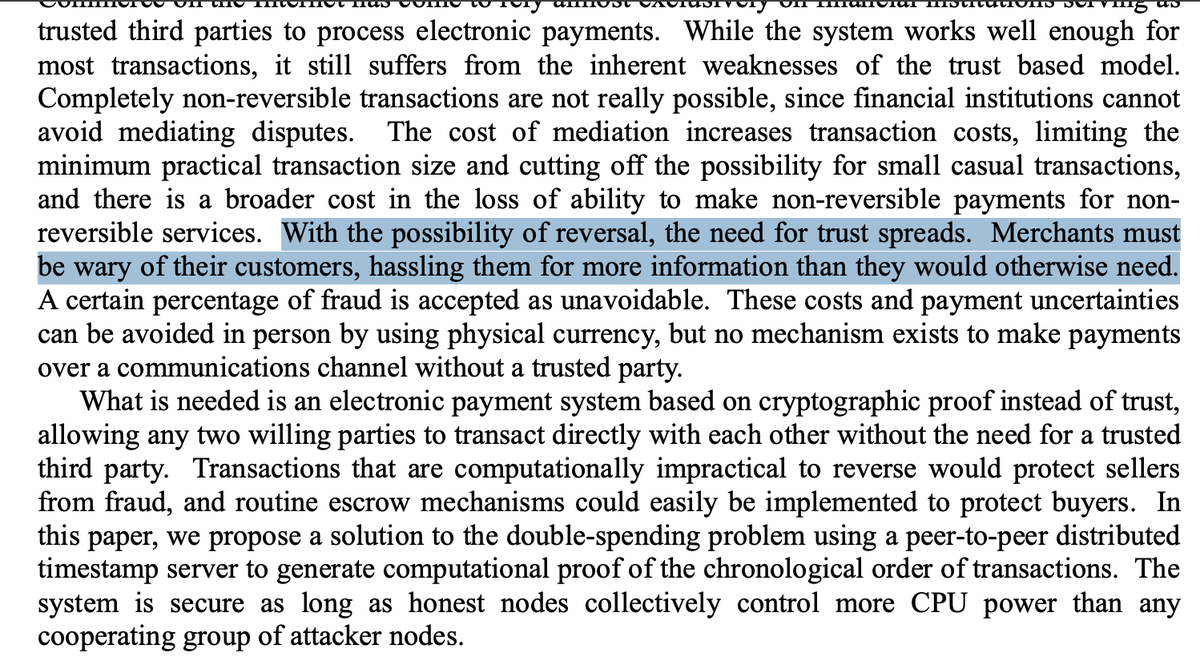
one of my favorite quotes - 'with the possibility of reversal, the need for trust spreads'
bitcoin proved irreversible txs work. Basic fairness (all txs equal). The periphery improves because incentives do.
here's to new tools
This is a smart contract on Bitcoin. More precisely it is a public Taproot transaction carrying a Tacit envelope that records the seeding of a standard xyk curve AMM pair and a 0.30% LP fee. (i.e., uniswapv2-style pool)
The pair tokens are bridged ETH (tETH), and TAC - a fixed supply token etched by the rules of the Tacit V1 confidential token metaprotocol on Bitcoin.
Unlike other indexer-tracked tokens on Bitcoin, such as ordinals and runes, etc., TAC and tETH on Bitcoin have confidential amounts, shielded pools, and their transactions are reflected and validated by an immutable smart contract on Ethereum, the Tacit Confidential Pool V1. Anyone can issue similar assets on either chain, too, using the bridge factory, but they work as if they are on both. This means that Ethereum can provide programmatic guarantees to Bitcoin assets and also receive them, too. Without any new hardforks for either blockchain. And Bitcoin users can rely on Ethereum to catch lying indexers as those assets won't bridge, completing the loop.
Since these assets are UTXO notes, they are relatively cheap to process, privacy preserving, and they also share the same state across both Bitcoin and Ethereum. This means Bob can send a tacit token from Bitcoin to Ethereum, in some cases, in minutes.
This is what I mean when I talk about confidential crosschain DeFi on @tacitfi.
wrt justin's fable (fable because claude) I think it's useful to warn people to take best measures against unknown unknowns. RN that is basically whether AI is, or will soon (months) be able to crack crypto keys. Because getting better at math than we are. So "can just do things". (I know this is simplistic, but well, not like anyone knows...)
Be that as it may. It is also useful to consider human behavior. Most crypto participants are not here for a long time. Certain whales and CEX treasuries are. But the vast majority are trading or doing grey market or remittances. And would just switch to another solution even centralized if regulations changed.
In the "fallout" scenario, where certain smart people 'bunker down' in the interim and survive and everyone else gets rekt. It does not seem to me anyone returns to crypto. They will not be imo, impressed or relieved to see such caution on display as something to imitate, now wizened by the carnage ("well crypto can work if you just keep ahead of the curve...").
The bunker dwellers might squint and see, well, not much to return to ('I have my ETH.... but no buyers'). This is not to layer on the doom, though. In fact the opposite.
The game here says to me, we will not reasonably expect most people in crypto to secure themselves. Many are correct that the mere suggestion to migrate under the threat of 'lose it all' will now inevitably lead to phishing and mistakes that could amount to same fallout.
When speaking from a position of authority, you are not simply relaying information. You are setting up epochs and pushing dominoes.
In this epoch, I think we must strive to solve crypto and cyber threats at the root layer: consensus. There will undoubtedly be clever maths and so on. But my gut is that we are playing with fire against a fire bender, in terms of AI. What can humans do? They can govern. The resolution against fallout scenarios is not going to be by the preppers, but by the enclaves. Don't trust people to protect themselves if you want to help them. The DAO hardfork might not have been the biggest blemish on Ethereum. But a dress rehearsal for something that will keep us on our toes: the unknown unknown of securing our property rights and networks against alien powers.
Social recovery, at network level, can be communicated in a way right now to help people not panic and see around the corner (if the machines break all the things, it won't matter). I wish I could honestly give a smarter prescription here, but any "smart" thing will just get outfoxed. So it is more going to be about legitimacy. I do not think super intelligence automatically gives something legitimacy. If for example, I am chilling in front of a chessboard and someone uninvited sits down, and absolutely mops the floor with me, and then I replace my pieces and then say "chessmate" - who won that round? Me I would say.
Anyways a lot of text to say, don't panic. Let's think about what else blockchains and crypto are. The bearer instrument aspect does require strict control. But these instruments are subject to networks. We can figure this out, while not needing to be the smartest in the room.
you're thinking too small. i don't need terabytes of random bits. i need a seed and a complete rejection of elliptic curves.
from this seed i grow an astronomical number of one-time secrets. each secret becomes a hash chain. you can walk forward through the chain but never backward. i arrange these chains into winternitz one-time signatures, and their public keys become leaves of merkle trees. those trees become leaves of larger trees. trees all the way up. a hypertree.
but first, at the bottom, i plant the FOREST OF RANDOM SUBSETS. FORS. the message is reduced to a string of ones and zeros. groups of bits select leaves from independent merkle trees. i reveal the corresponding secrets and the neighboring hashes, and you reconstruct the roots. the roots become a single hash. this is the message's signature, born from the forest.
now i sign that hash with a winternitz key. i prove the key belongs to a merkle tree by revealing its authentication path. i sign that tree's root with another key from the tree above. and again. and again. we ascend through layers of hash chains and sibling nodes until the entire structure collapses into ONE ROOT.
32 bytes. that's my public key. the entire forest is committed to those 256 bits.
i don't store the forest. i don't even remember which leaves i've used. the forest is deterministically regenerated from the seed whenever i need it. the message itself tells me where to go.
there are no elliptic curves here. no discrete logarithms. no hidden algebraic relationship waiting for a mathematician to invert. only preimages, hashes, and an unfathomable number of ones and zeros arranged into trees whose branches authenticate each other.
you can have my elliptic curves. you can have my RSA. but you cannot have the forest.
the forest is stateless. the forest remembers nothing. the forest verifies everything.