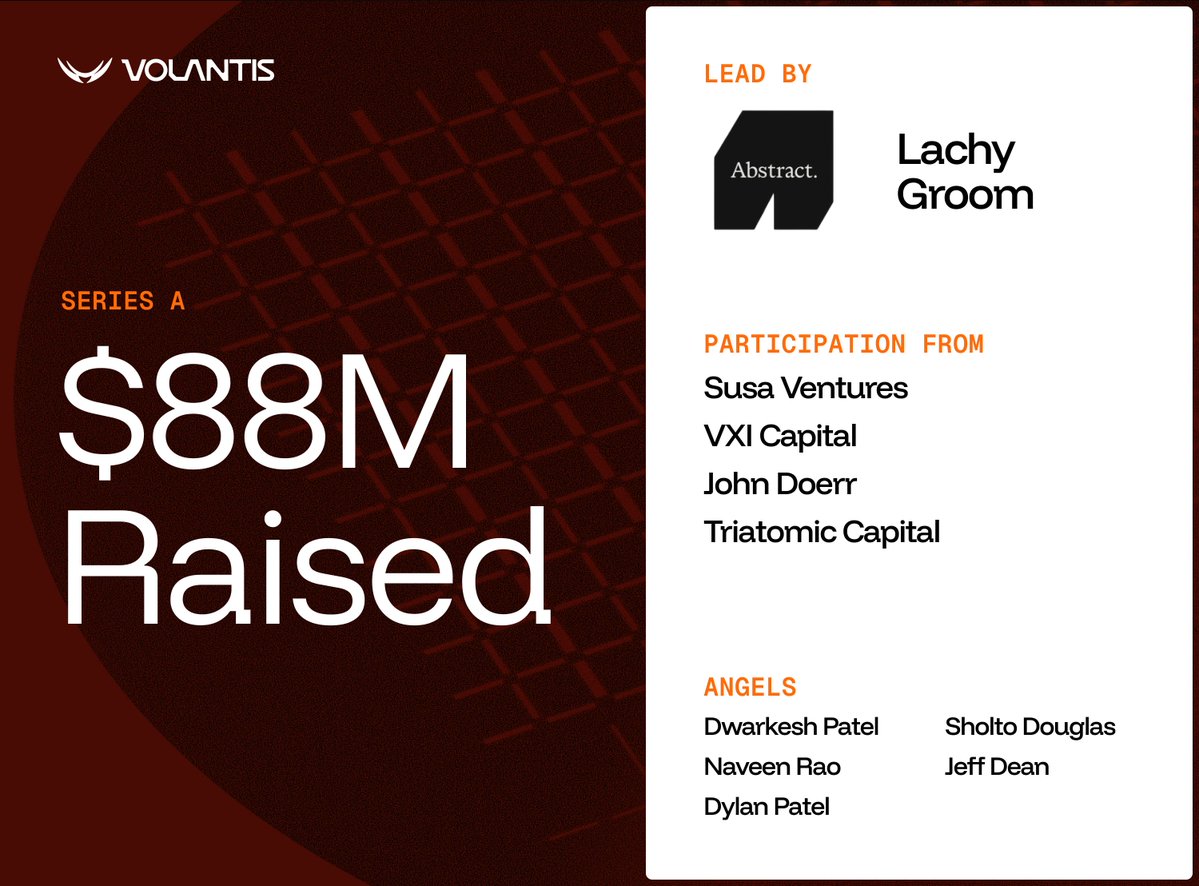
Excited to announce Volantis's $88M Series A.
We are solving Al's memory bottleneck by using optics, enabling chips with huge amounts of fast & cheap memory.
By boosting both the memory bandwidth and capacity per chip by orders of magnitude, we enable ultra-fast inference (up to 10,000 tps/user) for large models (>10T) - with low $/tok to boot.
Initially, this will enable insanely fast agents - think coding agents that finish in minutes or even seconds instead of hours.
More excitingly, optics is a fundamentally scalable way to increase memory systems. Not 2X/year, but by orders of magnitude across new generations. This will enable a structurally new Al industry, including restarting scaling laws, holding entire repos in context windows & more.
Our team has pioneered many core semiconductor technologies: the 1st CoWoS product, early HBM, the 1st silicon photonics CPO systems, the 1st high volume tunable VCSELs, the 1st processors to directly communicate using light & more.
We’ve already sent data >10× farther than equally tiny electrical wires inside a chip package. Our next iteration is already taped out and targets world-record bandwidth density over relevant distances, read more: https://t.co/ljYTimdcbJ
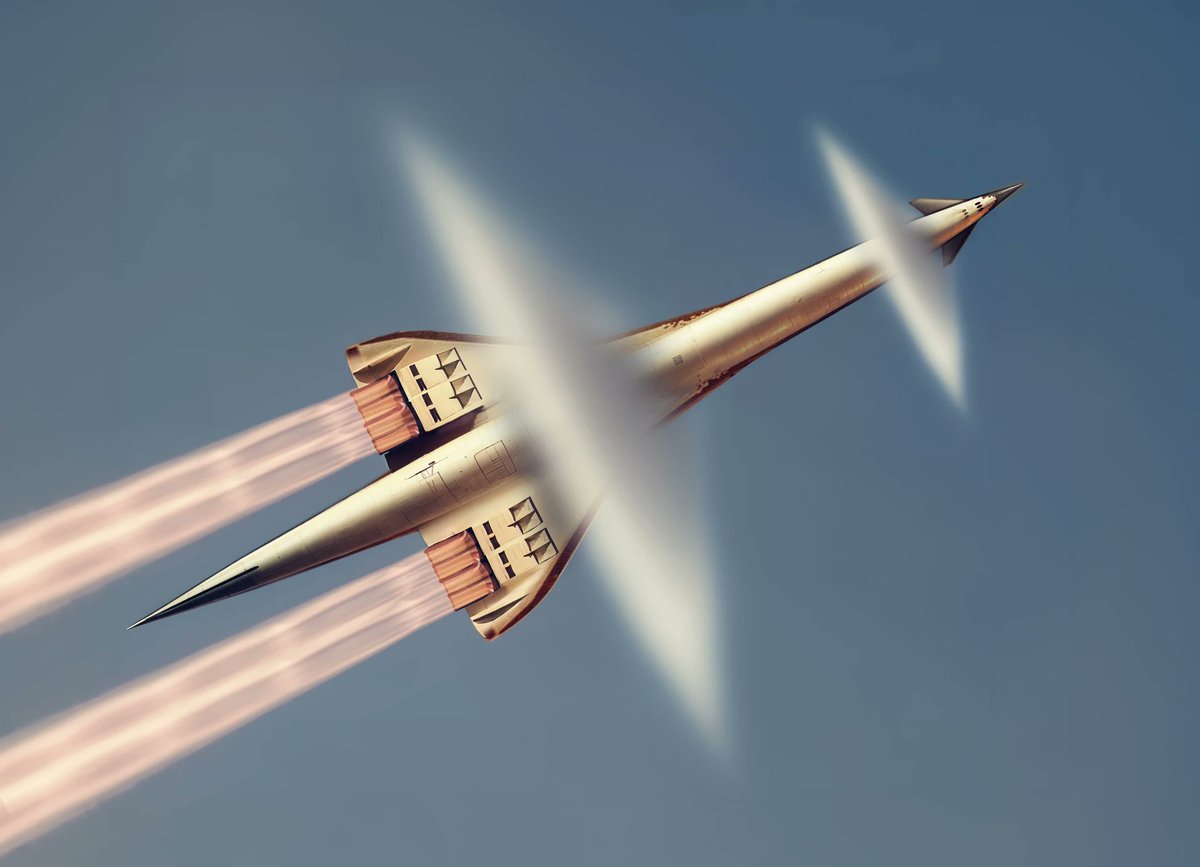
A Skylon-like spaceplane goes supersonic during testing. Instead of complex Sabre engines, it's using a simpler RBCC with linear aerospikes.
#space#art by Matija Tomšić.
https://t.co/mt9Rt8BQmH
I think this is only true in retrospect
The previous viewpoint on the Riemann hypothesis was that it would require new tools that had yet to be developed
The surprise is, IMHO, equally to its resolution, is that it was resolvable using the existing tools
Reading about Alpöge's proof, I find it curious why Terence Tao was so pessimistic about the Riemann hypothesis. From a distance, the proof strategy that was emerging from previous works somehow seems to be very well suited for an LLM-based attack on the problem.
There is a misconception that VC’s exist to back non consensus ideas. VC’s exist to make their LPs money. They get to do that by backing ideas that return capital, which at times, includes non consensus ideas
@aiwithadb@grok ASML is only a small portion of the overall $$$ amount
Out of say $1000 of GPU capex, only ~$10-20 makes it to ASML, they have an extremely defensible, high margin business on that, but the total profit pool is smaller
@aiwithadb@grok ASML is only a small portion of the overall $$$ amount
Out of say $1000 of GPU capex, only ~$10-20 makes it to ASML, they have an extremely defensible, high margin business on that, but the total profit pool is smaller
The Navier–Stokes equations wouldn’t exist for a galaxy-scale intelligence. Our model of reality and our laws of physics come from our limitations as the observer. Take water, for example. When we look at it, we see the properties of a continuous fluid: density, momentum, energy, temperature, and pressure. These properties come with the fact that we can’t see individual molecules. But a galaxy-scale intelligence with the capacity to track the trajectory of every molecule wouldn’t understand the properties of water that we are talking about. That is why it wouldn’t come up with the Navier–Stokes equations.
Even though a Superintelligence would understand humans very well (since it was initially trained on human data), it would have a very different construct of reality. The question is: what would that construct be? More importantly, would we be able to understand each other?
Watch the full interview with Jonathan Gorard here 👇
https://t.co/uhOdoiaK1S
I think in 5 years it's quite possible that CPU ISAs like x86/ARM won't matter, AI will be able to translate between binaries with sufficient performance.
Fallback will be emulation, but rare enough that it doesn't materially matter
Bearish for x86/ARM moat?
@vernic_daniel@mattmvinson Hedge funds aren’t benchmarked to sp500, that’s a pop-finance myth
The issue is that VC has high correlation with QQQ and underperforms it
@draecomino@damnang2 You have the metrics reversed (should be tok/sec/$) for your argument, but sadly I think your tweet as initially written is correct