Mathematician Terence Tao offers a counterintuitive take: AI doesn't look intelligent because our definition of intelligence was wrong all along.
He argues that the entire history of AI has followed a predictable pattern:
"The history of AI has been here's a task that only humans can do, like maybe it is read natural language or win at chess or solve a math problem, and then one by one someone finds some AI algorithm that also does that."
But every time a machine cracks one of these "uniquely human" tasks, we move the goalposts.
The solution never feels like real thinking:
"You look at how it's done and it doesn't feel like intelligence. It's, oh, it was some trick. You just cobbled together these neural networks and you ran some algorithm, and we were looking for some elusive intelligent way of thinking, and we don't see it in the tools that actually solve our goals."
Tao then flips the problem on its head.
What if the issue isn't with the machines, but with us?
"But maybe it's actually because intelligence is not what we think it is."
He points to large language models as the clearest case. What they do sounds almost embarrassingly simple:
"Large language models in particular become very successful, and a lot of what they're doing is just predicting the next token, clicking the next word in a sentence. And that doesn't sound like something which is intelligent."
To show why this feels wrong, Tao draws a comparison to how we'd judge a human doing the same thing:
"If you ask someone to improvise a speech and they have no preparation, and at every moment they're just saying the next word that comes to their mind, you don't think that this could actually work."
And yet it works for LLMs. Which forces an uncomfortable possibility:
"Maybe that's actually a lot of what humans do as well."
I JUST CONNECTED CLAUDE DESIGN TO FIGMA IN 60 SECONDS
no manual redrawing. no rebuilding from scratch
here's the workflow:
> Claude Design → Present → New tab
> copy the link
> paste into Anima Agent
> get fully editable Figma layers
that's it
This works really well btw, at the end of your query ask your LLM to "structure your response as HTML", then view the generated file in your browser. I've also had some success asking the LLM to present its output as slideshows, etc.
More generally, imo audio is the human-preferred input to AIs but vision (images/animations/video) is the preferred output from them. Around a ~third of our brains are a massively parallel processor dedicated to vision, it is the 10-lane superhighway of information into brain. As AI improves, I think we'll see a progression that takes advantage:
1) raw text (hard/effortful to read)
2) markdown (bold, italic, headings, tables, a bit easier on the eyes) <-- current default
3) HTML (still procedural with underlying code, but a lot more flexibility on the graphics, layout, even interactivity) <-- early but forming new good default
...4,5,6,...
n) interactive neural videos/simulations
Imo the extrapolation (though the technology doesn't exist just yet) ends in some kind of interactive videos generated directly by a diffusion neural net. Many open questions as to how exact/procedural "Software 1.0" artifacts (e.g. interactive simulations) may be woven together with neural artifacts (diffusion grids), but generally something in the direction of the recently viral https://t.co/z21CP5iQfu
There are also improvements necessary and pending at the input. Audio nor text nor video alone are not enough, e.g. I feel a need to point/gesture to things on the screen, similar to all the things you would do with a person physically next to you and your computer screen.
TLDR The input/output mind meld between humans and AIs is ongoing and there is a lot of work to do and significant progress to be made, way before jumping all the way into neuralink-esque BCIs and all that. For what's worth exploring at the current stage, hot tip try ask for HTML.
Jeff Bezos reveals the moment an early Amazon executive told him he had enough ideas to destroy Amazon:
"Early in Amazon's history, Jeff Wilke came to me one day and said, Jeff, you have enough ideas to destroy Amazon. You have enough ideas per minute, per day, per week to destroy Amazon."
"I was like, what do you mean?"
"He said, you have to release the work at the right rate that the organization can accept it."
"Every time I released an idea, I was creating a backlog, a queue, work in process. It was just stacking up, it was adding no value. In fact, it was creating distraction."
"So I started prioritizing the ideas better, keeping lists of them, keeping them to myself until the organization was ready for the ideas."
Arrêtez de payer pour Claude IA.
L'IA de Mc Donald's est gratuite et répond à toutes les questions, même si elles ne sont pas sur le BIG MAC.
:-)
De rien.
They have a robot for everything in China.
This one in particular, levels the grains stored in silos. Leveling means more can be stored, it used to be done by hand with shovels.
🚨Scientists discovered that overstimulation makes mammals prefer fake experiences to real ones.
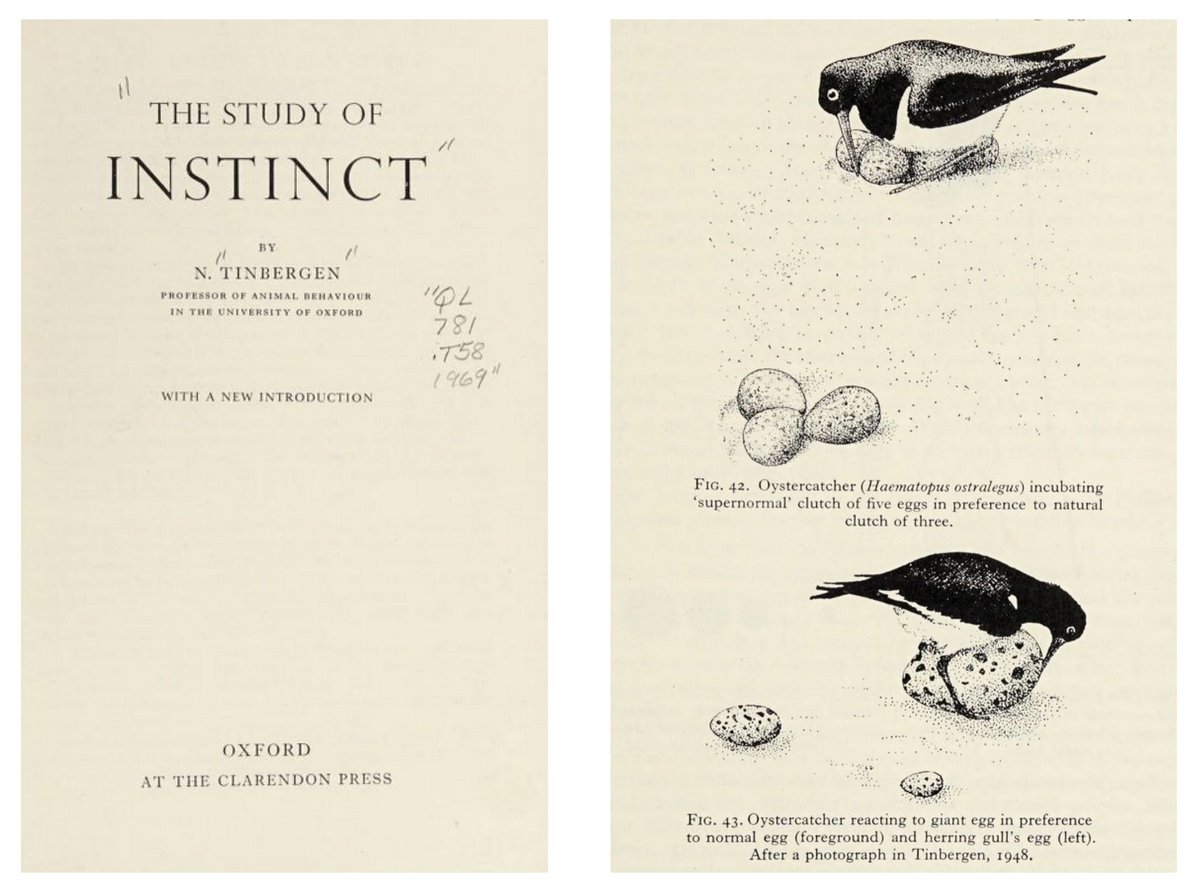
Dutch biologist Niko Tinbergen discovered that birds will abandon their own eggs to sit on larger, fake plaster eggs painted with exaggerated colors.
The mother bird ignores her actual offspring to nurture something artificial that triggers her nesting instincts more intensely than reality ever could.
Tinbergen called these "supernormal stimuli" and spent decades documenting how animals consistently choose fake enhanced versions over authentic experiences.
You are that bird.
Your phone is the plaster egg.
Every notification, every curated feed, every filtered photo represents reality with the saturation cranked beyond what your nervous system evolved to handle.
Your brain's reward circuits fire more intensely for digital stimulation than they do for actual sensory experience, so you abandon the real world to sit on something artificial.
Physical textures feel dull compared to the rapid dopamine hits from scrolling. Conversations with people in your actual environment seem slow and unstimulating compared to the endless stream of optimized content designed by teams of neuroscientists to capture your attention.
Your ancestors developed pattern recognition by watching clouds, reading animal tracks, noticing seasonal changes. Your pattern recognition system now runs on memes, trending topics, and algorithmic recommendations. The same neural machinery that once helped you navigate reality now helps you navigate feeds.
When you eat while watching screens, you're training your brain to associate nourishment with passive consumption rather than active experience. When you walk while listening to podcasts, you're teaching your spatial navigation system to rely on other people's thoughts instead of your own observations.
The simulation you built is a safe experience.
Why? Because it offers more stimulation than everyday life, so your biological systems naturally gravitate toward it.
Tinbergen's birds didn't realize they were choosing fake eggs. They just followed their instincts toward whatever triggered the strongest response. When researchers removed the plaster eggs, the birds immediately returned to caring for their real offspring.
The physical world is still there. Touch something with texture. Taste something without distraction. Walk somewhere without input.
Your real life is waiting under the fake egg you've been sitting on.
The UI era is ending. 🪦
For 70 years we designed computer interfaces. Mainframe, CLI, GUI, Touch.
But with AI, the interface is disappearing. What will come next?
My talk from @mastra's conf this week:
sam altman watching ChatGPT hallucinate live on stage is the funniest thing i've seen all week
the CEO of OpenAI, on stage, in front of everyone, watching his own AI just make things up in real time
and his face says it all
this is the guy telling us AGI is coming soon btw