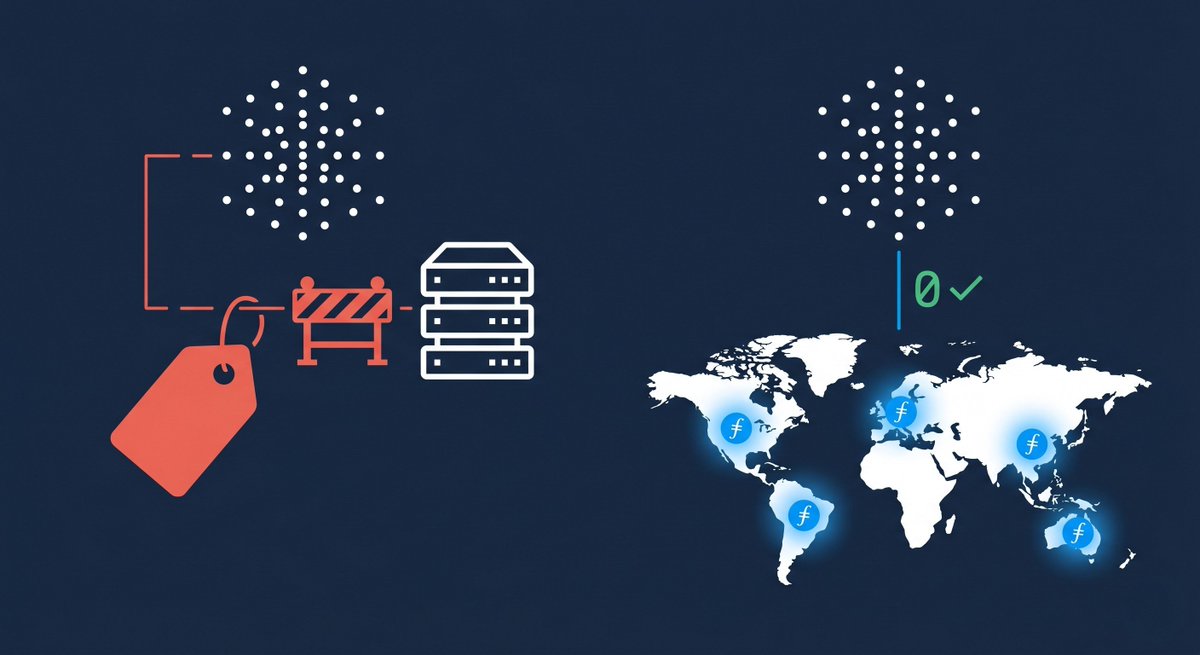
The biggest AI costs aren't always compute.
Sometimes it's paying over and over just to access data you already own.
Open-weight models can't reach their full potential on infrastructure designed around extraction. The data layer matters, and that's exactly where @Filecoin fits into the conversation.
Most people watch the $FIL chart. The builders watch retrieval.
Storing data is only half the story. If files take forever to access, nobody cares how decentralized the network is. That's why the recent retrieval improvements matter. Faster access means a better experience for apps, AI workloads, media platforms, and anyone actually using the network.
A storage network becomes real infrastructure when people stop noticing it's decentralized and just notice that it works. That's the part of @Filecoin that excites me most right now. Price follows attention, but usability is what keeps a network relevant years later.
@BusinessInsider Storage costs are next.
Moving 100TB out of hyperscalers can cost $9,000 before a single inference runs.
Filecoin brings that down to $1,499. AI budgets aren’t just about tokens.
Last year, President Trump set an aggressive goal: next generation nuclear reactors critical by July 4th of this year—for America's 250th.
We are on track to have multiple reactors achieve criticality to meet @POTUS' goal and accelerate the American Nuclear Renaissance.
Anthropic has confidentially submitted a draft S-1 registration statement to the Securities and Exchange Commission.
Pending completion of SEC review, this gives us the option to pursue an initial public offering.
Read more: https://t.co/onGZAhRLvD
President Trump is unleashing the American Nuclear Renaissance—aiming to have multiple nuclear reactors critical by July 4th on our nation's 250th anniversary.
@SecretaryWright: “This summer you will see multiple next generation nuclear reactors running...America is back!"
Surplus clean energy. Land. Grid access. Leadership that sees the future.
Paraguay has all of it. 🇵🇾
The proof is a 240 MW campus that mines Bitcoin today and has AI compute optionality tomorrow.
@hashrateindex went inside Yguazu. ⬇️
https://t.co/4gugfYztlW
@binance Stocks and ETFs onchain 24/7 need records that hold up years later.
Every transfer needs verifiable storage behind it, so ownership can be trusted long after the trade clears.
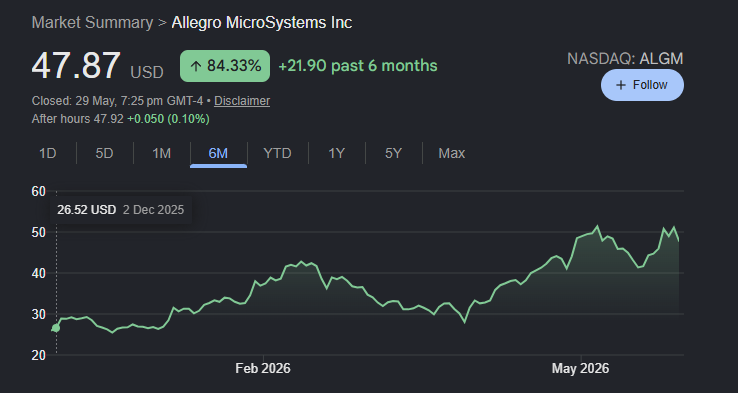
Listen to me. This company is currently MISPRICED and has the potential to 10X.
This thesis will explain where the market is inefficient and HOW this company will re-rate 10x HIGHER.
$ALGM is highly misclassified. The market views it as a automotive semiconductor company. But it's real thesis is the movement towards sensing and motor control for intelligent machine. The TAM is incredibly wide - including EVs, ADAS, humanoid robots, factory automation, data-center power system, AI cooling/power/fan control.
Simply put $ALGM sits at the literal core of AI machine - it is the "nerve" and the "motor control layer" in rudimentary sense.
So how does it exactly do this? $ALGM specializes in magnetic sensors, position sensors, motor drivers AND power ICs.
Remember - a robot, EV or AI server does not just need computing power - it needs to know where parts are moving, the current that is flowing through the grid, how to control these motors and how to safely/effective manage power.
THIS is $ALGM's domain. In fact we are seeing real time utility of $ALGM - with data center application reaching 14% of Q4 sales.
The hidden call option here is AI data-center power and control + Humanoid robotics sensing/motor control.
The two sectors that the market is focused on NOW and likely in the next 3-5 years.
But what's the moat? Why $ALGM. This is important and core to every thesis. The moat is qualification + reliability limiting switching.
The rationale here is that chips go into safety-criticial and performance critical systems. Once desgined into an EV/Robot/Data center system it is NOT EASY to switch suppliers. Switching involves redesigning/testing, validation, customer qualification and supply chain risk. It is a real industrial semiconductor moat.
Pay attention here. Unlike $SIVE or $IQE, $ALGM has MUCH stronger financial foundations. It executes. (No offence to $SIVE or $IQE investors.)
Latest FY2026 numbers
- Q4 revenue: $243m, up 26% YoY
- Q4 non-GAAP gross margin sitting at 50%
- Q4 EBITDA adjusted margin at 20.4%
- FY 2026 free cash flow $125m
- Cash $175m
- Data center recording 14% of Q4 sales indicating high uptake
My forecast in the coming years. Humanoid robotics and AI data centers take off > $ALGM becomes key sensing/motor control supplier.
AI data-center continues to grew with combined CAPEX of 7+ Trillion as predicted by 2030. Revenue reaches $5-8b
Expect a 5-10x gain.
America can't lead international conversations about digital asset standards while refusing to pass its own. Without the Clarity Act, other nations will fill that vacuum & write rules that may never align with American values or interests. We can't leave this credibility gap open
You will never out-earn your conviction.
The size of what you build is capped by what you actually believe is possible for you, specifically.
Raise the ceiling.
Centralized clouds charge you up to 70% more than you need to pay for GPU compute.
Not because their chips cost more. Because you're also paying for their electricity, cooling headaches, software bundles, and egress fees.
We broke down every option for GPU compute with the actual numbers.
Full guide: https://t.co/P8kaF8z20s
💠 C$3.5 billion.
💠 320 megawatts.
💠 100,000+ GPUs.
💠 800+ construction jobs.
💠 Hundreds of permanent high-skill roles.
Toronto-Waterloo built the minds behind modern AI.
Now it's building the machine.
https://t.co/UYda4Jh9j6
The US just got its first and only domestic producer of two metals the entire defense industry runs on.
Stock IPO’d at $14 in April and nobody is talking about it.
Here it is:
The spatial computing market hits $225 billion this year.
Pulling 100 TB of point cloud data out of a legacy cloud costs $12,000 in egress fees before a single rendering job runs.
Filecoin is built for zero-egress retrieval at exabyte scale.
The lie: crypto legislation is slow because lawmakers don't understand it.
The truth: it's slow because the biggest banks on earth are still negotiating how much of it they get to own before it passes.
$323 billion in stablecoins is now moving through the global financial system.
That number doubled in two years. Almost nobody is paying attention.
Tether. Circle. PayPal. BlackRock. Western Union. Visa runs a $4.5 billion annualized stablecoin settlement business. Mastercard and Stripe both run live rails. The GENIUS Act gave them the legal framework last July. CLARITY is closing the rest of the gaps this summer.
Every major payments company on earth either issues a stablecoin or settles in one.
By 2031, analysts expect stablecoins to handle 10 percent of all US dollar payments.
No ticker. No IPO. No earnings call. Just $323 billion quietly rewiring how the dollar moves while everyone debates the next Fed cut.
In ten years, when your kids ask why you held crypto through every drawdown, you won't have to say you had insider info. You'll just say you noticed the dollar itself was moving onchain while everyone else was waiting for permission.