Between 1982 and 2020, the number of the 100 richest Americans who got rich from inheritance decreased from 60 to 27. And yet on the left they think the mid 20th century was the good old days, because economic inequality was lower then.
https://t.co/ggPKu1gN8u
222K likes.
The fixed pie fallacy is probably the single most destructive delusion on the planet. The belief that wealth cannot be created—only distributed—has done more than any other to stop people from lifting themselves and others out of poverty.
5 gallons of water =
→ $132 from data centers
→ 2¢ from almonds
One powers AI, auto safety, space exploration, medical research, banking, and innovation.
The other is a mostly exported (75%) snack from drought-prone California fields.
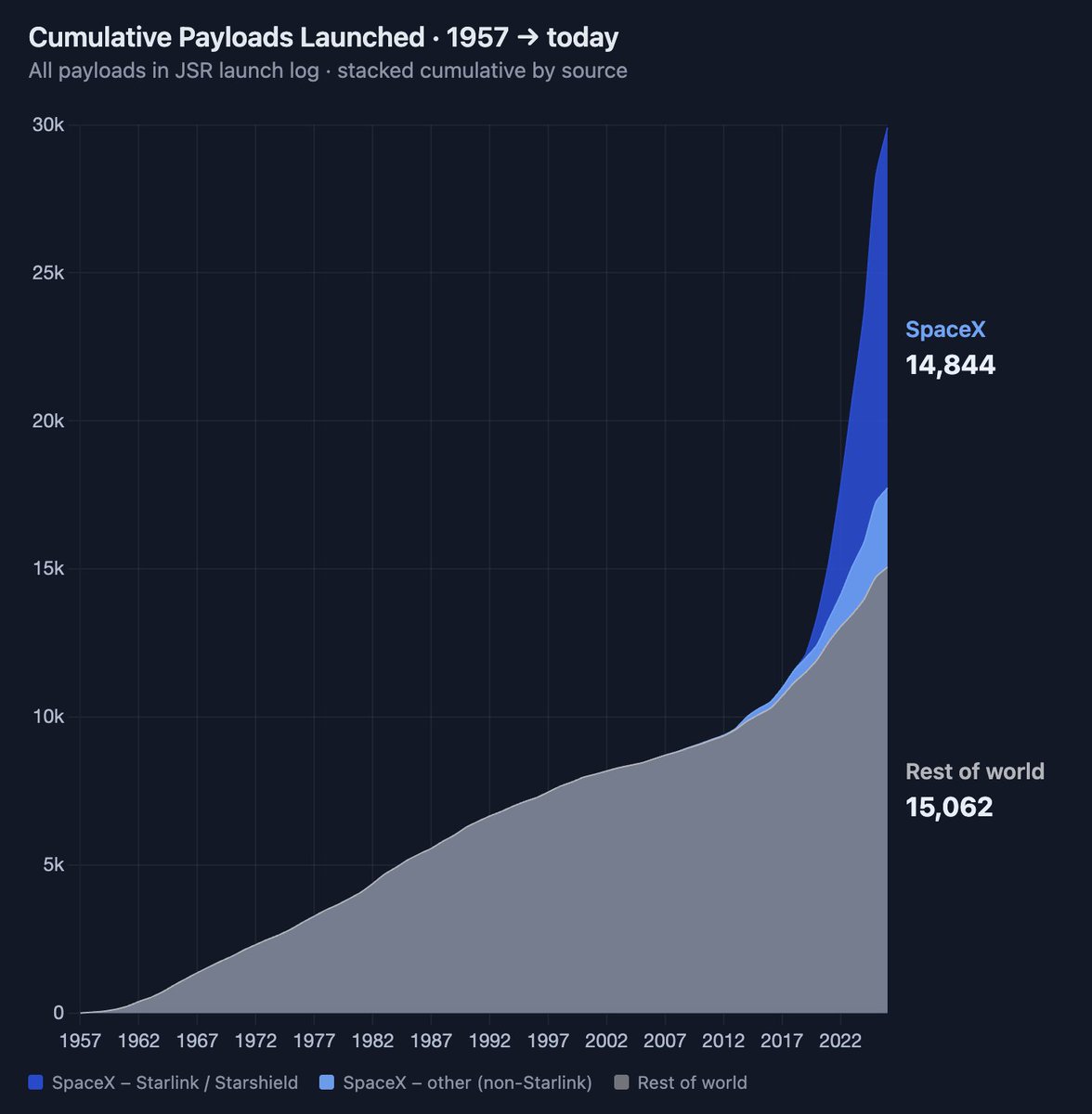
Resource allocation in one chart.
SpaceX is only ~200 satellites away from having launched as many satellites as the rest of the world combined
(despite giving the rest of the world a 61-year head start)
Imagine you run a 24 hour hamburger joint. You do pretty well. You sell 1000 burgers a week for $10 each, netting $5 on each. But almost all your money is made during “peak” hours when demand is highest — lunch, dinner. You net $5000 a week.
Then a big change. A 24 hour factory opens across the street. The workers at the factory don’t have a set lunch hour, so they just run out for burgers whenever they feel hungry, roughly evenly distributed throughout the day and night.
Burger demand surges — a little bit during those peak hours, but also at all hours of the night, mid-afternoon, early morning, all times you previously weren’t selling many burgers and your staff was mostly sitting around.
With the surge in demand, you’re now selling 2000 burgers a week. You cut the price to $8 per burger (to encourage more factory customers), so you now net $6000 per week. Demand went way up, but you cut prices and are making more revenue and profit.
At this point you might think I’ve told you a story about hamburgers. I’ve actually told you a story about data centers and electricity prices.
rien ne ressemble plus violemment au choc de revenir en Chine et de réaliser à quel point l'occident est devenu une civilisation qui demande la permission avant de construire
à Shenzhen un gamin de 20 ans qui a une idée à 8h du matin a un prototype fonctionnel à 18h le même jour, dans le même temps un diplômé français achète une formation à 1500 euros pour apprendre à valider son idée avec un canvas notion qu'il ne montrera à personne, attend l'avis de 4 mentors linkedIn qu'il n'a jamais rencontrés, lit 12 livres sur le lean startup pour bien comprendre la méthodologie & 6 mois + tard le hamin chinois a vendu sa boite à Tencent pendant que le français en est encore à choisir le nom de son LLC sur shine
je pense que le vrai problème CULTUREL c'est qu'on a appris aux jeunes occidentaux et notamment aux européens que l'entrepreneuriat était une recette de cuisine, ouvrez le bon livre m, suivez les bonnes étapes obtenez le bon résultat alors que que personne ne sait rien, personne n'a jamais rien su et tous les empires industriels de l'histoire ont émergé d'une combinaison de hasard de séréndipité et d'une seule personne qui a juste commencé sans avoir compris d'avance
pour rappel Brian chesky (Airbnb) a loué son matelas gonflable parce qu'il ne pouvait pas payer son loyer, Zeng Yuqun de CATL a démonté des batteries dans un garage de Shenzhen sans savoir où ça allait le mener et la vérité c'est que l'illusion du plan parfait est le mécanisme de protection psychologique préféré de ceux qui ont peur de commencer
le meilleur conseil que j’ai à vous donner ici c’est juste de commencer, ouvrez votre laptop ce soir et codez la version moche de votre idée, soudez vos premiers prototypes même mal foutus dans votre garage, lancez votre premier produit avec un site web hideux, vendez votre premier service à un client trouvé sur un groupe Telegram…
vous comprendrez en 3 jours d’action concrète ce que vous n’auriez jamais compris en 3 ans de réflexion abstraite, le seul algorithme qui a jamais fonctionné dans toute l’histoire de la création humaine c’est commencer mal mais itérer rapidement, échouer publiquement, apprendre violemment & recommencer en mieux
foncez comme des bourrins sans vous poser 36000 questions parce que les questions trouvent leurs réponses dans le faire jamais dans le penser
et soyons honnêtes sur le vrai blocage, ce qui paralyse 90% des aspirants bâtisseurs c'est le regard des autres beaucoup plus que le manque de compétences, la peur de paraître stupide aux yeux de la famille des collègue ou des amis
on préfère ne rien tenter et garder la dignité sociale plutôt que d'essayer et de risquer le ridicule public, c'est exactement le mécanisme qui a tué l'industrie française depuis 30 ans et qui continue de tuer chaque trimestre des centaines d'idées brillantes dans les têtes de gens qui n'oseront jamais les sortir
si vous êtes dans un environnement social qui rit des gens qui essaient je ne peux que vous conseiller de juste changer d'environnement, déménagez dans le bon endroit mais sortez de l'écosystème qui vous tire vers le bas
je suis persuadé que la seule chose qui sépare aujourd'hui un bâtisseur d'un commentateur c'est le courage de paraître stupide pendant 18 mois en échange d'avoir construit quelque chose qui compte pendant les 30 années suivantes
bref je pense que j’ai UNE NOUVELLE FOIS été trop long mais vraiment entourez vous avant tout de weirdos qui construisent, qui échouent, qui recommencent, qui passent leur temps à itérer & surtout qui ne demandent pas la permission et qui se foutent de ce que pense autrui
dites vous que dans 10 ans vous serez la moyenne pondérée des 5 personnes avec qui vous passez le plus de temps, choisissez les donc comme vous choisiriez les fondations d'une maison qui doit résister à toutes les tempêtes de votre vie
Friendly reminder, Hinton is the same guy who told us this:
"We should stop training radiologists now. It's just completely obvious that within five years, deep learning is going to do better than radiologists.".
That was six year ago.
He was right about the AI. Wrong about the job.
AI already reads scans better than any human. Six years after this nonsense prediction we have more radiologists. That's because Hinton and many others just fundamentally misunderstand that tasks are not jobs and that the job of a radiologist is also interacting with patients, being a light in darkness, providing hope and warmth and care and a thousand other things.
Again we need to stop listening to these folks.
I cannot say it enough, just because this fellow is brilliant with AI does not mean he has any clue how it will impact society. None. Zero.
This is the story of Hyperliquid, the most profitable startup per employee on earth, told from a guarded office in Singapore.
Last year, its team of 11 generated $900 million in profit. It's 3 years old, has never taken a dollar of venture capital, and is beginning to change how century-old markets work.
Its founder, Jeffrey Yan (@chameleon_jeff), had never taken a physics class when he picked up a textbook at 16. Two years later, he won gold at the International Physics Olympiad. In 2019, he started trading with $10,000 from a living room in Puerto Rico—working off a television because he didn't own a monitor.
Within 3 years, he was running one of the largest anonymous crypto trading firms.
Then he shut it down. Yan was rich and free, but he had spent years inside crypto, watching it betray itself. Bitcoin's central premise was decentralization. Yet the biggest exchanges were centralized. Crypto kept reintroducing the dependence on trust it was built to eliminate. He set out to create what should have existed.
Hyperliquid is a blockchain with a trading exchange on top, and anyone can build on it. Yan's vision is to house all of finance. In 3 years, it has done over $4 trillion in volume. And in the past few months, it has begun to outgrow crypto.
Markets for oil, silver, and the S&P 500 now trade on Hyperliquid around the clock, weekends included, and are growing roughly 40% week on week. When the US and Israel bombed Iran on a Saturday in February, Hyperliquid was the venue traders turned to.
Hyperliquid's success has cost Yan his freedom. He works out of a secret office in Singapore and cannot travel without two bodyguards. Even the team's housekeeper doesn't know what they do.
In January, @domcooke spent a week at their office. Read his profile on Yan and @HyperliquidX below.
Notice in every city where crime is down (most cities), there's no reduction in poverty, no improvement in educational outcomes, no end to systemic racism, no massive increase in affordable housing. If I didn't know better, I'd think those things are unrelated to crime fighting.
This is actually an amazing point.
SF should've built way more housing over the years, but I can be sympathetic because it's genuinely a beautiful historic city.
But it's absolutely insane that San Jose, in the literal Silicon Valley, doesn't look like a Chinese mega city.
The average American today lives better than John D. Rockefeller did in 1926. That is not an exaggeration. It is a fact.
Rockefeller could not fly across the country in five hours. You can for $200. He could not video call his family from another continent. You do it for free. He had no antibiotics, no MRI, no air conditioning in July. He could not carry every book ever written in his pocket. You are reading this on a device that does all of that and more.
Americans throw away 30-40% of their food. Not because they are wasteful, but because food is so abundant that waste is affordable. Your car has climate control, navigation, and safety systems that did not exist at any price a century ago. Your home has heating, cooling, refrigeration, and entertainment that emperors could not have imagined.
None of this was voted into existence. None of it was redistributed from the rich. It was created by free minds operating in what remains of a free market. Every comfort you enjoy today is the product of a man who thought, invented, produced, and traded voluntarily.
This is what the remnants of capitalism still deliver, even while it is being dismantled. Imagine what a fully free society could build.
There are about 430,000 U.S. households worth $30 million or more, according to an analysis of Federal Reserve data. Within that, there are about 74,000 worth $100 million or more.
Crazy numbers.
"populists" are converging on slop:
- banning "blackrock" from buying homes
- boomer tax cuts
- wealth taxes that don't work
zero constituency for:
1) make government efficient + able to build/act directly (vs. nonprofit grift)
2) subsidize the welfare state w/ population growth
We were close to a major national YIMBY bill, one that would have made real progress.
Then the dumbest people on both sides turned it into a bill that stops housing from getting built, because they're obsessed with the completely fake problem of 'big companies rent homes'