Exploring Databricks Lakeflow SDP & AUTO CDC INTO for implementing SCD Type 2 with full history tracking. Modern incremental CDC pipelines without complex MERGE logic. #Databricks#Lakeflow#CDC#DataEngineering#data https://t.co/NJiaNhzyrF
Databricks Delta Sharing enables secure cross-org data collaboration across clouds & BI tools. Important: consumers get READ-ONLY access, no DML/DDL operations. #Databricks#DeltaSharing#data https://t.co/Er7Fi2pEr6
AWS IDENTITY AND ACCESS MANAGEMENT (IAM)
INTRODUCTION
AWS Identity and Access Management (IAM) is a security service that helps you securely control access to AWS resources. IAM allows you to define who can access resources, what actions they can perform, and under which conditions access is granted.
WHAT IS IAM?
→ IAM is a global AWS service used for authentication and authorization
→ Helps manage users, permissions, and secure access to AWS services
→ Enables fine-grained access control across the AWS environment
CORE COMPONENTS OF IAM
IAM USERS
→ Represents a person or application needing AWS access
→ Each user can have unique credentials
→ Supports passwords and access keys
IAM GROUPS
→ Collection of IAM users
→ Simplifies permission management
→ Permissions assigned to a group apply to all users inside it
IAM ROLES
→ Temporary access identities with specific permissions
→ Used by AWS services, applications, and external users
→ No permanent credentials attached
IAM POLICIES
→ JSON documents defining permissions
→ Specify what actions are allowed or denied
→ Can be attached to users, groups, or roles
HOW IAM WORKS
→ User/Application sends request to AWS
→ AWS authenticates identity credentials
→ IAM policies are evaluated
→ Access is either Allowed or Denied
→ Requested AWS resource responds accordingly
TYPES OF IAM POLICIES
MANAGED POLICIES
→ Predefined or reusable policies
→ Can be attached to multiple identities
INLINE POLICIES
→ Directly embedded into a single user, group, or role
→ Tight one-to-one relationship
AWS MANAGED POLICIES
→ Created and maintained by AWS
→ Covers common use cases
CUSTOMER MANAGED POLICIES
→ Created and managed by the organization
→ Provides custom access control
IAM SECURITY FEATURES
MULTI-FACTOR AUTHENTICATION (MFA)
→ Adds extra security layer beyond passwords
→ Requires a second verification factor
PASSWORD POLICIES
→ Enforces strong password requirements
→ Controls expiration and complexity rules
ACCESS ANALYZER
→ Identifies resources shared externally
→ Helps maintain least privilege access
IAM ACCESS KEYS
→ Used for programmatic access via CLI or SDKs
→ Should be rotated regularly for security
BEST PRACTICES FOR IAM
→ Follow the Principle of Least Privilege
→ Enable MFA for all users
→ Avoid using the root account for daily tasks
→ Rotate credentials regularly
→ Use IAM Roles instead of sharing access keys
→ Audit permissions frequently
REAL-WORLD IAM ARCHITECTURE FLOW
→ Developer → IAM User → IAM Group → Policies → AWS Services
→ EC2 Instance → IAM Role → Temporary Credentials → S3 Access
→ Application → STS Token → Limited-Time Permissions
COMMON IAM USE CASES
DEVELOPER ACCESS
→ Grant developers controlled access to AWS resources
APPLICATION AUTHENTICATION
→ Allow applications to securely interact with AWS services
CROSS-ACCOUNT ACCESS
→ Share access between AWS accounts securely using IAM Roles
TEMPORARY ACCESS MANAGEMENT
→ Provide short-term credentials for secure operations
WHY IAM IS IMPORTANT
→ Protects AWS resources from unauthorized access
→ Simplifies permission management
→ Enhances cloud security posture
→ Supports compliance and governance requirements
TIP
AWS IAM is a foundational security service that enables secure and scalable access management across AWS environments. By properly configuring users, groups, roles, and policies, organizations can maintain strong security while ensuring efficient resource access.
Grab the AWS EBOOK
https://t.co/G3pdEOq4DK
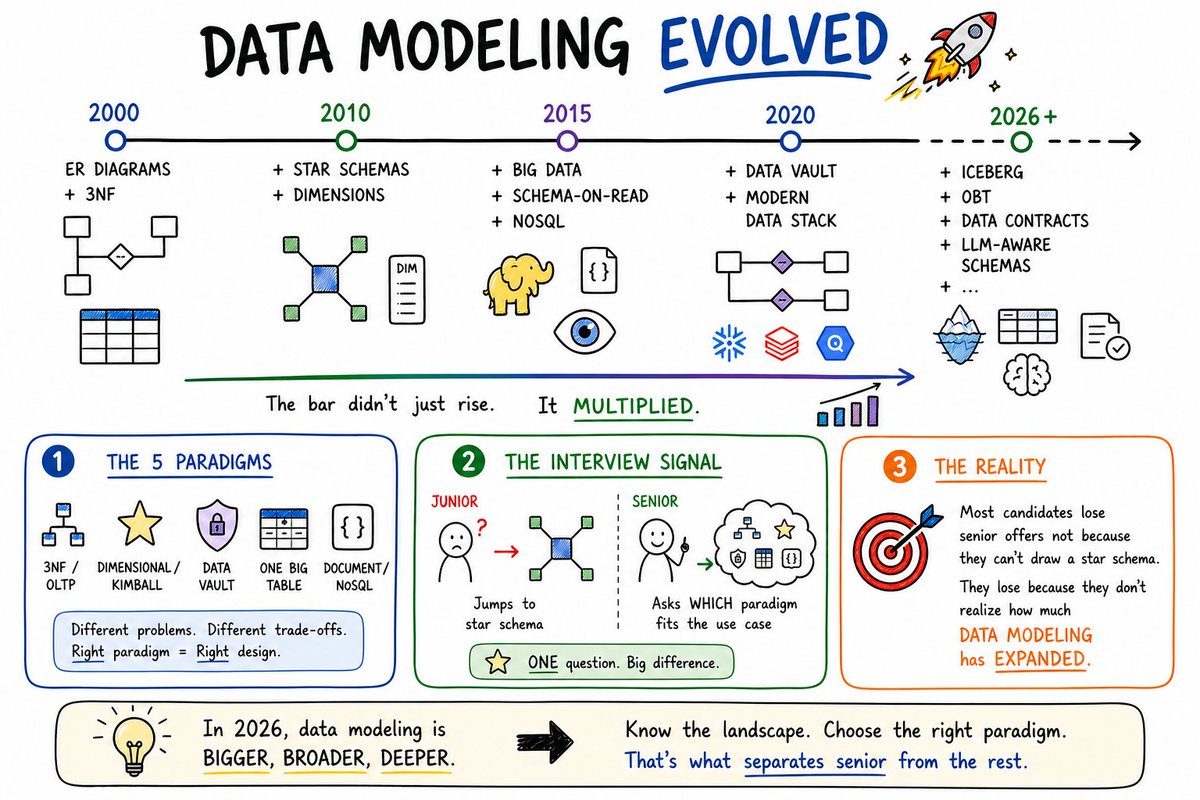
2000: Data modeling = ER diagrams + 3NF
2010: + Star schemas + Dimensions
2015: + Big Data + Schema-on-read + NoSQL
2020: + Data Vault + Modern Data Stack
2026: + Iceberg + OBT + Data Contracts + LLM-aware schemas + ...
→ Today's "design a schema" interview
Most candidates still jump to a star schema.
The bar didn't just rise. It multiplied.
Here's what "data modelling" actually means in 2026 👇
🟦 𝗧𝗵𝗲 𝟯 𝗹𝗮𝘆𝗲𝗿𝘀
→ Conceptual (entities + relationships)
→ Logical (tables, columns, keys, normalization)
→ Physical (indexes, partitions, storage strategy)
🟩 𝗧𝗵𝗲 𝟱 𝗽𝗮𝗿𝗮𝗱𝗶𝗴𝗺𝘀
→ 3NF / OLTP (transactional databases)
→ Dimensional / Kimball (analytics warehouses)
→ Data Vault (audit-heavy enterprise)
→ One Big Table (modern columnar)
→ Document / NoSQL (flexible schemas)
🟧 𝗧𝗵𝗲 𝗶𝗻𝘁𝗲𝗿𝘃𝗶𝗲𝘄 𝘀𝗶𝗴𝗻𝗮𝗹
When the interviewer says "design a schema":
→ Junior: jumps to a star schema
→ Senior: asks WHICH paradigm fits the use case
That ONE question separates levels.
Most candidates lose senior offers not because they can't draw a star schema.
They lose because they don't realize how much "data modeling" has expanded.
I'm dropping a complete Data Modeling Masterclass on May 16.
Inside:
→ All 5 paradigms compared (with code examples)
→ Worked example with Uber
→ Physical modeling (partitioning, indexing, costs)
→ Anti-patterns that fail interviews
→ Leveled expectations: junior / senior / staff+
FREE.
Stay tuned.
Data engineers, what's the first paradigm you think of when you hear "data modelling"? 👇
🚨 In 1993, Steve Jobs literally predicted the future of technology decades before it happened.
Most people still haven’t seen this.
Long before the iPhone, modern Internet, or AI boom…
He was already describing it.
Watching it today feels unreal.
He talked about computers becoming personal companions not just tools, but extensions of how we think and live. Devices you carry, systems that understand you, and technology that feels almost human.
He imagined a world where everything is connected, information flows instantly, and software adapts to people not the other way around.
And his biggest insight? The future isn’t about machines.
It’s about people.
That’s why this still hits hard.
Because while most people wait for the future…
A few can see it coming years before it arrives.
@dhanushkraja and gv sir we’ve created a song with the help of AI tools and would truly value your time if you could give it a listen. Your feedback would mean a lot to us. @gvprakash https://t.co/7jrVMhiuBT
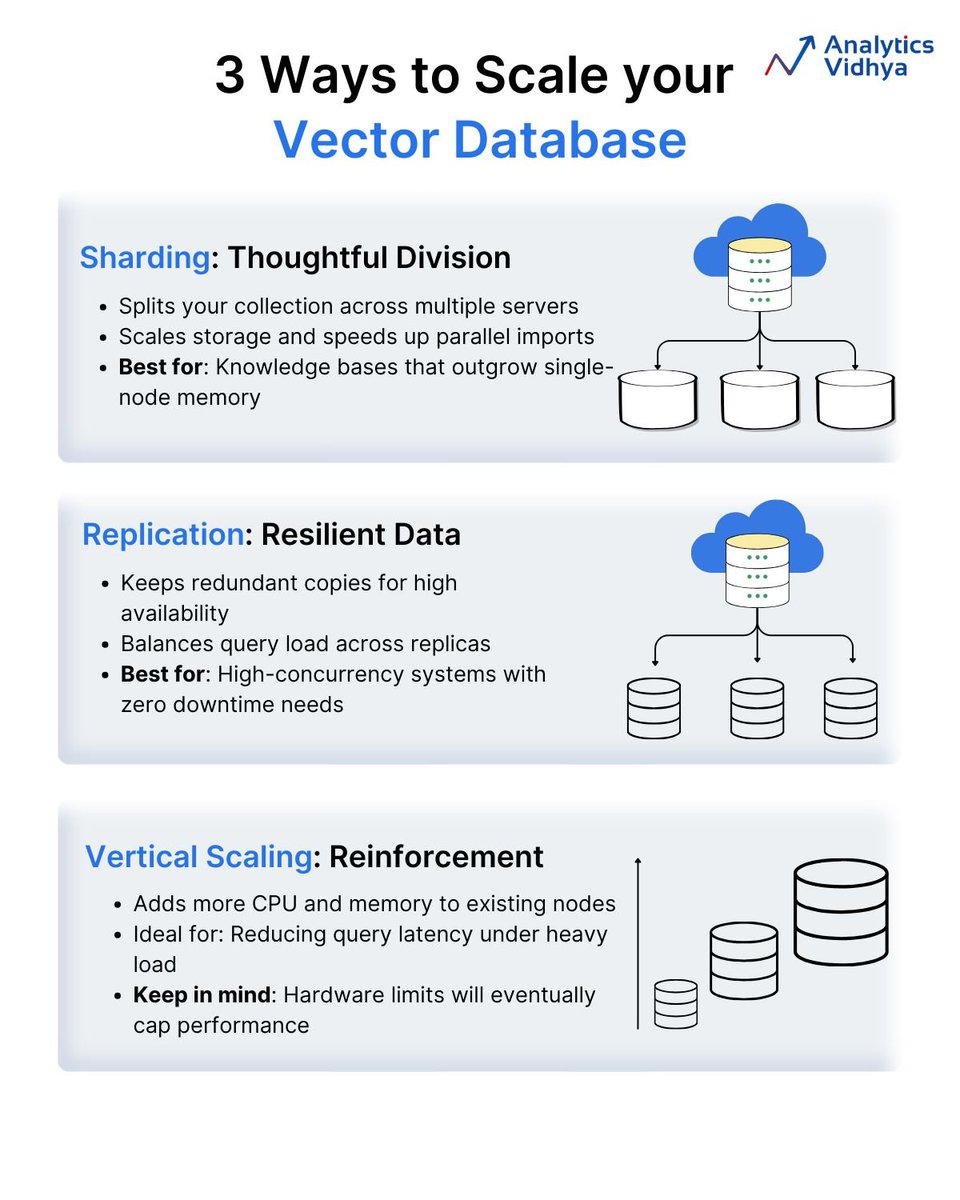
3 ways to scale your vector database 🧠⚙️
When your embeddings start to outgrow a single node, scaling isn’t optional it’s survival. Here’s how to do it right:
🔹 Sharding – Split your data across multiple servers to scale storage and speed up parallel imports.
🔹 Replication – Create redundant copies to handle high query loads and ensure zero downtime.
🔹 Vertical Scaling – Add more CPU and memory for faster queries (but remember, hardware caps out eventually).
Scaling smartly isn’t just about performance it’s about reliability at scale.
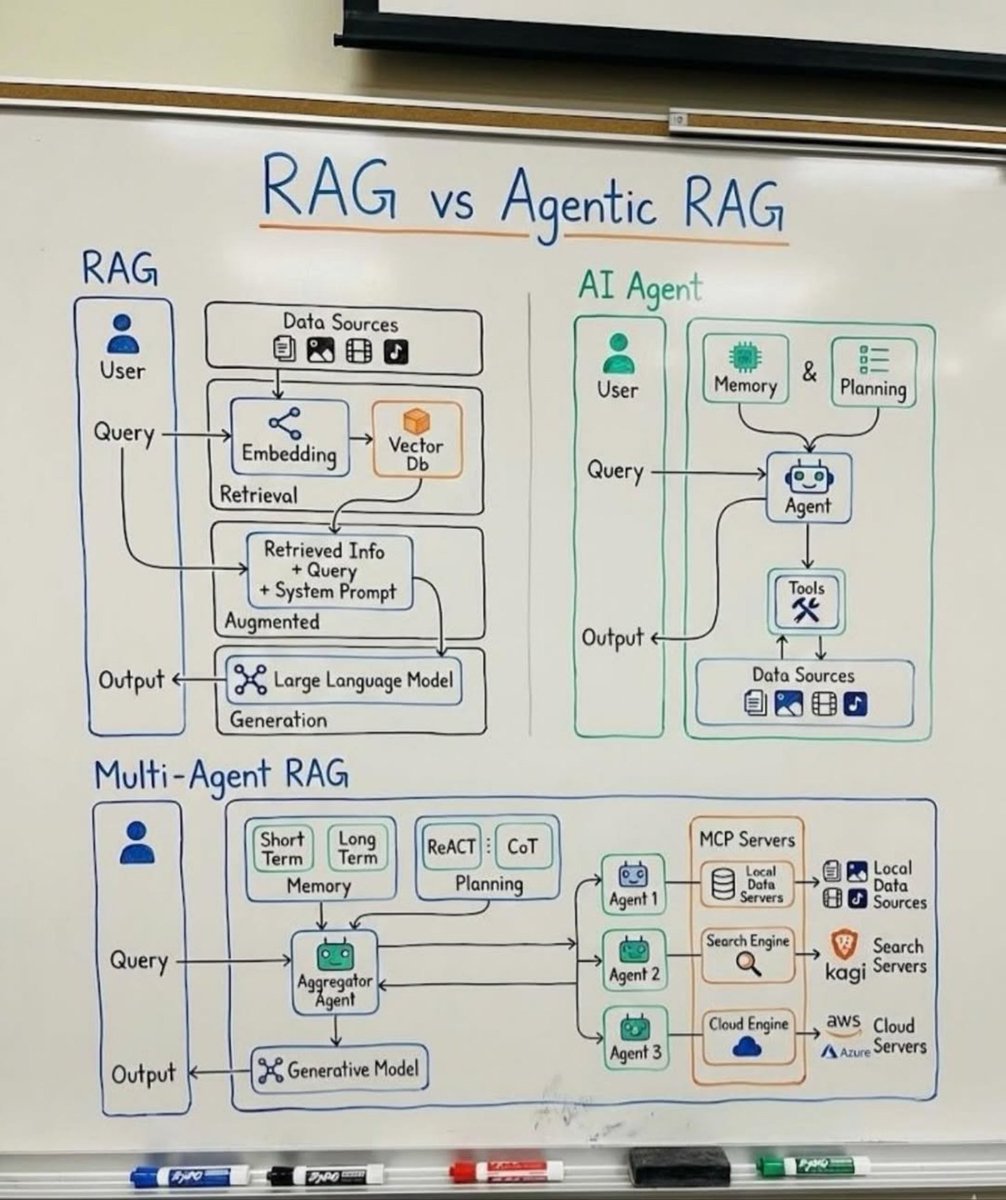
🧠📸 How to Build Multimodal AI Agents from Scratch — No Prior Experience Needed.
𝗧𝗵𝗶𝘀 𝗶𝘀 𝗮 𝟵-𝗦𝘁𝗲𝗽 𝗚𝘂𝗶𝗱𝗲 𝗳𝗿𝗼𝗺 𝗦𝗰𝗿𝗲𝗲𝗻𝘀𝗵𝗼𝘁 𝘁𝗼 𝗥𝗲𝗮𝘀𝗼𝗻𝗶𝗻𝗴.
STEP 0: WHAT IS AN AI AGENT?
✹ A system that uses an LLM to reason, plan, act, and adapt
✹ Goes beyond prompts & RAG — can use tools + learn from memory
✹ Use when workflows are complex, multi-step, or need personalization
》Agents ≠ demos. They’re decision-makers.
STEP 1: DEFINE THE AGENT’S ROLE AND GOAL
✹ What will your agent do?
✹ Who is it helping?
✹ What kind of output will it generate?
》Example: An agent that answers questions and explains graphs from reports
STEP 2: PREPARE THE MULTIMODAL CORPUS
✹ Convert each page of your PDFs into screenshots
✹ Preserve text + image layout together
✹ Store image paths as metadata
》Why? So retrieval captures full document context
STEP 3: GENERATE UNIFIED EMBEDDINGS
✹ Use Vision-Language Models (VLMs)
✹ Avoid the “modality gap” of CLIP-style models
✹ One encoder for both text + visuals
》Tools: YJI-VLM, Gemini 2, Claude Opus
STEP 4: STORE IN VECTOR DATABASE
✹ Embed screenshots and attach metadata
✹ Store in a retrievable format
✹ Make retrieval page-level, not just paragraph-level
》Tools: MongoDB Atlas, Weaviate, ChromaDB
STEP 5: RETRIEVE CONTEXT VIA TOOL USE
✹ Agent uses vector DB to fetch relevant pages
✹ Returns image references, not raw text chunks
✹ Agent fetches actual images based on those references
》Think: tool = bridge to your multimodal memory
STEP 6: ADD MEMORY (SHORT-TERM)
✹ Use session IDs to track conversations
✹ Load past Q&A into LLM at each turn
✹ Let agent reason over previous steps
》Long-term memory optional — short-term is a must
STEP 7: PLUG IN A MULTIMODAL LLM
✹ Must support both images + text
✹ Inputs = query + memory + retrieved images
✹ Generates step-by-step plans or final answers
》Tools: Gemini 2.0, GPT-4o, Claude 3.5
STEP 8: DESIGN PLANNING AND FEEDBACK LOOPS
✹ Chain-of-Thought for stepwise reasoning
✹ ReAct for dynamic reasoning + tool calls
✹ Prompt the LLM to decide: act or answer?
》This is where real agentic behavior kicks in
STEP 9: WRAP IT IN AN APP OR API (OPTIONAL)
✹ Let users upload reports, images, or ask questions
✹ Build a UI or expose your agent via API
✹ This turns your agent into a product
》Tools: Gradio, Streamlit, FastAPI
https://t.co/zy8mvcqSrv
≣≣≣≣≣≣≣≣≣≣≣≣≣≣≣≣≣≣≣≣≣≣≣≣≣≣
⫸ꆛ Want to Build Real-World AI Agents?
Join My 𝗛𝗮𝗻𝗱𝘀-𝗼𝗻 𝗔𝗜 𝗔𝗴𝗲𝗻𝘁 𝟱-𝗶𝗻-𝟭 𝗧𝗿𝗮𝗶𝗻𝗶𝗻𝗴,
trusted by 1,500+ builders worldwide!
➠ Build Geo, Audio, Video & Vision Agents
➠ Master 5 Modules: 𝗠𝗖𝗣 · LangGraph · PydanticAI · CrewAI · OpenAI Swarm
➠ Deploy for Healthcare, Finance, Smart Cities & More
➠ 9 Real-World Projects with Full Code
Only basic Python required.
👉 𝗘𝗻𝗿𝗼𝗹𝗹 𝗡𝗢𝗪 (𝟱𝟲% 𝗢𝗙𝗙): https://t.co/5i2v1fIrhJ
New release from @PacktDataML >> Hands-On #AI for #IoT : Expert #MachineLearning and #DeepLearning techniques for developing smarter IoT systems [2nd Edition]
See it at https://t.co/36PCOv9cLc
𝓚𝓮𝔂 𝓕𝓮𝓪𝓽𝓾𝓻𝓮𝓼:
🔴Leverage the power of Python libraries such as TensorFlow and Keras to work with real-time IoT data
🔵Enhance your IoT solutions with advanced AI techniques, including deep learning, optimization, and generative adversarial networks
🟢Gain practical insights through industry-specific IoT case studies in manufacturing, smart cities, and automation
🔴Purchase of the print or Kindle book includes a free PDF eBook












![KirkDBorne's tweet photo. New release from @PacktDataML >> Hands-On #AI for #IoT : Expert #MachineLearning and #DeepLearning techniques for developing smarter IoT systems [2nd Edition]
See it at https://t.co/36PCOv9cLc
𝓚𝓮𝔂 𝓕𝓮𝓪𝓽𝓾𝓻𝓮𝓼:
🔴Leverage the power of Python libraries such as TensorFlow and Keras to work with real-time IoT data
🔵Enhance your IoT solutions with advanced AI techniques, including deep learning, optimization, and generative adversarial networks
🟢Gain practical insights through industry-specific IoT case studies in manufacturing, smart cities, and automation
🔴Purchase of the print or Kindle book includes a free PDF eBook](https://pbs.twimg.com/media/GrSBgMlXQAAKCsS.jpg)