For today’s #SimulationFriday, we simulated high-velocity hydrogen injection and combustion in the Sandia hydrogen direct-injection engine using #CONVERGEcfd’s SAGE detailed chemistry solver and Adaptive Mesh Refinement.
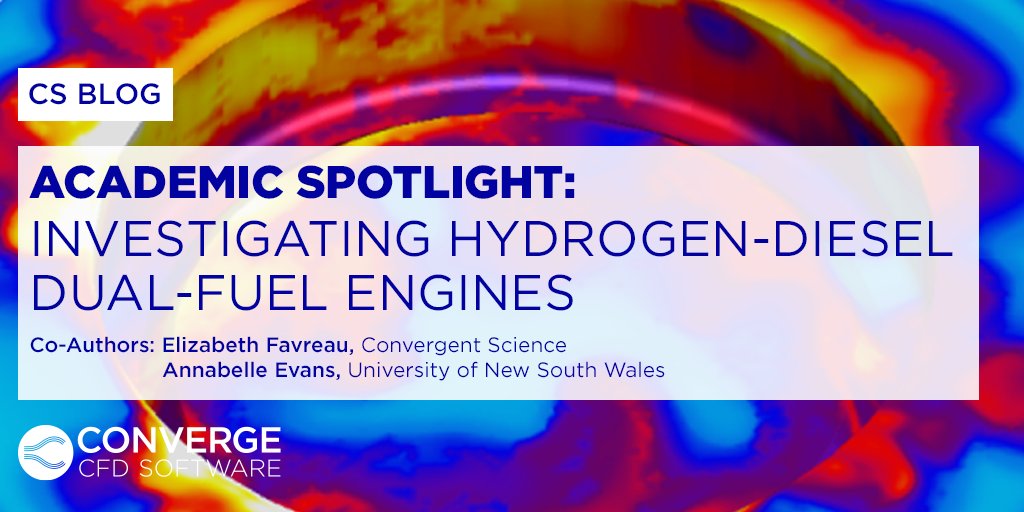
In this #ThrowbackThursday blog post, Annabelle Evans discusses her undergraduate research at the University of New South Wales, where she used #CONVERGEcfd to investigate a dual-fuel diesel-hydrogen engine. Read more! https://t.co/22ZvPT5zGU
Next week at ART2023, CS Research Engineer Achuth Nair will present on the latest #CONVERGEcfd advancements in rotor systems and wind energy simulations. Check out his talk on July 13 at 11:45 CEST in session I4b! Visit our website for details: https://t.co/dYu6FoYqtP
In today’s #SimulationFriday, we analyzed hydrogen storage tank filling dynamics in #CONVERGEcfd. We used a tabulated method to obtain thermodynamic properties for hydrogen, CHT modeling to predict wall temperatures, and AMR to capture velocity gradients.
With autonomous meshing, accurate rotor models, and robust FSI modeling, #CONVERGEcfd is an ideal tool for studying onshore and offshore wind energy applications. Learn more in this #ThrowbackThursday to last year’s wind turbine modeling webinar!
Last call to register for our webinar on July 6! Researchers from @tugraz will demonstrate how #CONVERGEcfd can capture smoke propagation and temperature stratification during a tunnel fire to help ensure the safety of tunnel users. Register today! https://t.co/7Itk3SfKHY