Japan has 9 million abandoned houses. By 2038, it's projected to be 1 in 3.
Many of these sell for near-zero prices. The government covers 30–75% of renovation costs. Japan also places no restrictions on foreign property ownership, identical rights to citizens.
Only a very specific profile would consider this. But there’s a lot of similarity to Italy's €1 home schemes, which were dismissed as gimmicks and are now attracting serious buyers to villages across Sicily and Sardinia.
Japan's abandoned house market is a real entry point for people willing to look past the obvious.
In Kyushu, you can also find move-in ready houses for $15,000–20,000 in towns with hot springs, fresh seafood, and Shinkansen access.
I will be exploring later this year personally, but quality of life in Japan looks to be incredibly high.
Is this one of the most overlooked property plays in Asia right now?
If you die without a plan...
- The government takes 40% in tax
- Probate court costs $100k+
- Your kids get the scraps
If you love your family, here's every document you need to protect them:
(from a CPA & father of two)
1) Emergency Access List
This should include:
-> All bank account numbers
-> Investment account logins
-> Life insurance policies
-> 401k/IRA beneficiaries
-> Safe deposit box location
-> Password manager master code
Keep a digital & physical version for safety...
And make sure your spouse has access.
2) Legal Documents
-> Will (name guardians for kids)
-> Durable Power of Attorney
-> Healthcare Power of Attorney
-> Living Will/Healthcare Directive
Setting all of this up costs about $500...
($1,500 with an attorney)
But without them, the state decides everything.
3) Money Protection
Your family will need time to mourn.
Make sure they can do it without going broke:
-> Term life insurance (10x income)
-> Emergency fund (6-12 mo in a HYSA)
-> Retirement accounts with spouse access
4) The "First 48 Hours" Sheet
Write down clear instructions for your family:
Call this attorney: [Name/Number]
Call this CPA: [Name/Number]
File life insurance claim here: [Details]
Don't touch investments for 6 months
All bills are on autopay from [Account]
Grief destroys decision making.
This protects them.
5) Business Owner Addition
If you have a business, set up:
-> Buy sell agreements
-> Key person insurance
-> Business succession plan
-> Separate LLC owned by trust
If your company can't survive without you...
It's a 9-5 with extra steps.
6) Trust Setup
A proper trust can save your family $400k+ in probate costs.
But 90% of them are set up wrong:
-> Assets never get transferred in
-> Beneficiaries aren't updated
-> Pour-over will is missing
Here's how to fix that:
"Bulletproof" Trust System:
1) Revocable Living Trust
-> Avoids probate completely
-> Keeps finances private
-> Protects kids' inheritance
2) Pour-Over Will
-> Catches forgotten assets
3) Guardian Designation
-> Who raises your kids
-> How they get paid
Setting this up takes a weekend...
But ignoring it could cost your family everything.
So start before you're ready...
Because no one plans on dying.
Hope this helps!
Share with your spouse if you want to set this up...
And follow me for more 🤝🏻
This 2 hour Stanford lecture on AI careers will teach you more about winning in the AI race than every piece of AI content you have scrolled past this year.
Bookmark this & give it 2 hours, no matter what. It'll be the most productive thing you could do this weekend.
In 1987, Boris Yeltsin visited a Houston grocery store and stood stunned in the produce aisle. The future Russian president couldn't believe ordinary Americans had year-round access to bananas, 30 types of bread, and shelves that never emptied.
He later said this moment convinced him communism had failed. Meanwhile, Soviet citizens queued for hours just hoping the bread truck would arrive before supplies ran out. The contrast wasn't subtle: one system trusted millions of daily decisions by individuals, the other trusted a handful of bureaucrats in Moscow to coordinate everything.
Today's supply chain crises offer a tiny glimpse of what central planning delivers permanently. When politicians promise to "fix" markets, remember Yeltsin's shock at seeing what happens when you simply let people trade freely.
As a European, I apologize to Americans for all the idiocy coming from our side.
You save your pilots no matter the cost.
You send humans to the moon.
You fight authoritarianism head-on.
It's truly inspiring.
We're on the wrong side of the moral equation.
@WSJ After an internal investigation, we stopped ranking Ivy League candidates ahead of state schools in 2022.
Academic rigor plunged after 2012.
The disparity between grades and actual work quality remains a central point of debate for both faculty and employers.
@PatrickC1995 Fewer people are married 47%, and college debt is much higher. It's difficult enough to buy and maintain a home. Between 2005 and 2014, rising student debt explained up to 20% of the decline in homeownership among 24- to 32-year-olds (45% to 36%). https://t.co/5mwWdyrqEP
@BenSchifman Electricity is a huge issue. China brought 98 GW of new coal burning capacity in 2025 alone. Ignoring cheap coal in electric generation is untenable as China (56%) knows. Poor governance in Western Democracies harms its people.
HSI civilian employee:
"We civilians are not getting paid, I'm working with my mom in the hospital and not getting paid. This is all so frustrating...sorry bill for venting!"
Some color on who is & isn't being paid in ICE & CBP via the One Big Beautiful Bill.
Most of ICE & CBP are funded through 2029 via the OBBB and operations won't be impacted if they aren't funded through appropriations, for now.
All frontline law enforcement is being paid. The ICE, Border Patrol, and CBP agents we see in the field are all getting paid via OBBB.
HOWEVER... their professional and civilian support staff are NOT being paid. These are people who work the computers, the public affairs offices, and other support staff who aren't on the front line making immigration arrests, but are supporting the agents who are.
These civilian support staffers haven't been paid for almost half of the last six months when you factor in the prior shutdown last fall. They feel left behind - and feel they have no light at the end of the tunnel with this Senate bill leaving CBP & ICE unfunded through appropriations. They would have to hope GOP could take care of them in a future reconciliation bill, or that more funds could be moved around to pay them.
These are some texts I've gotten from these staffers...
CBP support employee:
"The senate bill paid TSA but thousands of CBP & ICE professional staff will not be paid. The last paid work day for me was February 13. Now senate on paid vacation until April 13 that is a guarantee for 2 months no pay. Very likely we won’t be paid until May if Johnson lets the bill pass."
ICE civilian employee:
"I have a huge favor. When you guys report on the fact that ICE is funded through OB3 funds, can you please make it known that support staff (i.e. mission support, OPA, etc.) is NOT getting paid?"
HSI civilian employee:
"We civilians are not getting paid, I'm working with my mom in the hospital and not getting paid. This is all so frustrating...sorry bill for venting!"
@SenWhitehouse Uninformed leaders who are promoting the climate hoax are looking for company. The UK is bitter that their leaders bought into a scam that has destroyed their own economy. Misery loves company. China burns more coal that the rest of the world combined.
Open Letter on Housing, Fannie & Freddie
@realDonaldTrump@pulte@SecScottBessent@FHFA@USTreasury $fnma $FMCC
We studied housing square footage per capita adequacy, and found that there is no problem there. The US in fact has more residential square footage per capita than any other country in the world. This is not a housing shortage, despite what so many say.
The problem is that bigger houses are inefficiently housing fewer people. The post-COVID low rate environment locked people into a lifecycle real estate position. Empty nesters can't sell, first time home buyers cannot buy. Second-hand home inventory is near all-time lows due to record low supply, not record demand. Prices are high due to the same reason.
Home equity is now a record $35 trillion, nearly doubling pre-COVID levels. 40% of homeowners own their homes free and clear - a record. And about 30% of all home buyers pay for homes without borrowing. Older homes were upgraded at a record pace during COVID, extending and refreshing the usefulness of residential real estate.
Artificially low interest rates, ~$6-7 trillion in helicopter cash and forgivable loans helped drive both the home updates and high housing prices.
Work from home moved the office into the home, often expensed or deductible. People with white collar jobs and means chose to live/work in exotic or remote locations.
All of this together does not speak of a housing shortage, or a housing problem.
Instead it is a problem of current residential space allocation and mobility, and this problem was created by government manipulation of interest rates, cash money supply, and COVID lockups that went on too long and changed work/home behavior.
Government created the problem and now maintains policies that prevent free markets from reaching a solution, not the least of which is keeping the GSEs inefficiently run while in conservatorship. Recall Pulte's video upon arriving at Fannie Mae - no one was in the office buildings. The companies have become atherosclerotic, inefficient government programs, while a decade of financial engineering optimized for homeowner wealth accumulation rather than housing market velocity/mobility/fluidity.
Government must fix this problem by facilitating efficient re-allocation of housing stock with higher housing velocity/mobility through the release of the GSEs into free markets.
This is a problem made for the GSEs. Through well-targeted programs, the GSE can help the free market find spaces to intelligently reallocate , and help US citizens with housing mobility.
Building more new overpriced, poorly built homes in increasingly dangerous flood zones and other hazardous fringe areas is not the solution. It adds to the problem through high maintenance burdens on new homeowners with little equity in their homes.
Rather, to build mobility/velocity of homeowners and housing space, the GSEs need to be recapitalized and retain easy access to capital markets. They also need to be run by real mortgage executives, not government functionaries.
To achieve this they need to exit conservatorship in a manner that excites markets to fund these companies, now with guidelines to prevent risk-taking outside of their purpose, and grow their purchases of mortgages of well-targeted specification.
I should have written this into the Recurrence piece itself.
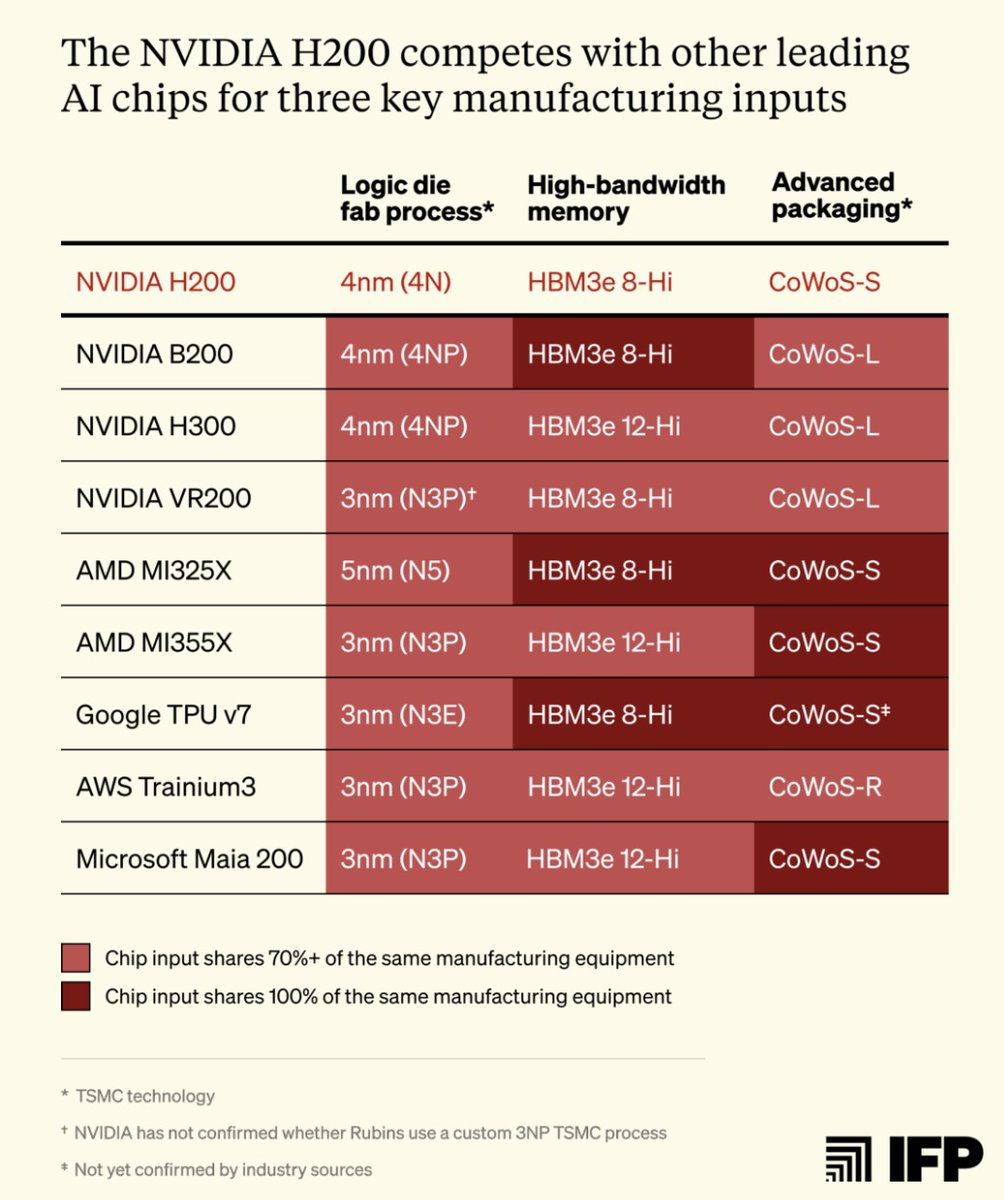
NVIDIA has restarted H200 production for China. But H200s share manufacturing inputs with more advanced US chips, and those inputs are severely supply-constrained.
BIS's January rule could permit up to as many as ~1 million chip exports, but requires applicants to certify exports won't reduce chip availability for US customers. However, the rule doesn't say how to evaluate this.
In a new report, @fiiiiiist and I lay out a methodology for assessing whether H200 exports could divert chips from US customers, and quantify what the US stands to lose: https://t.co/PiPbanWnEj
We distinguish between two forms of diversion: inventory diversion and manufacturing capacity diversion. Based on public information, we judge that:
1. There is weak evidence that exports of existing H200 inventories at current prices would divert supply from US customers.
Global Hopper sales have fallen sharply since Blackwells became available. But deployed H200s remain fully utilized in the cloud, and China is reportedly being offered chips at ~$27K/unit, below US market prices available to some customers.
Technically, a diversion holds if even one US customer would purchase the chip at the price offered to China. BIS needs non-public pricing data to make this determination.
2. There is strong evidence that new H200 production would divert manufacturing capacity for US customers of comparable or more advanced AI chips.
All leading US AI chips share at least one key input with the H200: advanced logic fab capacity, HBM, or CoWoS packaging. All three inputs are severely supply-constrained this year.
US hyperscalers and AI labs face enormous backlogs for these chips, meaning freed capacity would very likely serve American customers.
These conditions likely apply to the roughly 250,000 H200s reportedly manufactured for NVIDIA between early January and early March 2026, when severe supply constraints on advanced logic wafer fabrication, HBM, and CoWoS capacity were already in effect.
3. Under current inelastic supply conditions, the US loses disproportionately more computing power for every H200 export than China gains.
This is because the same inputs and/or manufacturing capacity are being used to produce less powerful H200 chips than frontier AI chips for US customers.
Each 100K H200s produced for China could delay ~75K Blackwell B200s — forfeiting 1.7x the processing power per chip.
We also provide a comprehensive set of questions BIS can ask license applicants and chip suppliers to assess both inventory and capacity diversion during license reviews, using the private data needed to make these determinations accurately.
Twelve years ago, San Francisco killed 8th-grade Algebra in the name of equity. Advanced math enrollment (including AP Calculus) dropped, and racial gaps expanded.
China graduates ~1.3 million engineers yearly vs. just 130,000 in the U.S.
Last night, the SF school board finally voted 4-3 to bring math back.
When DEI overrides academic standards, America falls behind.
https://t.co/5A1np2WX9j
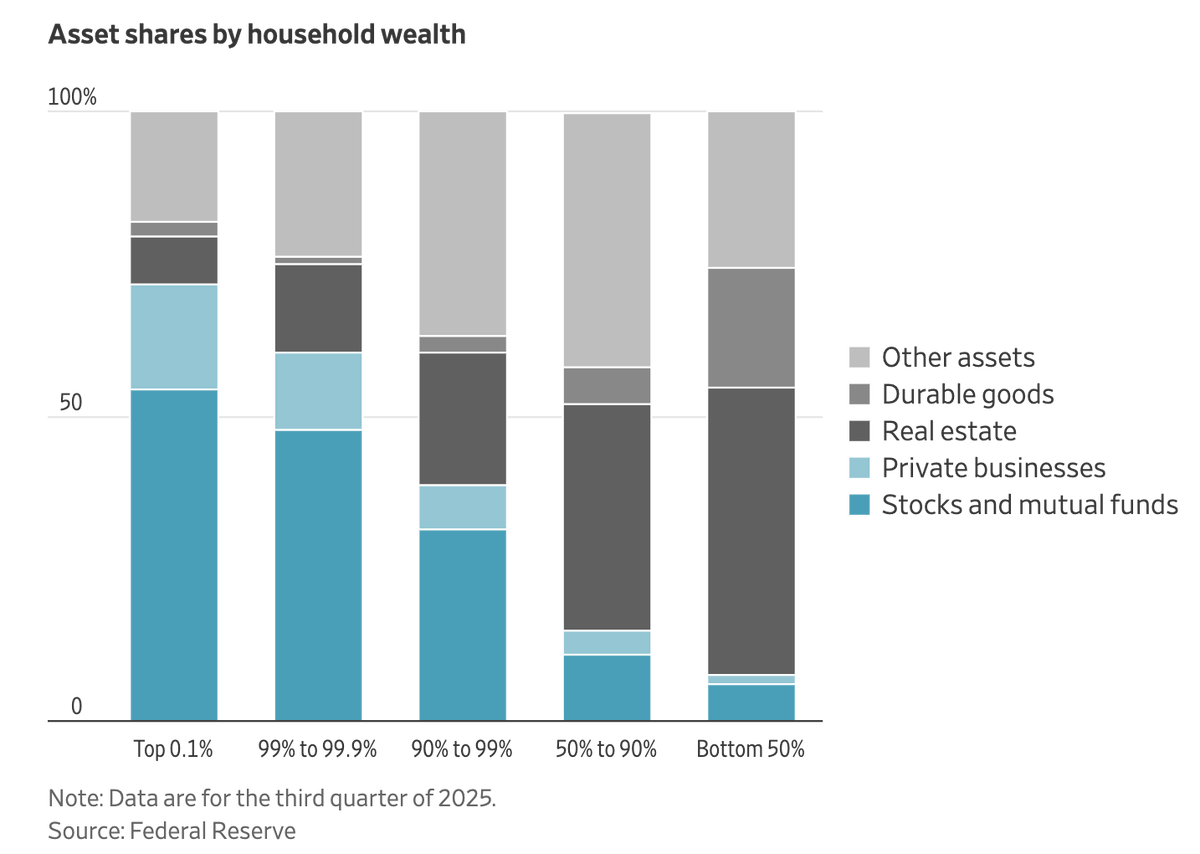
@texasrunnerDFW Socialists suggest that homeowners are rich, which is a blatant lie—the rich benefit more from stocks, not real estate. When I hear Leftists make these claims, it makes me cringe. It's literally "punching down" on the working class.