Web / App Developer and now ICT Teacher. Love my family, computers, video games, space & science fiction. Also like to take photos, watch movies and F1 races.
He decidido convocar para el viernes 27 de octubre una jornada de ayuno, penitencia y oración por la #paz; invito a que se unan a ella a las diversas confesiones cristianas, a quienes pertenecen a otras religiones y a cuantos se preocupan por la causa de la paz en el mundo.
🌟 New Codeblocks!
Learn about the new Modify blocks to control size, position, and scaling that have been added to Codeblocks and check out some of the example designs.
https://t.co/Y2oKFDprKZ
#TinkercadCodeblocks#BlockCode#MadeWithTinkercad
A brief history of Einstein's relativity: The special and general theory ✍️
1887: The Michelson–Morley experiment fails to detect any motion of the Earth through the luminiferous aether, a hypothetical medium for the propagation of light.
1892–1904: Hendrik Lorentz develops the Lorentz transformations, a set of equations that relate the coordinates and time of two inertial frames moving at a constant velocity relative to each other. He also introduces the concepts of length contraction and local time to explain the null result of the Michelson–Morley experiment.
1900: Max Planck proposes the quantum hypothesis, that light consists of discrete packets of energy called quanta, to explain the black-body radiation phenomenon.
1905: Albert Einstein publishes his paper on special relativity, in which he derives the Lorentz transformations from two postulates: the principle of relativity and the constancy of the speed of light. He also shows that mass and energy are equivalent, according to his famous equation E = mc².
1907: Einstein introduces the equivalence principle, which states that the effects of gravity are indistinguishable from those of acceleration.
1908: Hermann Minkowski presents his four-dimensional spacetime formulation of special relativity, which unifies space and time into a single entity.
1911: Einstein predicts the gravitational redshift, that light loses energy as it escapes from a gravitational field, thus shifting to lower frequencies.
1915: Einstein completes his general theory of relativity, a theory of gravity that describes gravity as a consequence of the curvature of spacetime caused by mass and energy. He also applies his theory to explain the anomalous precession of Mercury's orbit.
1916: Einstein predicts the existence of gravitational waves, ripples in spacetime that propagate at the speed of light and are produced by accelerating masses.
1919: Arthur Eddington confirms Einstein's prediction of the gravitational deflection of light by observing the bending of starlight during a solar eclipse.
1926: Einstein writes an essay on space-time for Britannica, explaining his theories in simple terms.
1960s–1970s: The golden age of general relativity, when many new solutions to Einstein's field equations are discovered, such as black holes, wormholes, and cosmological models.
1974: The discovery of the Hulse–Taylor binary system, a pair of neutron stars orbiting each other and emitting gravitational waves. This provides the first indirect evidence for gravitational waves.
2015: The first direct detection of gravitational waves by the LIGO and Virgo collaborations, from the merger of two black holes. This confirms one of the major predictions of general relativity.
2019: The first image of a black hole's shadow by the Event Horizon Telescope, showing the effects of extreme gravity on light around a supermassive black hole at the center of a galaxy. This provides another test for general relativity.
2020 was a terrible year, but it's still far from being the worst in recorded human history. Here are a few bad ones:
1349 was the peak of the Black Death, which killed an estimated 75 to 200 million people in Europe, Eurasia, and North Africa. It is considered the deadliest pandemic in human history.
1520 was when smallpox spread across the Americas, killing an estimated 90% of the Indigenous population. It is estimated that 25 to 55 million people perished.
1918 was when the influenza pandemic killed an estimated 50 million people across the globe. As many as 500 million people were infected.
These were all terrible years, but many historians believe that the absolute worst was 536 AD. According to medieval historian, Michael McCormick, "It was the beginning of one of the worst periods to be alive, if not the worst year."
So what exactly happened in 536?
Well for starters, a volcano erupted in Iceland, which dimmed the sun for 18 months, causing temperatures to decrease by 1.5 to 2.5 degrees Celsius. This led to the coldest decade (536 to 545) in 2,000 years, leading to crop failures and mass starvations in Europe, Mesopotamia, and China.
In 540 there was another volcanic eruption, this time in Ilopango, El Salvador, which killed tens of thousands of people and decreased global temperatures once again.
In 541, the Plague of Justinian began to spread throughout the Mediterranean Basin and would kill 35 to 55% of the population. The plague would greatly weaken the Byzantine Empire after devastating its capital, Constantinople.
The natural disasters, crop failures, and the plague would go on to decimate Europe's economy, which would not recover until 640, more than a century later. Ice core records show that in 640, there was a spike in atmospheric lead pollution which was the result of an increase in silver mining. Silver is found in lead-rich galena ores. During this time, periods of prosperity almost always coincided with increases in lead emissions.
Keep in mind that this is just from recorded history. Imagine all the crazy stuff that happened in prehistory, including population bottlenecks, which reduced the human population to just tens of thousands of people. We could have easily gone extinct on a number of occasions.
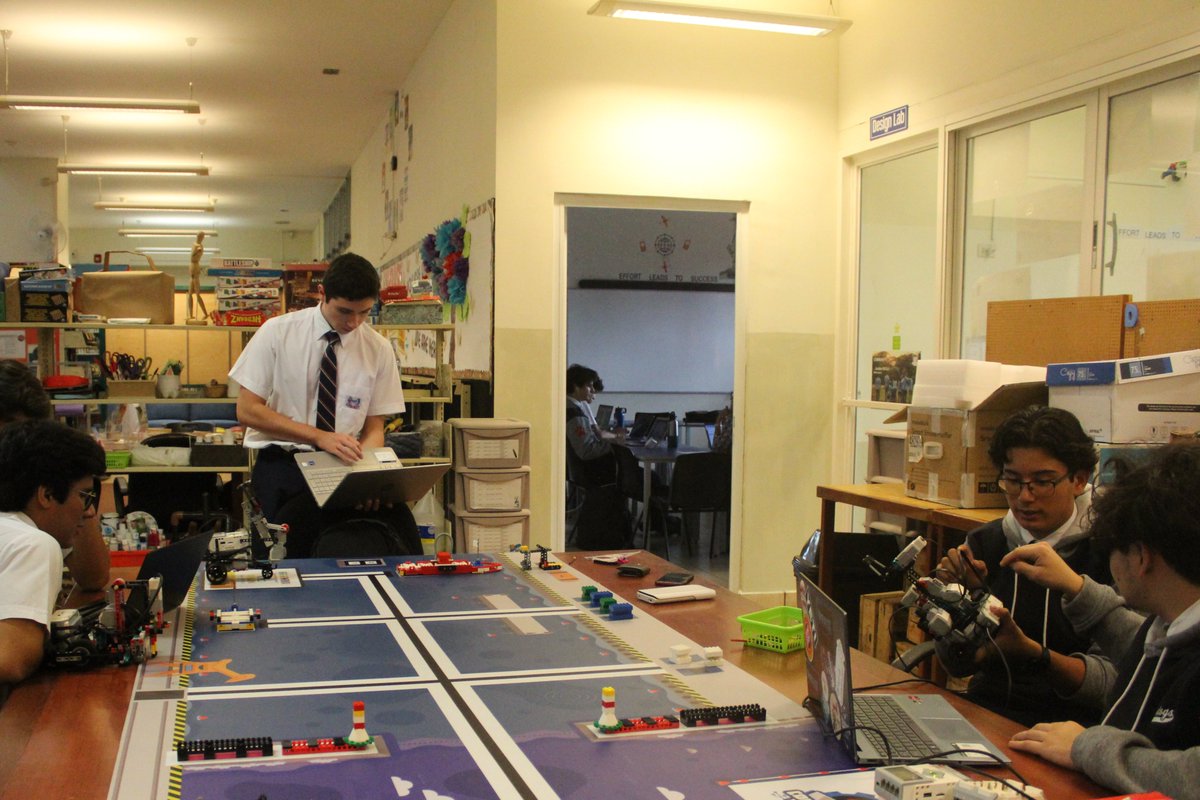
¿Sabías que Mañana es la Olimpiada Nacional de Robótica de la WRO?🤖
La #AcademiaBritanicaCuscatleca participará en las siguientes categorías: Future Engineers, Future Innovators, RoboMission.
Lugar: Colegio Highlands
A partir de las 8:00 a.m.
Entrada $1.00
#wroelsalvador