Darkness is preparation for light.
Sadness is preparation for joy.
Failure is preparation for success.
But only if you keep going and remain open to what comes next.
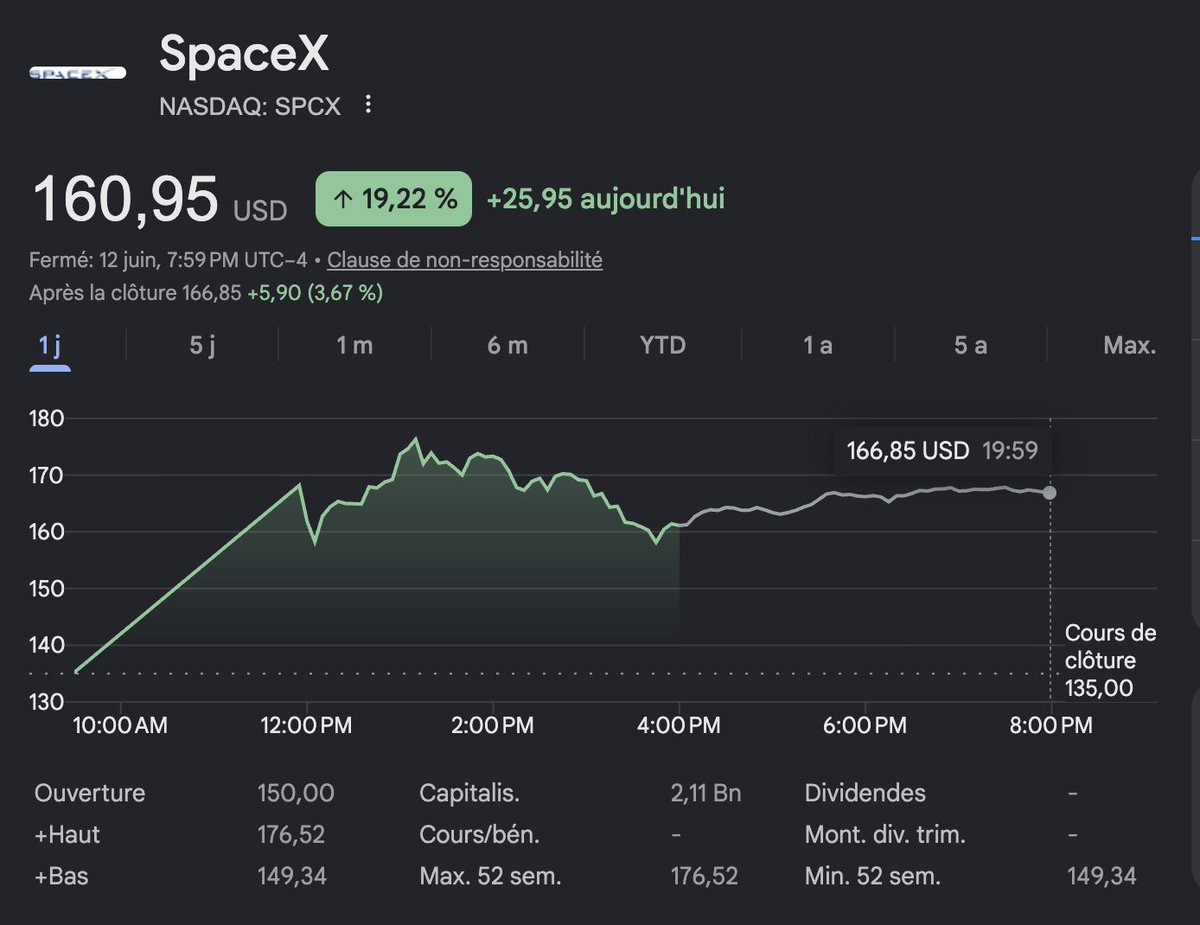
SpaceX a clôturé son premier jour de cotation à 2 100 milliards de dollars, +19%. Tout le monde regarde le chiffre. Personne ne regarde ce qu'il price réellement.
Laissez-moi vous dire ce que le marché vient d'acheter, et pourquoi je pense que cette boîte vaudra 30 à 50 trillions d'ici 5 ans.
D'abord, le symbole. Cette IPO est un référendum. D'un côté, 20 ans de discours sur la décroissance, la sobriété, la redistribution, la fin de l'histoire gérée par des comités. De l'autre, un homme qui a dit "je vais rendre l'humanité multiplanétaire", que tout le monde a traité de clown, et qui vient de créer la plus grosse entreprise cotée de l'histoire en partant d'un entrepôt à El Segundo. Le marché a voté. Le wokisme avait des départements RH, SpaceX avait des fusées. Les fusées ont gagné.
Ensuite, la mécanique économique, parce que c'est là que tout le monde se trompe. Les analystes valorisent SpaceX comme une entreprise de lancement plus Starlink. C'est comme valoriser Internet en 1995 sur le marché du fax. Starship ne réduit pas le coût du kilo en orbite de 20%, il le divise par 100. Et chaque fois dans l'histoire qu'un coût d'infrastructure est divisé par 100, ce n'est pas le marché existant qui grossit, ce sont des industries entières qui naissent. Le coût du calcul divisé par 100 a donné Internet, le smartphone, l'IA. Le coût de l'orbite divisé par 100 va donner une économie spatiale complète.
Faisons la liste de ce qui devient rentable quand le kilo en orbite coûte le prix d'un billet d'avion. Les data centers orbitaux, avec énergie solaire continue et refroidissement gratuit, au moment exact où l'IA fait exploser la demande énergétique terrestre. La fabrication en microgravité de semi-conducteurs, de fibres optiques, d'organes imprimés impossibles à produire sous gravité. Le tourisme orbital de masse, puis les hôtels lunaires, qui passeront du fantasme au business plan exactement comme la croisière de luxe au 20ème siècle. Le transport point à point terrestre, Paris-Tokyo en 40 minutes. L'industrie minière des astéroïdes, dont un seul corps de classe M contient plus de métaux que tout ce que l'humanité a extrait depuis le néolithique. Et Mars en ligne de mire, pas comme destination touristique, mais comme le plus grand projet d'infrastructure jamais entrepris, avec tout ce que ça implique de demande en énergie, matériaux, robotique, IA.
SpaceX ne participera pas à ces marchés. SpaceX possède le péage d'entrée de tous ces marchés. C'est AWS, mais pour la civilisation. Apple vaut 3 500 milliards en vendant des rectangles de verre sur une seule planète. Le premier monopole d'accès à une frontière infinie à 30 ou 50 trillions dans 5 ans, ce n'est pas de l'exubérance, c'est une simple règle de trois sur l'expansion du marché adressable.
Et maintenant, la partie que je préfère. Ce futur n'a pas besoin de bureaucrates. Il n'y a pas de comité consultatif en orbite. Pas de commission Théodule sur Mars. Chaque dollar de cette nouvelle économie sera créé par des ingénieurs, des techniciens, des soudeurs, des pilotes, des entrepreneurs. Les diplômés en gestion de la norme vont devoir apprendre un métier utile, et franchement, c'est une excellente nouvelle pour eux aussi : construire est infiniment plus fun que contrôler.
Parce que c'est ça, le vrai signal d'aujourd'hui. Pendant 50 ans on nous a vendu un futur rétréci : moins d'énergie, moins d'enfants, moins d'ambition, gérer le déclin proprement. Et là, d'un coup, le plus gros actif financier du monde est un pari sur l'abondance, l'expansion et l'aventure. Le pessimisme vient de passer en position vendeuse sur lui-même.
Le futur sera méga fun. Il y aura des hôtels avec vue sur la Terre, des honeymoons en orbite, des gamins qui diront "papa, c'était comment avant les fusées réutilisables" comme on dit "c'était comment avant Internet". Et quelque part dans les années 2030, un humain marchera sur Mars en livestream devant 5 milliards de personnes, et ce jour-là plus personne ne se souviendra du nom d'un seul de ses détracteurs.
Achetez de l'optimisme. C'est encore sous-valorisé.
Yann Lecun published the most heretical AI paper of the year.
He opens by arguing Magnus Carlsen isn't good at chess and only gets more unhinged from there.
The Turing Award winner and his co-authors dropped a paper demanding the AI industry abandon its biggest obsession, AGI.
Right now, everyone from Silicon Valley CEOs to politicians assumes AGI is the ultimate goal. A machine that can do everything a human can do.
LeCun argues that this entire concept is a biological illusion.
Humans do not possess "general" intelligence. We are highly specialized biological machines, tuned by evolution simply to survive in the physical world.
We only think our intelligence is "general" because we are completely blind to the millions of cognitive tasks we are incapable of comprehending.
Which brings us to the chess argument.
Magnus Carlsen is the greatest human chess player in history. But compared to a modern computer? He is fundamentally terrible.
Our belief that Carlsen is "good" at chess is pure human-centric bias. He isn't objectively good. He's just better than the rest of us, who are biologically awful at it.
LeCun says we need to stop building AI to mimic human generality.
Instead, he proposes a new North Star: SAI.
Superhuman Adaptable Intelligence.
Instead of trying to build a machine that mimics our flawed, biologically-limited brains, we need to embrace extreme specialization.
SAI is about the speed of adaptation.
It is an intelligence that can learn to exceed humans at any specific, economically important task.
More importantly, it is designed to fill the vast skill gaps where humans are fundamentally incapable.
Things like managing global energy grids in real-time. Or predicting complex molecular structures.
The entire AI industry is obsessed with building a digital reflection in our own image.
LeCun's paper is a brutal wake-up call.
Yazının düşünceyi genişleterek, dönüştürerek ve ona yeni hareket alanları açarak bilişsel bir teknoloji olduğundan söz eden bu makaleye denk geldim. Kısaca yazmak düşüncenin hareket halidir diyor. Mutlaka tavsiye ederim.
Link: https://t.co/T1SfD6aR3G
I'm a big fan of both @theallinpod and @Jason Calacanis.
We applied to Jason's @LAUNCH Accelerator a while back, and I just found out we got into Startup Tune Up.
Excited about it.
Looking forward to meeting great founders, learning a few things, and having some good conversations.
It's already a pretty nice day.
https://t.co/mjGfWjPucU
@rorysutherland@OgilvyConsult@Ogilvy We trained 7 AI agents on work that has won more than 3,000 awards, including Grand Prix, Lions, and many others.
You simply give the brief, and the system generates world class strategy and creative concepts in 40 minutes.
Would you like to try it?
Big news for us. 🚀
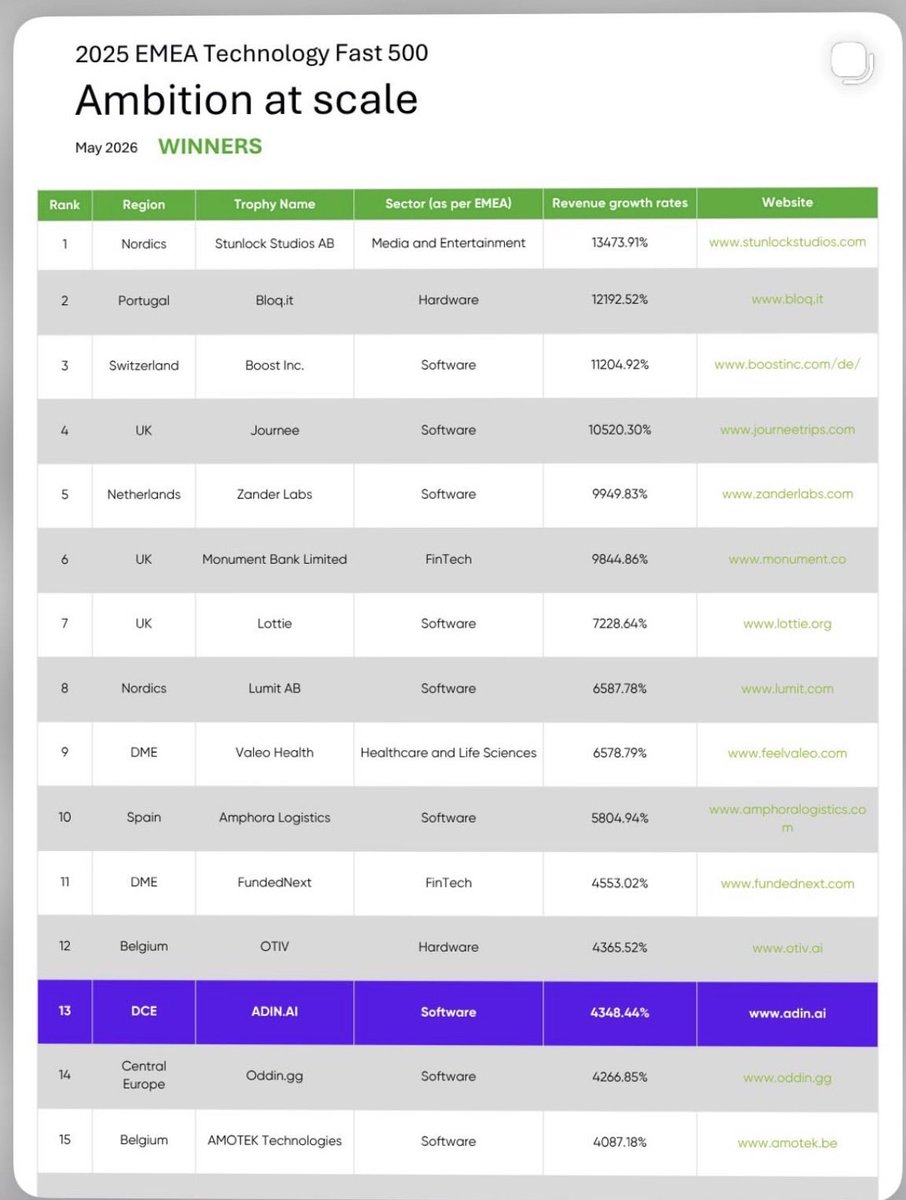
https://t.co/mjGfWjPucU ranked #13 on the Deloitte Tech Fast 500 EMEA list.
What does that mean?
It means we're among the fastest growing companies across Europe, the Middle East, the UK, and Africa.
It means we're competing alongside some of the most exciting technology companies in the region.
It means every teammate, customer, partner, and supporter is part of this story.
And most importantly, it means we're just getting started.
Thank you to everyone who believes in what we're building. The journey continues. 💙
-ADIN.AI Founding Team
👉 Full Deloitte Report: https://t.co/PYobg3PvEk
I'm not a technical founder. I come from the domain side.
I always knew where https://t.co/mjGfWjPucU needed to go. The market, the need, what was missing... that part was always clear in my head.
But I didn't know how to actually build the tech. My partners and our tech team do that part brilliantly.
That's exactly where vibe coding changed my life.
Because now I can build the MVP of new features myself. I know the market. I know the pain points. I know how to sell a feature and how it fits into the core platform.
The only thing missing was building fast. Now I can do that too.
And here's another thing. We have 15 data engineers at Adin. Being able to speak their language, understanding what's easy and what's hard... that's a whole different level.
I build features at night. On weekends and holidays, I build the company's own operating system.
Right now I'm actually writing our Finance & Ops OS. Soon I'll just ask my agent about the company's financial state and get a report whenever I want.
Honestly, I've never felt this 100x in my life. 🟪
Talking about AI is one thing. Getting your hands dirty and actually shipping a product is another.
So if you're someone who builds things but holds back because "I don't know how to code": start this weekend. ✨
Take the smallest idea in your head and just try to build it. You don't need a full day. One evening is enough.
Trust me, once you start, there's no going back.